
I must admit that in recent years I am becoming more and more a fan of great solitaire designs – be it a dedicate solo title, a position with solo variant or simply solo-friendly wargame (like with chit-pull mechanics). Of course, the pandemic time contributed greatly here – as except for occasional Digital or VASSAL/Tabletop Simulator assisted plays, my main entertainment was moving the chits alone on the map (or using my two boys as great bots).
Anyhow, you have probably seen my articles on wargames with solo mode as well as another about dedicated solitaire positions. Today I would like to propose to the Dear Readers a different journey. My idea is to look at Solitaire Wargames Series!
Yup, series. A a solid system, with interesting rules and main game-play mechanics similar between installments but the theme / scale / time of events differing – that is a receipt for getting to everybody what they like most. So instead of individual titles, I will present “wargame families” – as BGG defines it – and will leave to Dear Readers, which exactly position to choose in the first place. Do not worry, you will never go wrong with below proposals – it is more matter of taste / interest which should decide what you should get.
So let us start – some true heavy hitters below!
Other articles in the series:
Fields of Fire Series (Ben Hull, GMT Games)

About the series:
Fields of Fire is a solitaire game (or rather system) of commanding a rifle company between World War II and Present Day. The game is different from many tactical games in that it is dice-less and card based – yes!, the board is created from cards! There are two decks used to play. The Terrain Deck is based on a specific region and is used to build a map for the various missions your company must perform. The Action deck serves many purposes in controlling combat, command and control, various activity attempts.
The units of the company are counters representing headquarters elements, squads, weapons teams, forward observers, individual vehicles or helicopters. A single game is a mission and several missions from a historical campaign are strung together for the player to manage experience and replacements. A mission can be played in about 1 – 4 hours.
Current titles in the series:
- Fields of Fire
- Fields of Fire 2
- Fields of Fire – Battle of the Bulge Campaign
- Deluxe edition of Fields of Fire on GMT’s P500
Choices options:
You have variety of options here – whether to play with 9th Infantry Regiment / 2nd Inf Division (Part 1, WWII & Korea), 25th Infantry Division (Part 1, Vietnam) 5th Marines (Part 2) or again, going back to 9th Infantry Regiment (Battle of the Bulge). Another dimension to look at this is whether you would like to immerse yourselves in WWII campaign, re-fight battle of Korean War or maybe lead your Company in brutal battles of Vietnam War? The choice is yours! PS. Pretty soon we will get deluxe edition of Part 1, with re-written rulebook and tons of interesting training materials.
Some of the materials created by me on the series:
- [REVIEW] Fields of Fire 2
- Peleliu Mission full Playthrough
- First Look at FoF – Battle of the Bulge
- Fields of Fire – Storage Solution
Valiant Defense Series (David Thompson, DVG Games)
About the series:
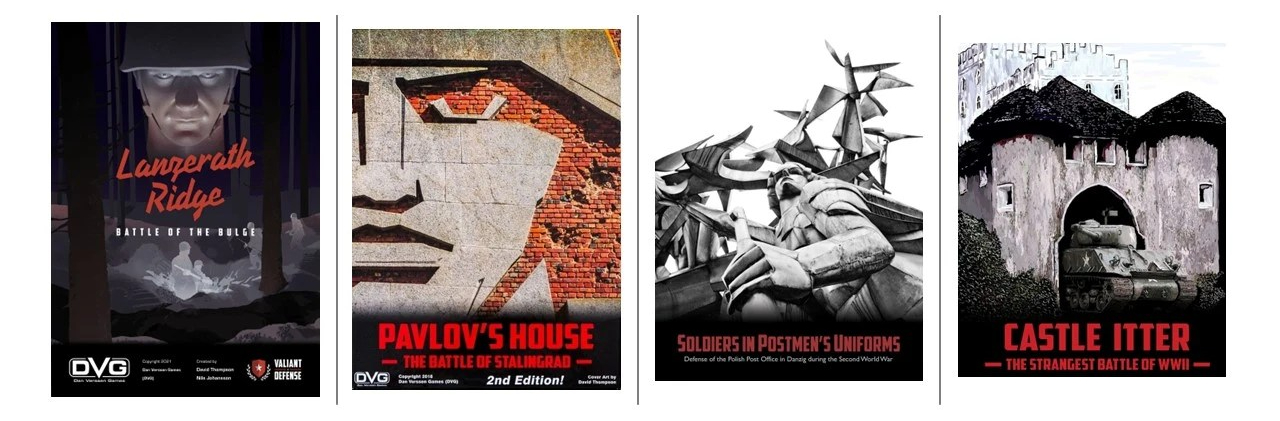
The Valiant Defense series allows you to play amazing stories of courage, with small forces holding the line against unimaginable odds. Games in the series focus on the individual defenders and are deeply rooted in history, while providing a quick play experience with a light complexity rule-set. Gameplay is focused first and foremost on solitaire play. Games take about one hour. Low complexity rules means that you can start playing almost immediately. Definitely, one of the series which will ease your entry in the world of Solitaire Wargaming.
Titles in the series:
Choices options:
Well, you have really some interesting options here. Pavlov’s House gives you three levels of battle – strategical, operational and tactical – and all of this in an epic struggle for Stalingrad between German and Soviet forces. The Castle Itter tells incredible story where Allies and Wehrmacht (!) cooperated against German SS units. Soldier’s in Postmen Uniforms is not only a heroic tale of the Gdansk (Danzig) Post Office defense, but brings new game mechanics with elevation. Lanzerath Ridge on the other hand further develops the weapon system in the game, while at the same time shines in the area of artwork and components.
Truly, the choice is yours and any of above will provide a fantastic experience.
Some of the materials created by me on the series:
- Castle Itter Application Playthorough
- [REVIEW] Pavlov’s House
- SIPU – Veteran level playthrough
- Lanzerath Ridge – gameplay example
D-Day Series (John Butterfield, Decision Games)
About the series:
As you probably can observe from my blog, I am devoted fan of John H. Butterfield creations. All those games are pretty procedural, with clear actions designed for the Artificial Intelligence (Bots). I really like the way cards drive the Competition / Germans / Japanese behaviors – you do not have to look up the possible actions in pretty complicated flowcharts.
Still, be advised that – especially in case of D-Day – you will face enormously difficult task to deal with. Those titles and its scenarios really try to depict the hardships, misfortunes and difficulties of the World War II amphibious assaults. But believe me, the joy of achieving even smallest successes is great.
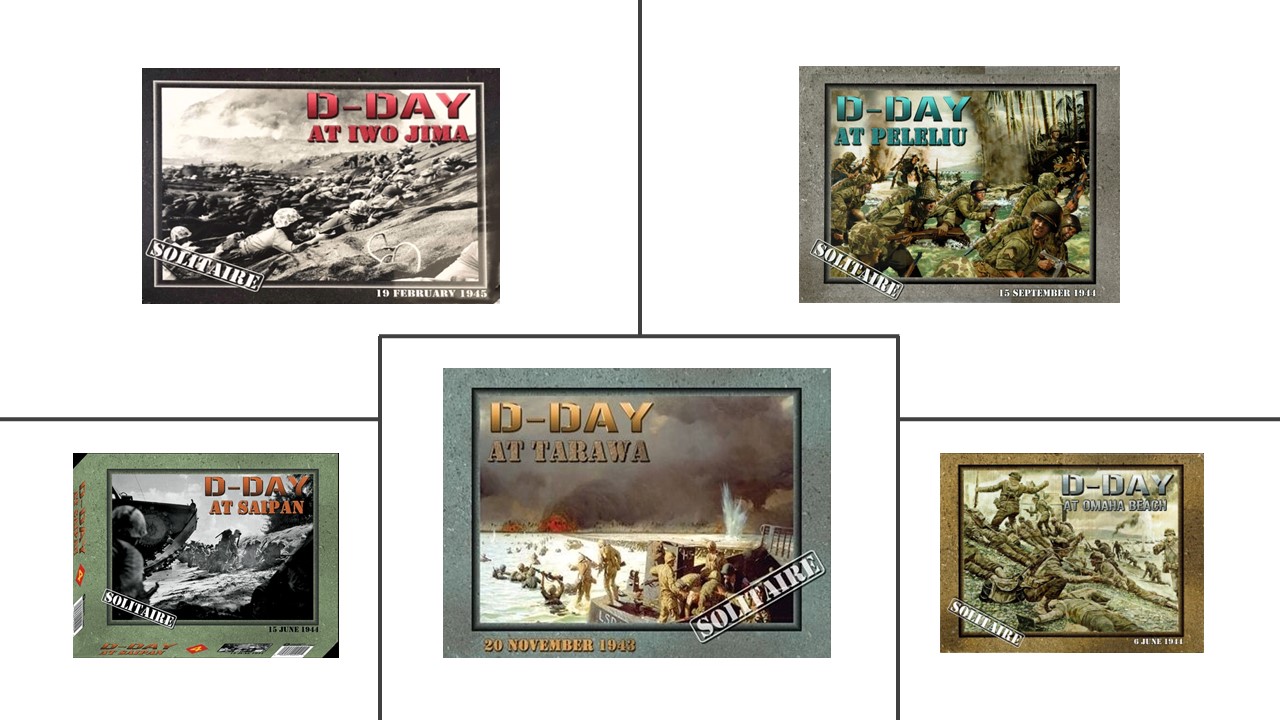
Titles in the series:
- D-Day at Omaha
- D-Day at Tarawa
- D-Day at Peleliu
- D-Day at Iwo Jima (have not played, heard mixed opinions, part of the series but not John Butterfield game)
- D-Day at Saipan (have not played, part of the series but not John Butterfield game)
Choices options:
I will focus only on first three games which I played. The main difference is of course between the European and Pacific theater; on top of this The Pacific Theater version brings usage of LVT (Landing Vehicle Tracked) to arrive at the beach, enemy actions from the onset of the game, close combat which significantly changes the flow of the game. If you start with the series, I suggest going with Omaha. My personal favorite is Tarawa (and only one I ever won!)
Some of the materials on the series:
- D-Day at Omaha Beach – animated session report
- D-Day at Tarawa – Replay by Volko Ruhnke
- [REVIEW] D-Day at Peleliu
State of Siege Series (Ben Madison, White Dog Games)
About the series:
State of Siege is a collection of solitaire games in which the player is the commander of a desperate situation. Surrounded by enemies in every direction, your decisions regarding your scarce military, political and economic resources decide the game.
The games share a set of characteristics: a series of tracks converging on an area. Each track can contain an enemy force, either real or abstract. A deck of cards (or chits marking the turns) instructs the players to activate units on tracks for movement and provides the players a number of action points, which are spent from a menu of options.
Players will engage the forces to attempt to stop them from reaching the end point of the track, which usually signals defeat. If the player can reach the fixed endpoint (usually the end of the deck of cards or last turn), victory points are summed up to determine the level of victory.
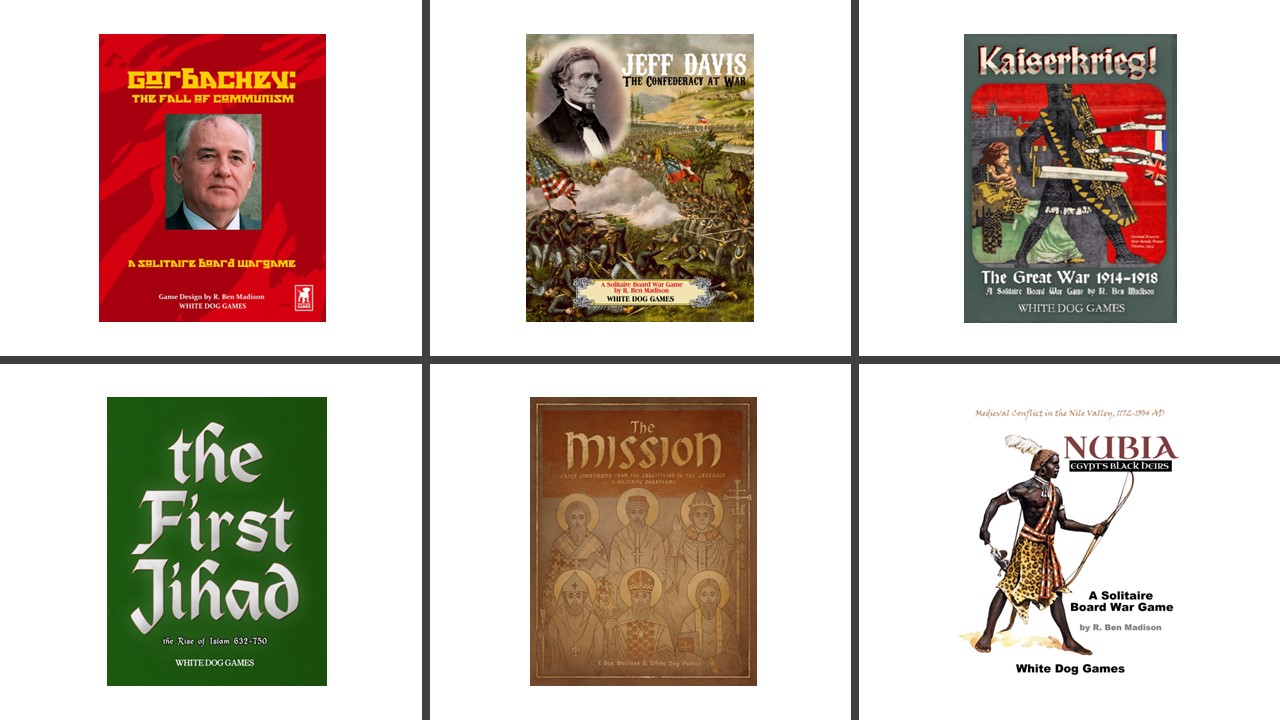
Some of the titles in the series:
- The Mission
- The First Jihad
- Nubia
- Gorbachev
- Jeff Davis
- Kaiserkrieg!
Choices options:
Those are plentiful – you can decide on interesting history period – from ancient times, through US Civil War up to World War I or recent times. You can also try slightly different mechanics – from pure state of siege (multiple paths converging at the center – Nubia), through the updated system (multiple paths each converging at separate areas you need to defend – The Mission) to such a novelty where enemy attacks from inside (The First Jihad). The choices are plentiful! And the new game, Global War, where I have a pleasure to be a play-tester, is almost ready to publish!
Some of the materials created by me on the series:
Honorable mention
I could not resist and avoid mentioning one of the newest releases which made great impression on me and has a potential to also become a series – Stalingrad: Advance to the Volga, 1942, Volume 1 in Solitaire Area Movement Series.
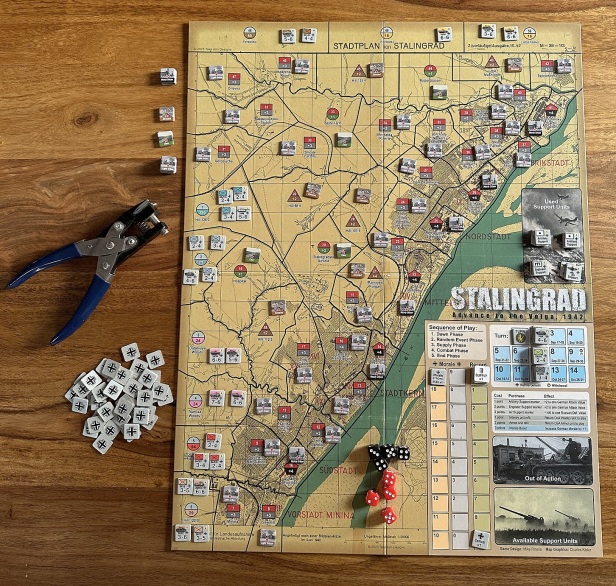
Stalingrad Advance to the Volga, 1942 puts the player in charge of the attacking and at the same time far more mobile German side while the game system handles the defending and largely static Soviet side. Believe me, not two games will ever be the same as disposition and composition of defenders will vary. After several plays I can definitely say this is system for me and can’t wait for the next installment (probably Manila!)
Summary
I hope that above title will be inspiration for Dear Readers to reach for some interesting titles I am proposing above. I can vouch for all above series – but the choices of particular title I am leaving to you (of course, I have some preferences!)
And what are your favorite solo games series? Please let me know in comments!
 The Boardgames Chronicle
Some great suggestions here! I’m waiting for the new edition of Fields of Fire because I couldn’t make heads nor tails of the rules form FoF 2. But it’s stored nicely in Cube4Me trays! 🙂
LikeLiked by 1 person
True, new edition, with new rulebook and trainign materials will be something great!
LikeLiked by 1 person
Great list!
For me I’d add another John Butterfield, RAF The Battle of Britain 1940.
I’ve also recently picked up Atlantic Chase by GMT Games. I’m only part way through the tutorials but its game mechanics are refreshingly different.
LikeLiked by 1 person
Very good choices! If you would like to learn more about Atlantic Chase, feel free to have a look at my series of training materials: https://www.youtube.com/playlist?list=PLygbq4U_f6ayunDCy2RjJYhCnsp0Dfh7E
LikeLike
The DVG Leader games are also a great solitaire series. I enjoyed them so much I created a few.
LikeLiked by 1 person
Yes, played them but not so extensively as proposed titles. Thanksfor comment!
LikeLike
Nice choices, I have a fair few of them.
Currently learning Skies Above Britain, another solitaire series worth looking at.
LikeLiked by 1 person
My colleague also plays this series and has very high opinion on this!
LikeLike
Iwo Jima and Saipan are not Butterfield games.
LikeLiked by 1 person
Yes, fully agree.
LikeLike
This is a good list as are many of the others mentioned in the comments.
There is however a small company who has slipped through the cracks here. FORTRESS GAMES out of Florida has four titles by designer Bob Phaneuf. His series covers four solo titles, the flag ship of which is 8th Air Force covering the daylight bombing campaign of Germany. An excellent game, this one and its sister game 20th Air Force covering the bombing of Japan is just this week coming out in a deluxe 2nd Edition.
I highly recommend this small company and it’s products, fo anyone looking for an intersting and unique approach in Solo Historical Wargames.
LikeLiked by 1 person
I’m the person who left the comments on Fortress Games and 8th Air Force. They we not intended as Anonymous. I am not affiliated with Fortress, I’m just a guy who believes in the little engine that could.
https://fortress-games.net/8th-air-force/
LikeLiked by 1 person
Thank you for your comments as well as pointing me to those titles!
LikeLike
Glenn directed me here – you did cover some great games! I’m a huge fan of all the “States of Siege” games from all their various designers and makers. My favorites are probably “Empires in America” and “Zulus on the Ramparts” among many, MANY others.
I am the designer for Fortress Games and hope you do get a chance to explore our titles, they’ve received pretty good reviews from pretty respected folks! In the meantime thanks for the fun read. (BTW, “Lanzerath Ridge” gets my vote for year’s most beautiful game board. It is stunningly attractive!)
LikeLiked by 1 person
Hi Bob,
thanks for kind comment. I would love to learn more about Fortress Games designs. Please drop me an email via CONTACT page so we can discuss further! Thanks!
LikeLike
Terrific post with your usual well-thought out attention to detail, Michael – well done! I find myself playing more and more solo designs now, despite still playing a lot of games vs humans via Vassal. And you hit on some of my favorites: Fields of Fire and Butterfield’s designs. Just want to echo Glenn and give a very entusiastic shout-out to Fortress Games. They are really intriguing wargames that hit many solo design “sweet spot must have’s” for me: meaningful decisions to be made every turn; outstanding narrative; accurate history that doesn’t straight-jacket you into strictly historical outcomes. They took me by surprise and deserve to be widely played.
LikeLiked by 1 person
I will definitely give a try to Fortress Games titles. They really intrigued me!
LikeLike
Not sure why my post came up “Anonymous” – I was logged in to leave a Like on your post. But I don’t hide on forums; immediately previous post was by Tom Marshall.
LikeLiked by 1 person
Thanks!
LikeLike