

Welcome to another installment in “My Top 3 Wargames” series. I am usually presenting here the titles which follow the common theme, mechanics or historical subject. Creating such materials gives me a lot of fun and in the past oftentimes allowed me to familiarize with great titles.
Today I will follow different approach. I would like to focus on creations of one author, whom you can treat as a whole wargaming history in micro-scale. Whom I have in mind? This time I am presenting designs of John H. Butterfield!
Let me be clear here. I have not been able to play all the games by this author, and some of them not enough to justify entering the Top 3 club. Still, my subjective feelings are pretty strong about below positions and I will share in details why they hit the sweet spot for me.
So let us see the titles in my selection!
Other articles in the series:
D-Day at Tarawa (Decision Games)

Let me start with D-Day at Tarawa, probably my favorite dedicated solitaire game by this author. Tarawa is based on John Butterfield’s D-Day at Omaha Beach system and presents fighting at platoon and company scale in solo mode only. You command the invading American forces against dug-in Japanese defenders, which are controlled by the game system. Tarawa covers the landings on Betio Island in November 1943, and the operations of the US 2nd Marine and 27th Infantry Divisions to clear it – the first heavily contested landing of the Pacific War. The battle for the tiny Island raged for four days and, when it was finally over, fewer than 200 of the 5,000 Japanese defenders remained alive.
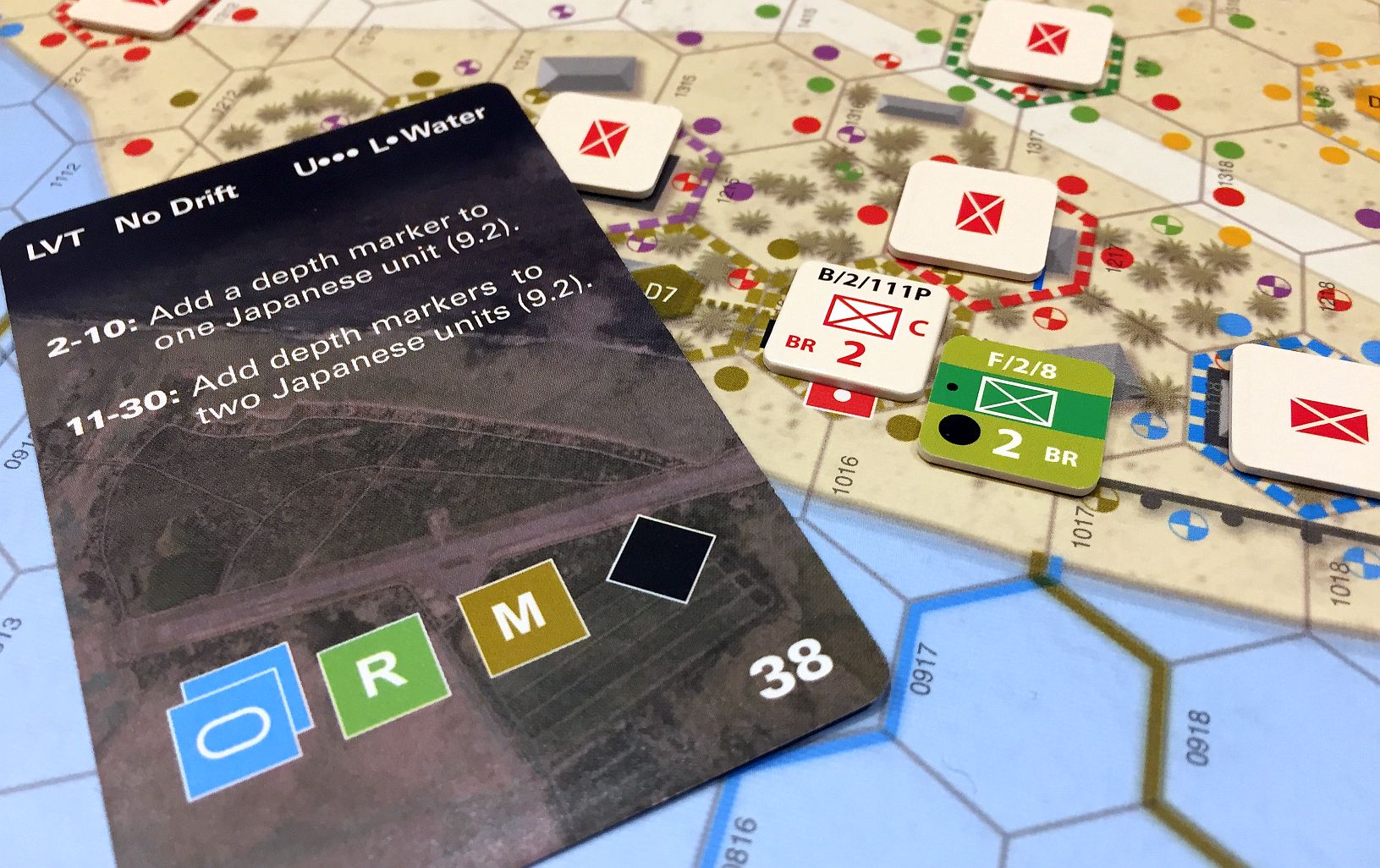
Let me now point to specific areas which I appreciate mostly – to name only a few:
- The theme – amphibious landing operation in the Pacific Theater – is depicted in such a fantastic way in that game. The game components, mechanics, additional booklet with historical background – all of this allows you to immerse yourself in the Tarawa battle.
- The game is tough to win. And I mean it – you really need to well plan your moves, execute strategy flawlessly, reinforce the important points and have some luck from time to time. With the experience and plays you start to see some weaker Japanese points but it will never be easy. And yeas – I love it as it gives you so much motivation to try one more time!
- Replayability – each game is completely different – the way LVTs were depicted in the game and the possible drifts means that one time you will be attacking mainly in the East, but on the other occasion in the West. Also, there are like 4 scenarios, which allow for reenacting various stages of battle. All in all, that provides for many hours of enjoyable play!
- Changes in comparison to the first title in the series (Omaha Beach). The Pacific Theater version brings usage of LVT (Landing Vehicle Tracked) to arrive at the beach, enemy actions from the onset of the game, close combat which significantly changes the flow of the game and many more. This is great to see such a refreshing additions!

Playing D-Dat at Tarawa is very enjoyable experience although do not expect easy wins. The game is tough, you need to be prepared to get a lot of casualties but in the end – once you are more familiar with the map – you see the paths and possible axis of attack. The learning curve is painful but satisfaction even greater once you manage to achieve your goals! Highly recommended!
More about game:
Enemy Action Kharkov (Compass Games)

Enemy Action: Kharkov (EAK) is the second game in John Butterfield’s acclaimed Enemy Action series of card-driven games simulating pivotal battles in World War II, playable by two players or one player controlling either side in the conflict. The game portrays the Third Battle of Kharkov, the key Eastern Front engagement in which the German Army ended a string of Soviet victories which begun at Stalingrad. In the late winter of 1943, Soviet Operations code-named Star and Gallop drove the Germans from the city of Kharkov and threatened a complete breakthrough, only to be driven back by the German counteroffensive known as Von Manstein’s Back Hand Blow.
While Enemy Action series is probably one of the most detailed and somehow complicated of the John Butterfield’s games, it is at the same time very much rewarding and exciting. The Ardennes proved to be a great position, with special rules for solo German, solo American and 2-players. We are getting similar system in Kharkov installment – it is like 3 games in a box!

Again, let me stipulate what I especially like about this game:
- So if you are familiar with the hex & counter games it will be reasonably easy for you to quickly get into the game; the rulebook for 2-players is shortest one and most straightforward – here, you should have no problems with quick start.
- Additionally, what we are getting in this title is a very neat activation mechanic which is based on cards. There is no typical “I-go-You-go” all front movements which usually caused long downtimes; instead each side uses cards to move specific armies / corps / units, i.e. small segments of the troops under their command. That also creates fog of war as you do not know which part of enemy forces can still act in a turn. I really like it!
- Another solution which I would like to call-out is the battle resolution procedure. No CRT, no terrain modifiers – just drawing the chits which are applicable in particular situations – like type of terrain, forces ratio, status of opponent battle tactics played – and resolving the net score of hits vs. defender and attacker. That proved to be a great solution which we loved from the start (although sometimes a bit time-consuming).
- I have to admit the components quality is great – just see the clipped counters, the clear, colored designation for fronts and armies, beautiful rulebooks, clearly readable map.

It is probably obvious from my description that I enjoyed the game immensely. It is beautifully produced, has unique combat resolution mechanic as well as great card-driven activation system; it has like three games in one box, as each of them plays differently and gets separate rulebook. While not a title for a completely green wargamers, this is definitely position which one day should land on your shelf. Highly recommended!
More about game:
SpaceCorp (GMT Games)
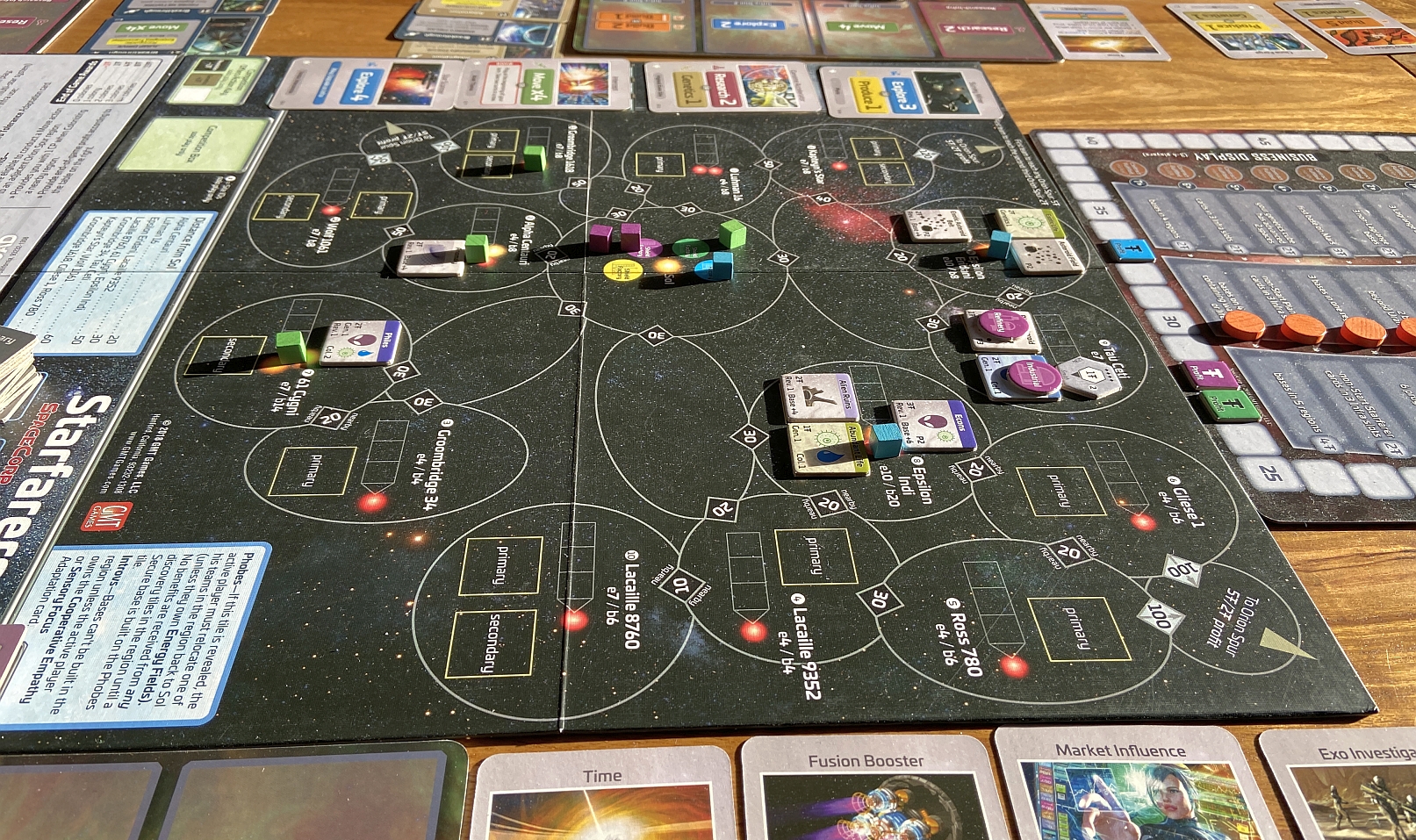
SpaceCorp: 2025-2300 AD is a board game in which one to four players explore and develop outer space over three eras. We control the enterprises – located on Earth – through three epochs:
- Mariners – covers exploration and development out to Mars.
- Planeteers – focuses on the whole Solar System
- Starfarers – we send missions to nearby star systems in order to establish interstellar colonies.
There are tons of actions players can take and each era is played on the different board. What is more, the expansion brings so much needed variety as now each player can start with his unique corporation. And of course, as a hallmark of John H. Butterfield creations, it has a very decent, card-driven solo mode.
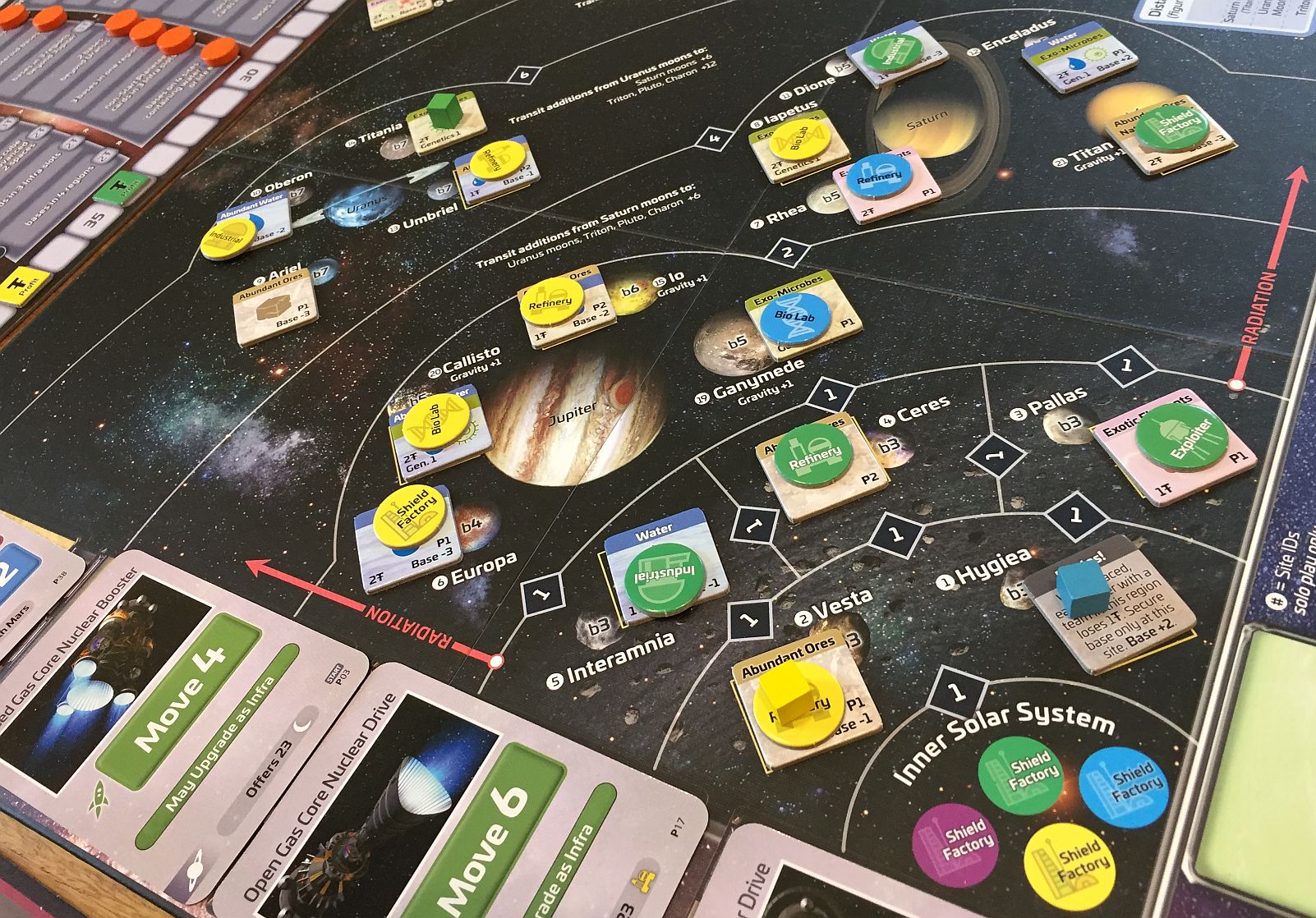
A couple of specific elements which I appreciate greatly:
- I must admit I am hooked with theme; space exploration – in more or less probable timeline and with rule reflecting on high level how it can be done in reality; this is so thematic and not too over-engineered with tons of rules
- The growing complexity of the game – you learn as you play through eras
- Discovery tiles – everybody loves it, children especially. What would I get this time? What awaits me on this planet or moon?
- Aliens – it is not easy to find them and they can be nasty; but what a fun is to finally meet them; my boys always try to get them 🙂
- Great, dedicated and well designed solitaire mode – John H. Butterfield at his best
- That will be repetition with GMT games but I have to do it – top quality of components
SpaceCorp was a surprise – first, an Euro game from GMT Games (you do not get many from them) and secondly, a very interesting journey through the stars with great solitaire mode. This is definitely not the most complicated space game I played and has very limited negative interaction. That makes it perfect for introduction potential players to our hobby or simply for family boardgames. We love to play it with my kids as it gives us so much fun!
More about game:
Summary
I hope that you will like my selection. All above titles are highly recommended – hope you will find some interesting inspirations here. As always, any comments are welcome.
However, this is of course not the end of the great creations we can expect from John H. Butterfield. As hinted in my Top Anticipate Boardgames article, we wait for Away Team: The Voyages of the Pandora which will be published by GMT Games. That will be so much fun!
 The Boardgames Chronicle
SpaceCorps is so good! I really need to play it again soon.
LikeLiked by 1 person
I love that space exploration theme 🙂
LikeLiked by 1 person
I’ve only played Downfall by him (and Chad Jensen)!
One of his most curious designs, I think, is the 1979 “Freedom in the Galaxy” – an indirect precursor to Star Wars: Rebellion!
LikeLiked by 1 person
I have Downfall on my shell of shame…. Need to play it!
LikeLiked by 1 person