
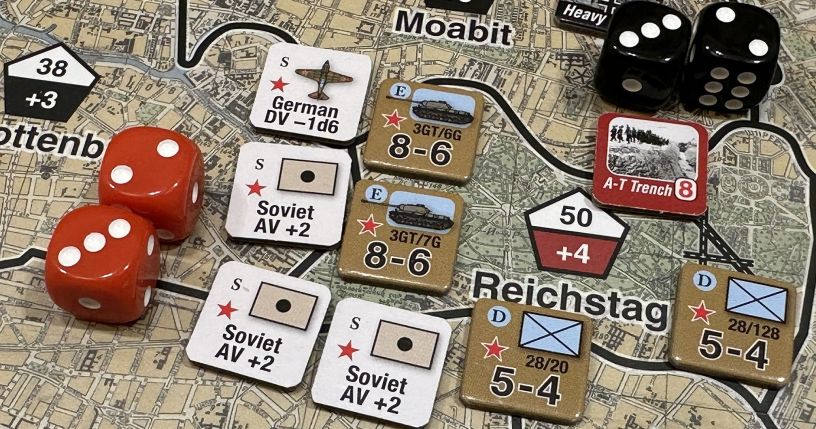
I am always eager to try new solitaire wargame designs. The appetite for this type of boardgames definitely intensified for me during the pandemic times. Still, even today I find it very attractive to try to outsmart the Bots which are preventing my victory on board. I have even my favorite solo titles and favorite solitaire game series.
Two years ago I spent many exciting hours playing a new discovery to me – Stalingrad: Advance to the Volga, 1942. A year ago another installment in the series – Manila: The Savage Streets, 1945. Those titles surprised me with straightforwardness of their rules as well as with the depth – and replayability – of their actual play. So it was pretty obvious that I will try to get also the third title which was just published!
About the game
Berlin: Fall of the Reich, 1945 places the player in command of the war-weary yet experienced and determined Red Army, while the game system controls the largely static German defenders. No two playthroughs unfold the same way, as each turn introduces new challenges through random events, uncertain supply deliveries, and hidden German defensive strengths and strategies.
The game presents a nine-turn campaign covering the Soviet assault on Berlin in April and May 1945. As Soviet forces push deeper from the suburbs into the industrial districts and heavily fortified government buildings, German resistance intensifies while Soviet units gradually become exhausted and ineffective. Despite mounting losses, the offensive cannot slow – Stalin is watching and demands the capture of the Reichstag by May Day. Victory is achieved by forcing the German defenders to surrender, while failure comes if Stalin’s approval drops too low.
With a setup time of under fifteen minutes, low counter density, high replayability, and a fast playing time, Berlin: Fall of the Reich, 1945 appeals to players of all experience levels, from newcomers to veteran grognards. Few battles at the end of the Second World War matched the destruction and brutality seen in Berlin. Whether the commander earns the title Hero of the Soviet Union or faces Stalin’s wrath ultimately depends on the decisions made during the final battle for the city.
Example Session report
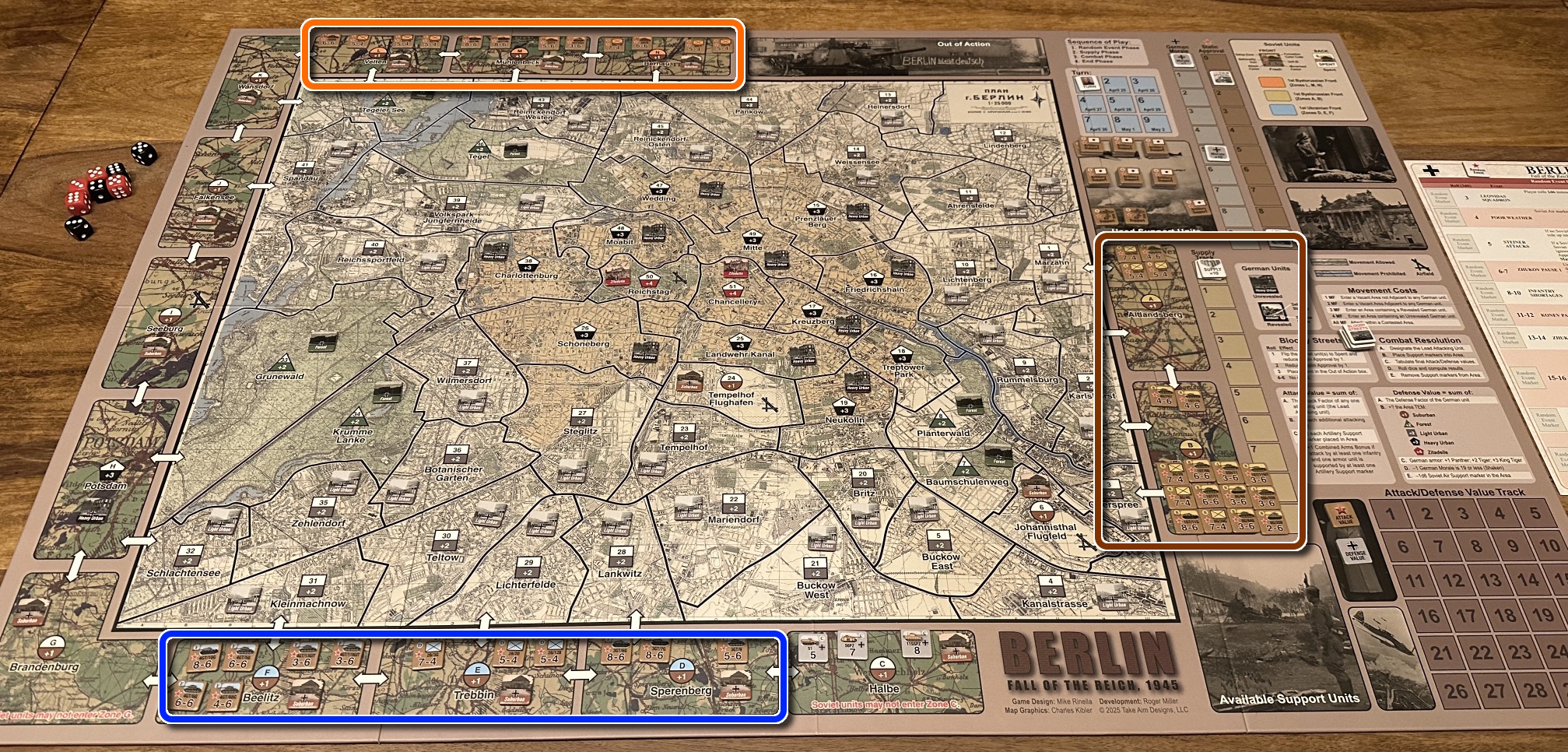
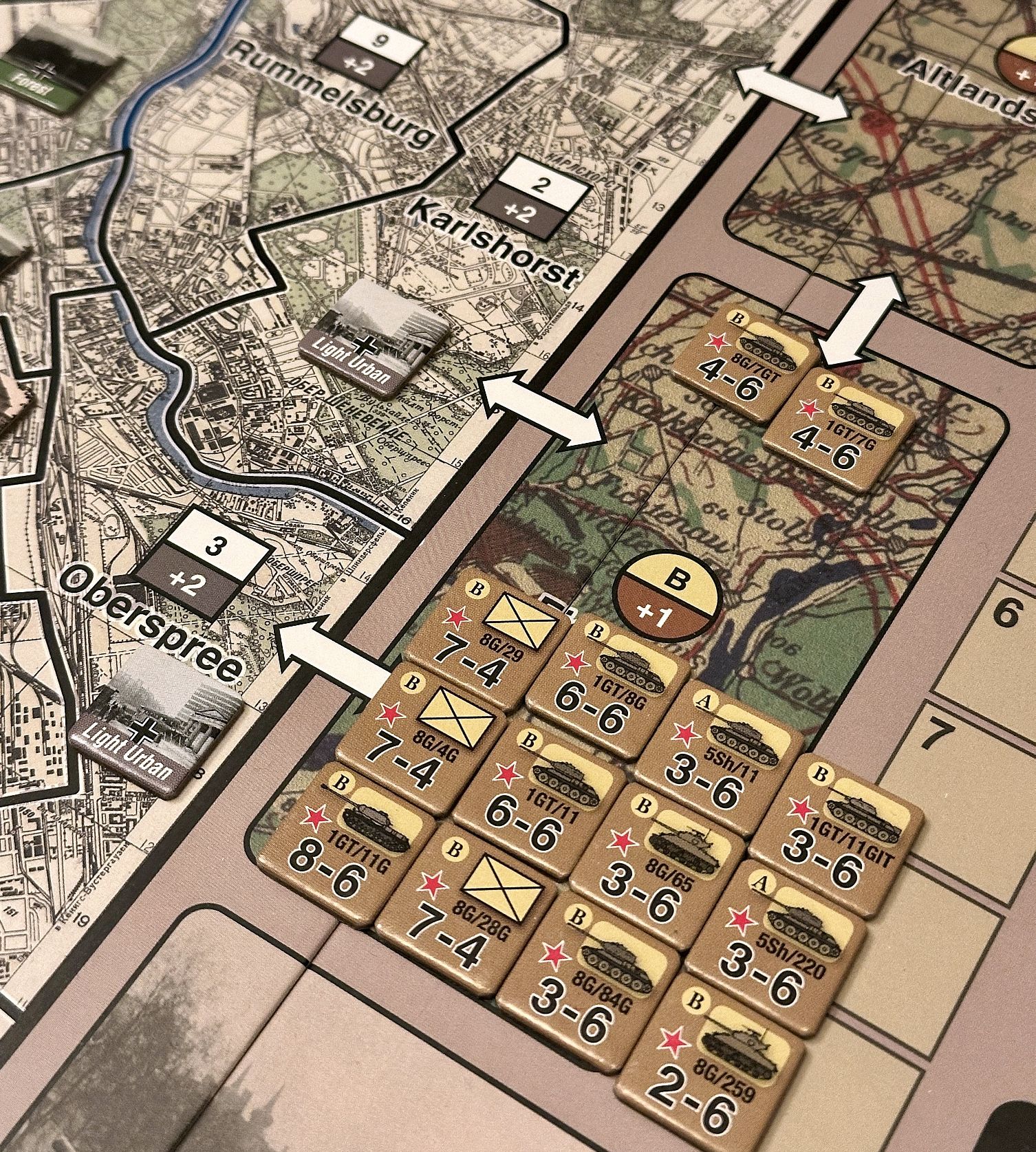
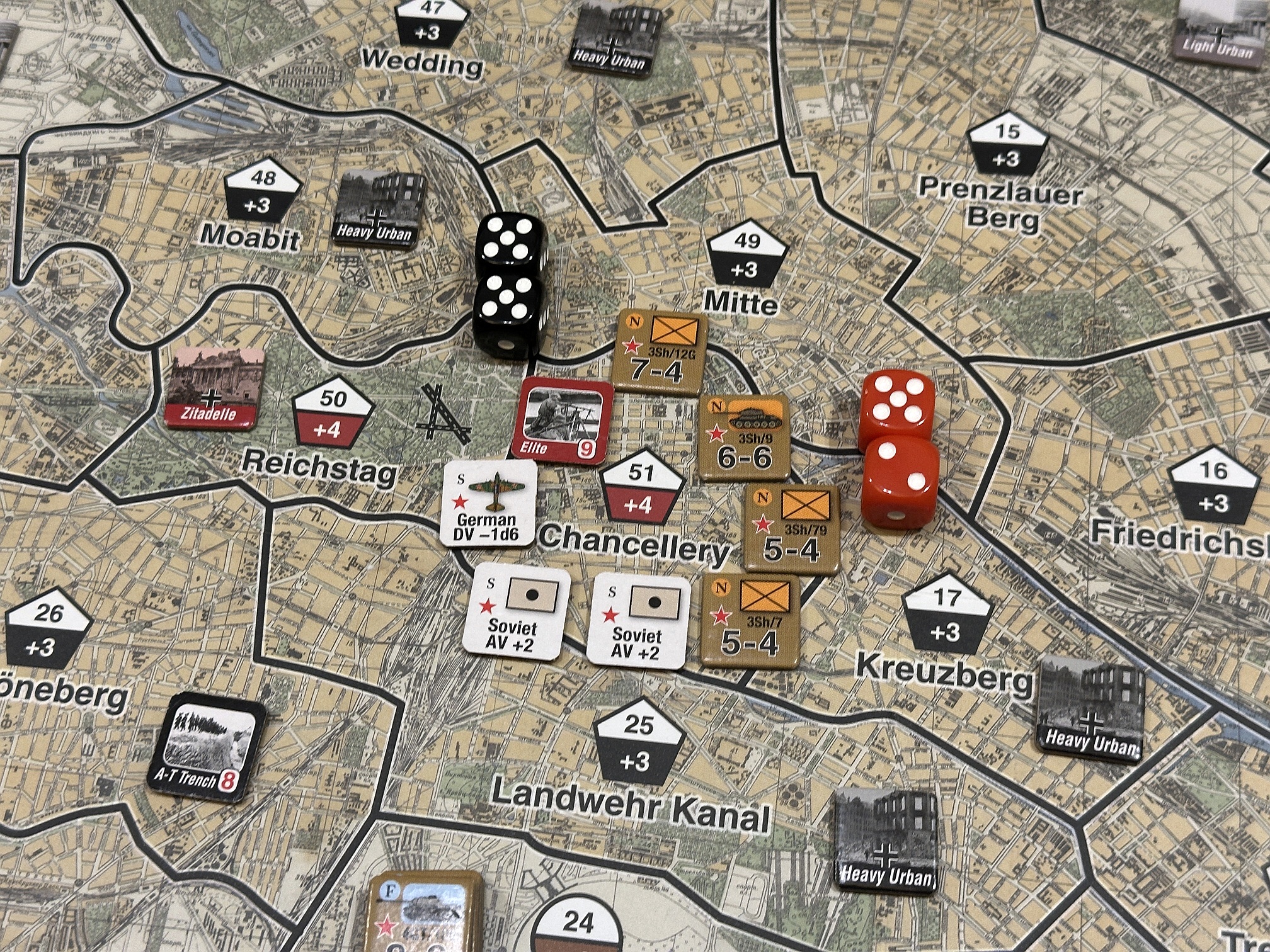
One of the most effective ways for me to get acquainted with a game is to play it several times in quick succession. This approach allows me to immediately apply the insights gained from previous sessions to the next ones. Before writing this article, I did exactly that, and now I will use one of those playthroughs as an example to share more details about the game. At the same time, this picture-rich session report gives me a great opportunity to showcase the game’s beautiful components.
Few things about the game victory conditions and then we jump to the report:
- Automatic Victory: The Soviet player wins an immediate Automatic Victory when at any moment they control Area 50 (Reichstag) and Area 51 (Chancellery) and German Morale is zero (0).
- Operational Victory: If an Automatic Victory has not been achieved by the end of Turn 9, the game’s final Turn, the Soviet player wins if they control Area 50 (Reichstag), Area 51 (Chancellery), Zone H (Potsdam) all four airfields, and German Morale is less than five. If they fail to do so, the player has lost the game.
- Automatic Player Defeat: The game ends immediately and the player has lost if at the end of any Turn Stalin Approval is zero (0). Design Note: Berlin will eventually be conquered but the player will not share in the glory.
PS. Feel free to click any of below images to expand them in new window for more details.

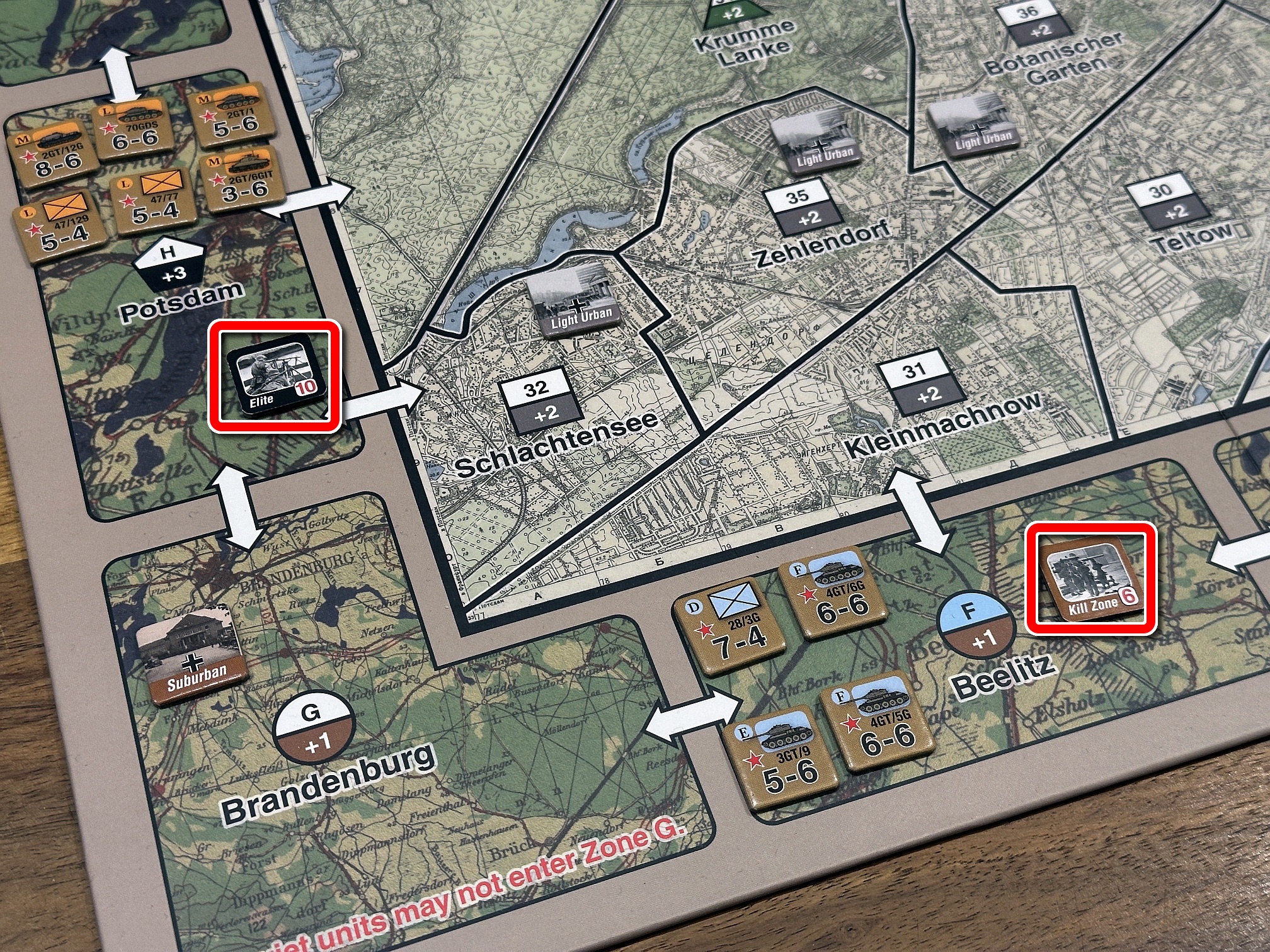
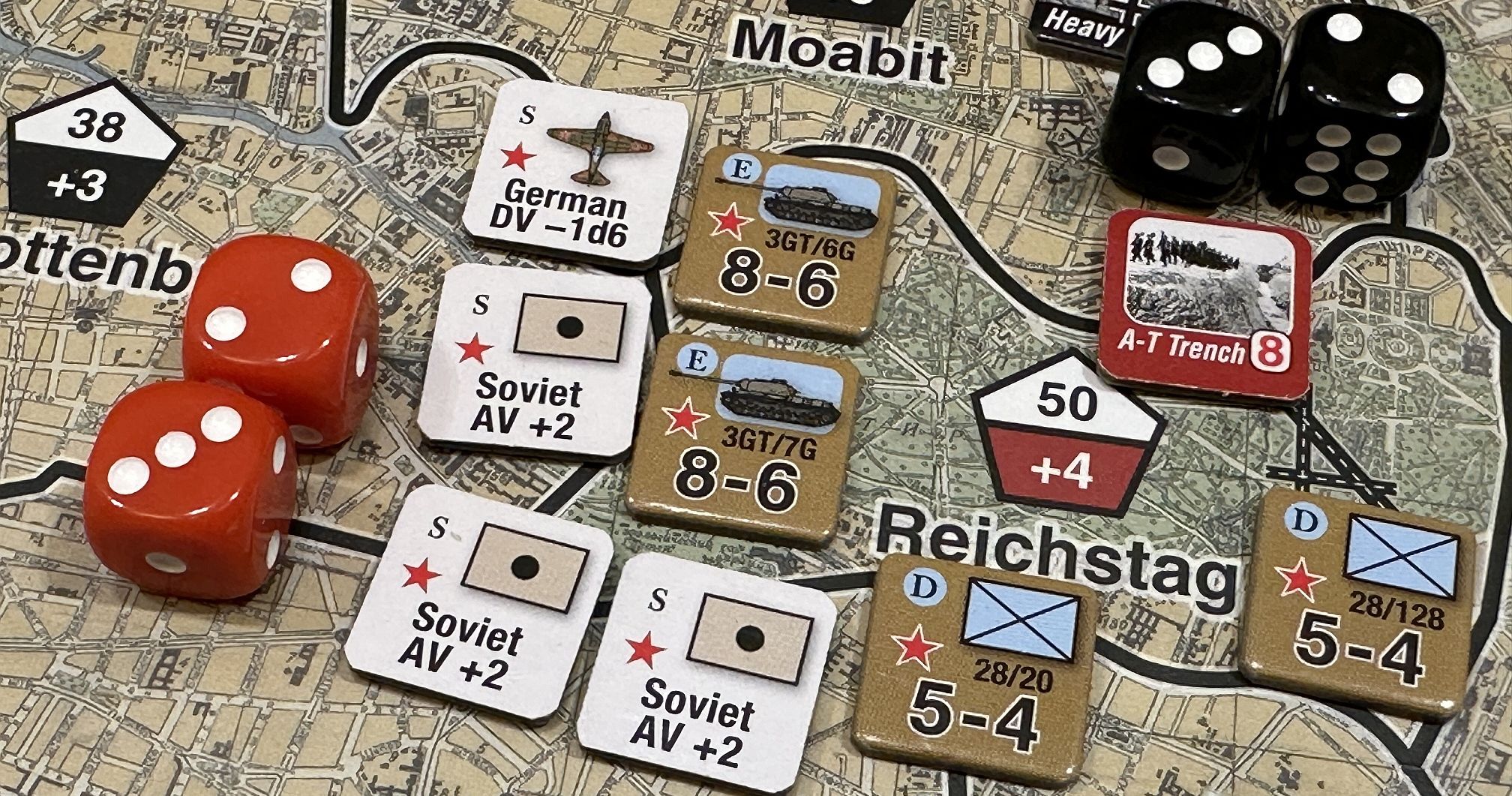
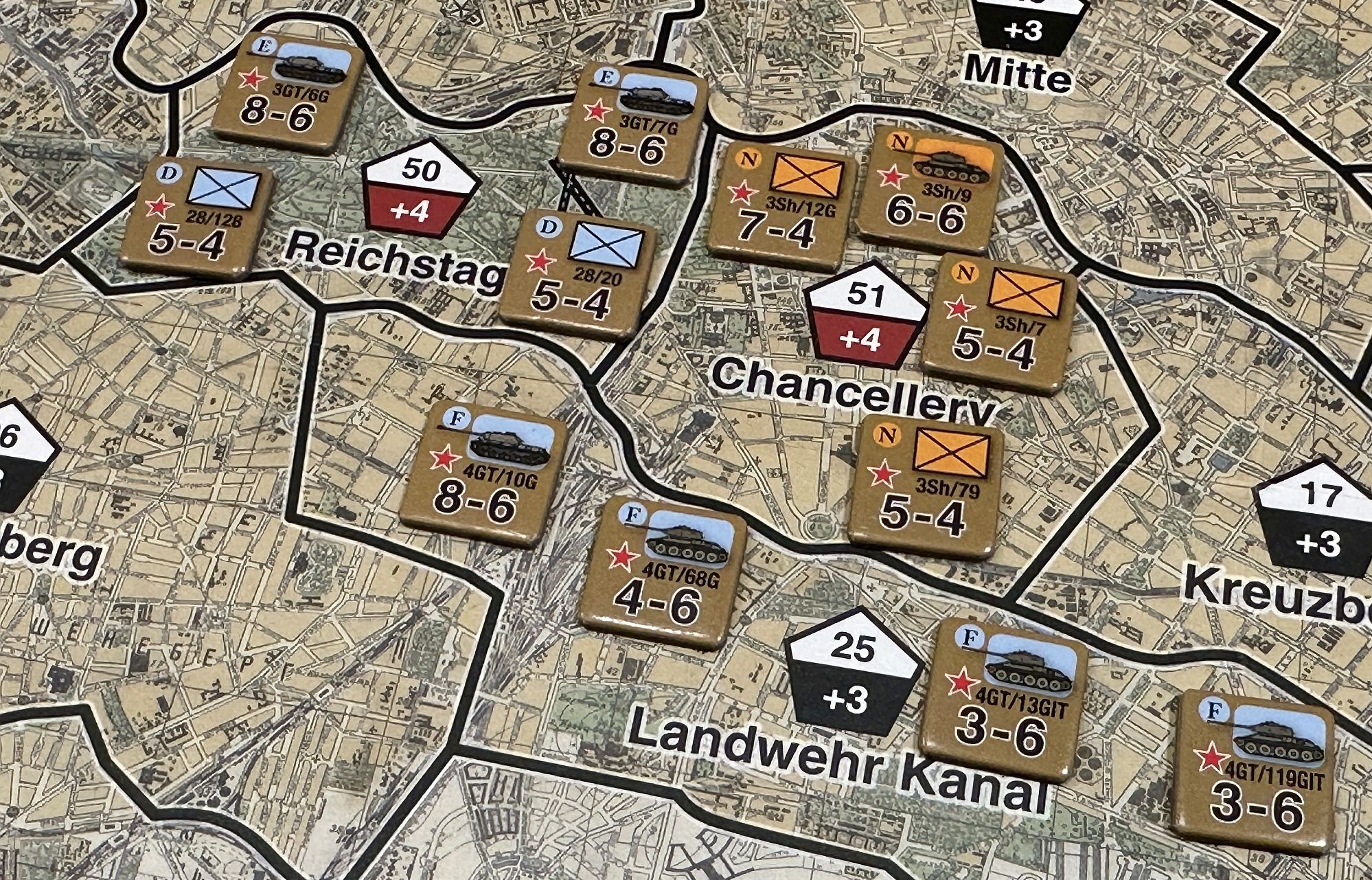
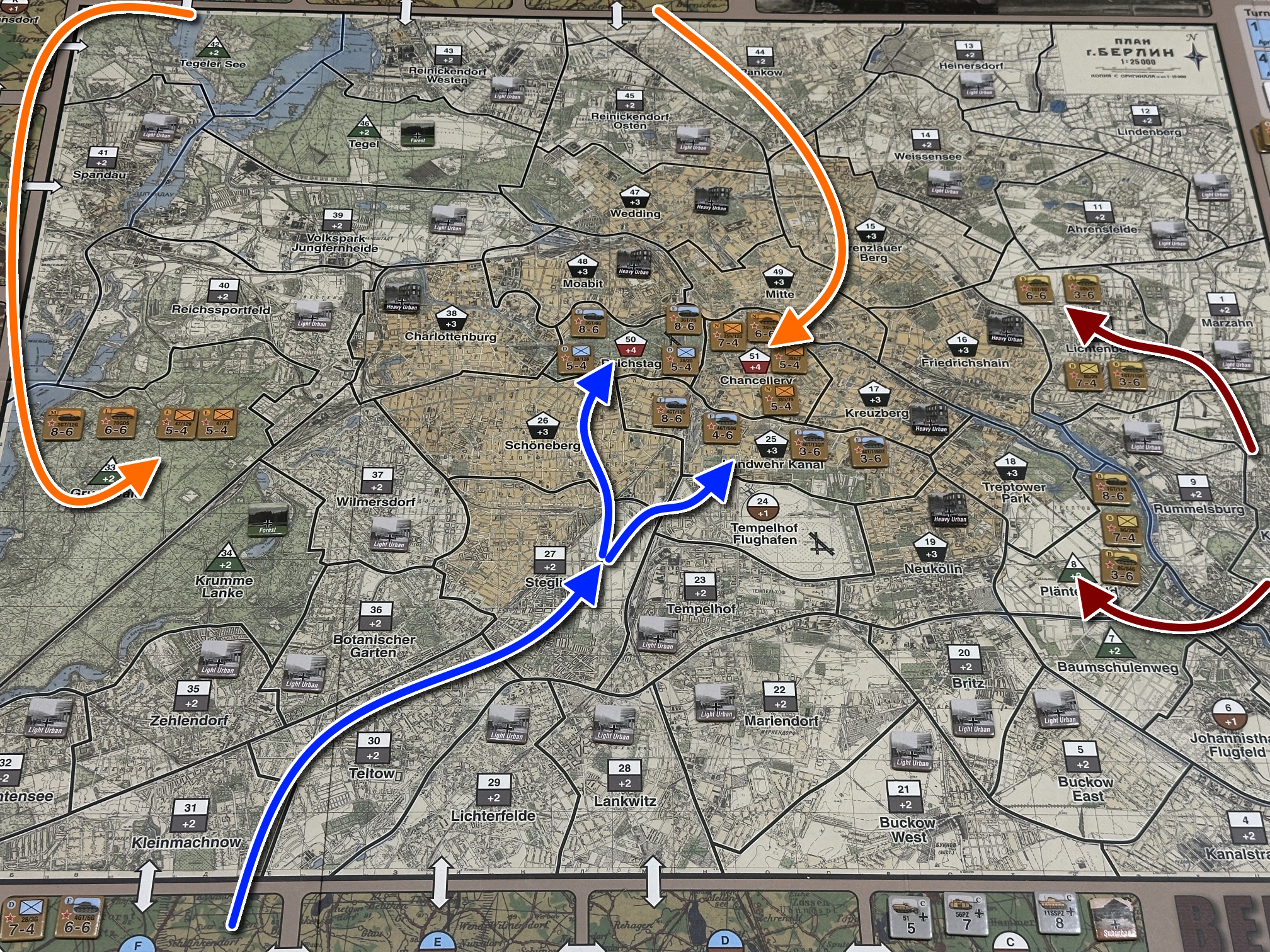
General First Impressions
After several sessions, time now to share my general impressions regarding this title – comparison with previous installments will be provided in next section. Let us talk about details:
- I want challenging AI in my solitaire games. Only then I have the inner urge to try and try to beat the opponent – you know, the syndrome of one more attempt. I believe I am getting exactly this in Berlin – despite German forces being mostly static (although not always), they really form-up a formidable opponent.
- Limiting the randomness factor – yes, you roll a lot of dice; but you have supplies and tools (Artillery, Airplanes, saving supplies from turn to turn) to make sure that you achieve success where you really need it. It is more a question of priorities where to spend them then just counting on luck.
- What also strikes me positively is the the Components Quality. The board stylized on the map from WWII, the beautiful, detailed tokens, the not-glossy rulebook or even neat dice set. Really great impression from esthetical perspective.
- We have here multiple Optional Rules, which predominantly increase the difficulty / make game more realistic. They give so much more replayability and can allow for interesting plays.
Comparison with Previous Installments
Now, for veterans of the series – but also newcomers – I would like to share my observations on what changed and how much I appreciate the evolution of the system. So let us see:
- New approach to victory conditions – you do not need to conquer whole map, you have exact goals for Total and Operational victory; this gives so much more flexibility and options to play, enormously increasing replayability of the game; love it!
- We have some cool, one time events which can make your play completely different from anything you previously experienced. If you combine it with several great optional rules – make sure to check the mobile 9th Army – it makes for some very interesting situations.
- this time we have two track to take care of – German Morale and Stalin Approval. The latter one works like morale in previous games, but first one is cool mechanic how to make Germans weaker – and it promotes proper planning of attacks.
- From the smaller things, we have many more terrain and defense types (including King Tiger!), it is much more costly to rebuild units – you have to accept some of them will die; permanently… Also, introduction of zones where Germans start uncovered, with their defense tactic spent is nice way to start the game.
- I have a feeling – but this is me after numerous plays of both Stalingrad and Manila – that Berlin is a bit easier to win. Mainly due to numerous options how victory can be achieved. But believe me, allow for couple of Optional Rules and it is getting much harder.
Summary
I must say that Berlin made a pretty positive impression on me and I simply liked it – it delivers exactly what it promises, a light, exciting entry level solitaire experience. What is even more, I see great trend how the system and series is being developed – it is not like having same game just in the different theater. There is a lot of changes, subtleties (stipulated above) which make playing it very refreshing while staying within core game mechanics. Can’t wait to see the next game in the series, and if you read the small text on penultimate page of the rulebook, you would know it will be Operation Michael: The Kaiser’s Battle, 1918! Yes, we are jumping to WWI!
 The Boardgames Chronicle
Great write up. I have Stalingrad and Manila but have yet to get Berlin on the table. Thanks for the tips on how to win….Manila has been almost impossible to win…at least for me so far.
LikeLiked by 1 person
I hope you will enjoy Berlin! And as for Manila, I never fully won (whole map conquered). But I tried hard, believe me…
LikeLiked by 1 person
Looks like a great solo game! I’d like to try it out sometime
LikeLiked by 1 person
This series is pretty cool, does not take too much space on table, quick to set-up and I would say max 2 hours of play. Definitely worth trying.
LikeLiked by 1 person
This looks very interesting! When I stay home for vacation, I could consider it for a solo game project 🙂
LikeLiked by 1 person
Very interesting historical setting and I am sure you would create some interesting article about it!
LikeLike