
To immediately jump to the Game Page follow the below link:
Michal: Hi Justin and welcome to The Boardgames Chronicle blog. Really glad to meet you! May I ask you to tell the Readers about what you do for a living, what are your interest, hobbies and what games do you play? Also, what is your role in the design and publication of the Seljuk: Byzantium Besieged, 1068-1071?
Justin: Thank you for having me! I work professionally in video games (but in communications, not as a designer). My main hobby is gaming and has been been for my whole life, but it wasn’t until 2012 that I really got into wargaming thanks to COIN and A Distant Plain. I play all types of games, but wargames and historical strategy are my favorite. I also enjoy hockey, history, video games, and comics. I am the designer of Seljuk: Byzantium Besieged.
Michal: Let me start with congratulations – when we create this interview the Seljuk is being charged as a part of GMT Games P500 program and will ship soon, as one of the most anticipated GMT’s games of 2025. That must have been a long, and arduous journey?
Justin: Over five and half years of my life! It’s crazy to think about, and I am so glad I’m here at the end with a finished product. I’ve never been professionally published before, so it’s a new experience. Seljuk was a labor of love throughout, and embodies a passion for Byzantine/East Roman history that I hope players will also be inspired by. It was a lot of work (game design is hard), but I don’t regret a moment of it.

Michal: Now, let us get back to the roots of the game. What historical events inspired Seljuk? And what the game is about?
Justin: The game is about the four years leading up to the Battle of Manzikert in 1071 and covers both the entire reign of the Roman Emperor Romanos Diogenes and also the campaigns of the Romans and Seljuk Turks in this period throughout eastern Anatolia and Syria. I was primarily inspired by the two hour episode of the History of Byzantium podcast about this period, as it has a strong narrative arc and a lot of drama. As a game, it’s also a great interactive experience for players to take a pivotal role in that history. Both sides will muster and supply their armies, conquer territory, set operational objectives, and ideally emerge victorious at the end of the game.
Michal: Can you tell us a bit more about two main antagonists in Seljuk – i.e. Byzantium and Seljuk Turks? What are their strategical situation, strengths, unique characteristics and units?
Justin: The Seljuks are a fast, mobile force comprised of semi-professional armies from the Muslim heartland of modern-day Iran and Iraq that are augmented by central Asian nomadic warbands allied to the Seljuk cause. They are driven by a desire for more pastoral grazing land for their herds, establishing the supremacy of Sunni Islam, and finding riches in the Roman Empire they can bring home. In game terms, each year sees them with an increasing goal of ravaging or conquering sites in the Roman Empire or risk losing VPs (representing the cohesion of their pan-Asian alliances). They are unmatched in horseback archery skills, and are hard to pin down in battle.
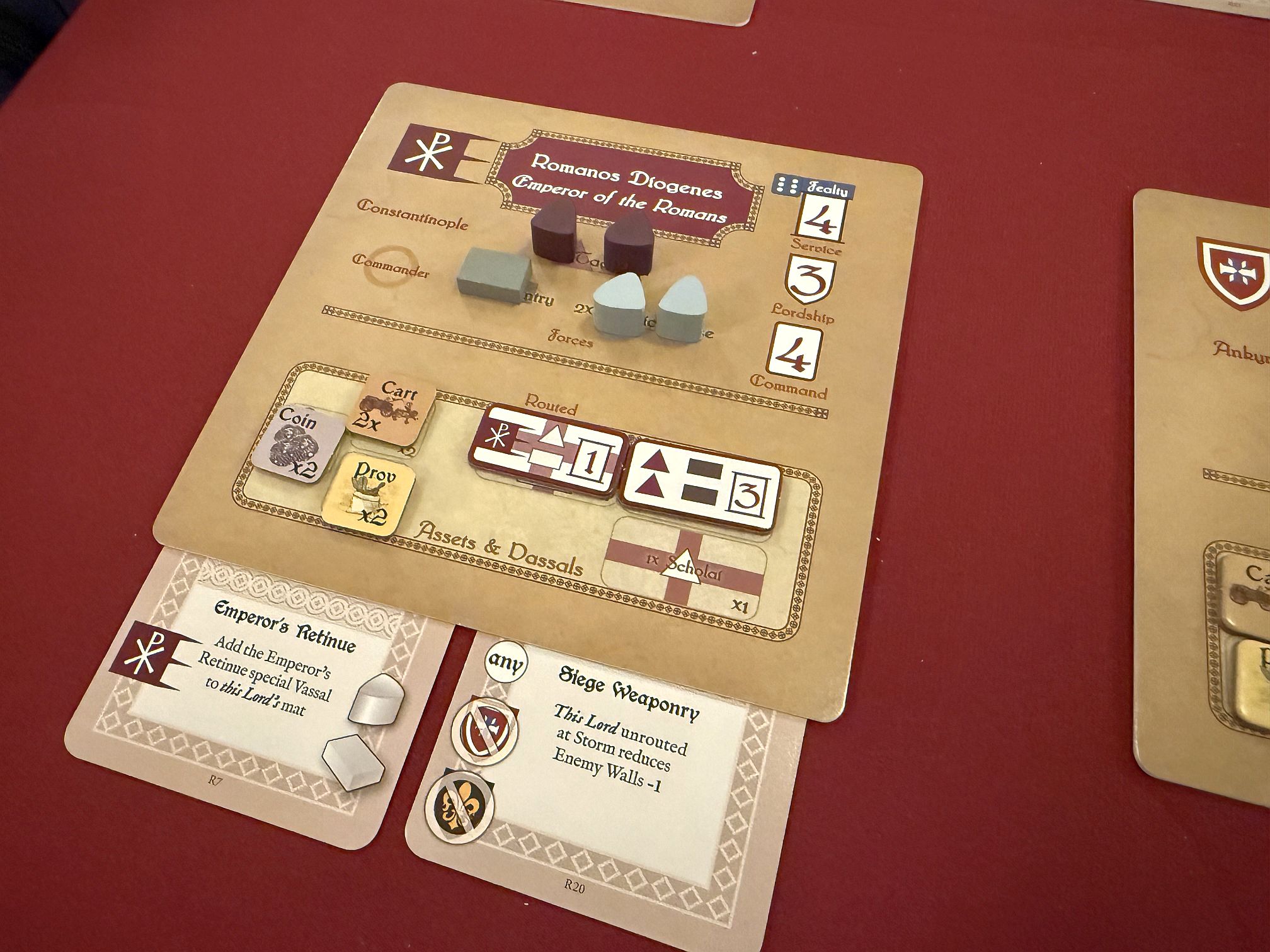
The Romans are more established on the game’s map and their troops are more heavily armored. They control a lot of territory, but their seat of power is in Constantinople, several hundred miles from the frontier areas under attack by the Turks. Because of this, though they enjoy a friendly territory advantage, they also have to march across lots of territory at the start of each year to confront the threat. Their iconic unit is the tagmata, mounted horseman capable of both ranged and melee combat (though not the best at either). Their forces are augmented by general-use infantry and militia. They also have specialized imperial units like the Varangian Guard (who are devastating in melee combat) and the Hetaireia, a group of mounted mercenaries loyal to only the emperor.
Generally speaking, the Seljuks are fast and light with an ability to hit hard at range but suffer when the action gets close, and the Romans have more staying power but they don’t hit as hard. This asymmetry will drive a lot of the strategic and tactical decision-making between players.

Michal: What are the key components of the game?
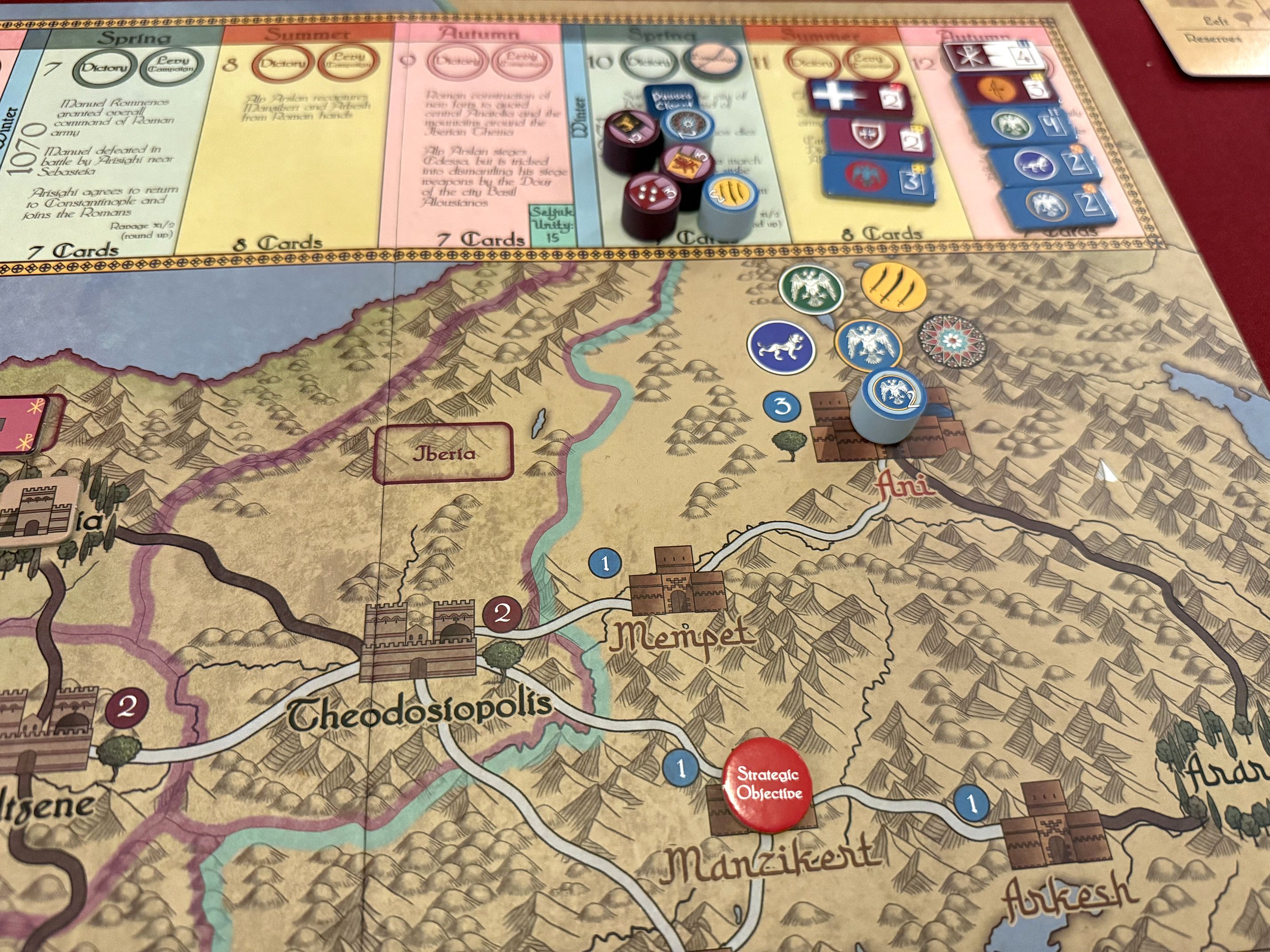
Justin: If you mean the physical components, the game will come with eight lords per side, each with their own lord mats, wooden cylinders, and unit and service markers. The military units are different colored wooden pieces in various shapes like previous games in the series. The map, with artwork done by Robert Altbauer, shows eastern Anatolia and northern Syria, as well as parts of Armenia and the Caucasus connected by point-to-point locations. A deck of dual-use capability and event cards for each player allows both sides to experience the historical occurrences that influenced the campaigns as well as outfit their armies with special abilities.
Michal: Can you elaborate a little about game mechanics?
Justin: The Levy & Campaign system is primarily all about the logistics and planning of medieval warfare. You’ll be creating a pre-programmed stack of actions, and then trying to achieve your goals with minimal knowledge of your opponent’s plan, all while trying to feed and pay your troops to keep them in the field. As it compares to other L&C games, I’d rate Seljuk on the more streamlined side; there is only one type of transport, and many of the game’s special rules affect very specific areas of the game rather than huge parts of the system.
Each turn will start with a random event draw for each side, then planning your upcoming turn by paying your armies, drafting unique capabilities for your forces, raising new troops, and creating your action deck. In the second half of the turn, you’ll alternate taking actions with your lords and moving around the map, possibly engaging in battle, and trying to score VPs. In the winter phase, armies will tend to go home, the Seljuks might score or lose points, and then you’ll reset to do it again.
Michal: Seljuk will be already Volume V in Levy & Campaign series. Why does this conflict fit that particular system?
Justin: I think series designer Volko Ruhnke did an amazing job coming up with a model for warfare in the medieval era, especially at the operational level. All the various gameplay mechanics fit the historical accounts of medieval campaigning perfectly. No matter where in the world you went during this time, armies were limited by logistical concerns and the ability of their commanders and troops. Levy & Campaign expresses this so well, so when I started thinking about a game set in Byzantium, Levy & Campaign fit everything that was needed to capture actual historical events.
Michal: What new mechanics you had to add or change in basic Levy & Campaign approach to reach the design goal which you had for Seljuk? In other words, what are the differences from other titles in the series?
Justin: There are a couple. First, the asymmetry in victory scoring between the sides is a dynamic not found in other titles in the series. The Seljuks are far more concerned with ravaging and spreading their devastation across the empire and bringing back loot at the end of the year than they are about conquering territory. Because each year requires them to do better than the last, there is a constant pressure for them to drive further westward in their campaigns. The Romans have to play defense, but they will also need to go on offense at some point to outscore their opponents. It makes for a tense game of cat and mouse.
Secondly, the Romans have to manage their themata, regional military units tasked with defending specific geographic areas. These units can be raised by the emperor while on campaign, used as garrisons to protect their home forts, or risked to attempt to stop Seljuk raids. They are a mostly finite resource, so the Roman player will need to judge how to best utilize them over the course of the game.
Michal: How do players determine victory?
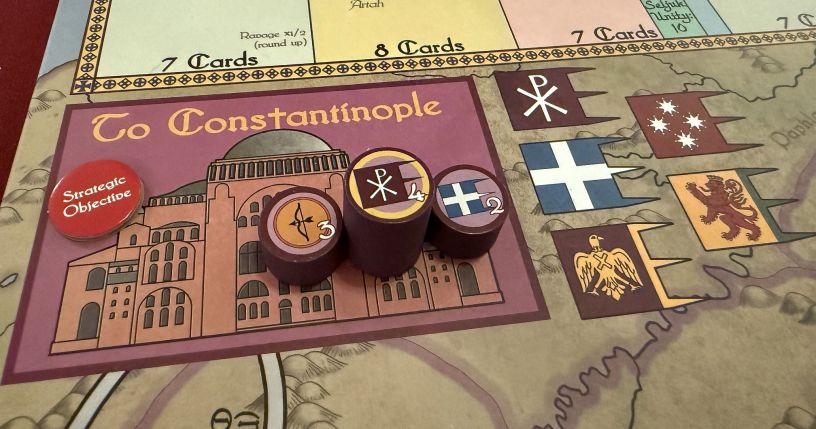
Justin: At the end of a given scenario, whoever has the most VPs wins. The Romans can score these by conquering Seljuk forts, ravaging the Caliphate, or achieving previously set strategic objectives (also a new mechanic to the series). The Turks score by ravaging Roman lands, returning loot back to their seats during winter, or ruining Roman fortifications.
There is also a unique way each side can achieve an auto-victory: if the Romans defeat Alp Arslan such that he permanently removed from the game, they win. If the Seljuks conquer Aleppo after certain events have happened, and then and hold it through the winter phase, they automatically win.
Michal: From what I saw, the game will feature several scenarios. What will they cover and how do they differ?
Justin: The game will have five scenarios: the campaign that begins in 1068 and goes through a possible four years, ending in the autumn of 1071. There are also three one-year scenarios playable in three hours or less: 1069, 1070, and 1071. There is a six-turn scenario that covers 1070 and 1071, the back half of the era. Additionally, players can choose any of these scenarios as a start point and choose their own end turn. Since the game is based on VPs, simply play as long as you agree and see who wins at any given point on the calendar; I do this a lot with 1068 during convention demos.
Michal: Now, as for Seljuk: Byzantium Besieged, 1068-1071 itself, what makes this game unique?
Justin: Well, the topic of medieval Rome isn’t usually seen in wargames and I wanted the history to be more exposed to a gaming audience. There is almost 1,000 years of amazing history centered in and around Constantinople and its empire, and as historical gaming becomes more popular, it deserves a spotlight on it.
Michal: How are you going to publish the game and where the players interested in the project can get more information?
Justin: GMT Games is publishing the game, and it’s shipping right now! You can get it from them directly or their various global distributors.
Michal: What other games / designs you are working on currently?
Justin: I have a lot of ideas, but I have been mostly focused on enjoying Seljuk releasing. My next design attempt will be about the War of Spanish Succession, but it’s still very early.
Michal: Thank you very much for the interview! Any last word you would like to add?
Justin: Thank you very much for having me. I hope the players who are excited about Seljuk find the Byzantine game they’ve been wanting, and I hope those who have never considered the setting will find something to enjoy about the history and Levy & Campaign in Seljuk.
Thanks!
 The Boardgames Chronicle
This looks great! I’m always up for an accessible Levy & Campaign game.
LikeLiked by 1 person
That one seems so!
LikeLike