

We have played with Clio already several games on Rally the Troops – not being able to often see each other live, this is our main and preferred option to spend time together with the boardgames. We had (and have!) fun with Time of Crisis, wrapped our head around with Vijayanagara, relived American rebellion in Washington’s War, tested fast 300 or tried to survive with Friedrich.
However, there are still some interesting classics which we felt have not been played enough by us. And having them on this great platform remove any excuse of not trying them! This is how the idea came about playing several sessions of Julius Caesar – and once we decided we do it, there was no turning back 🙂
In below article I would like to tell you how our sessions turned out, some info about game and platform itself – mainly for those who have not tried that great tool yet!
The Platform

Rally the Troops is an online site where you can play board games in your browser, with fully automated rules enforcement. Play live or asynchronously with friends or strangers, or explore the games on your own. It is free to play, and you do not have to look at any ads – which is impressive.
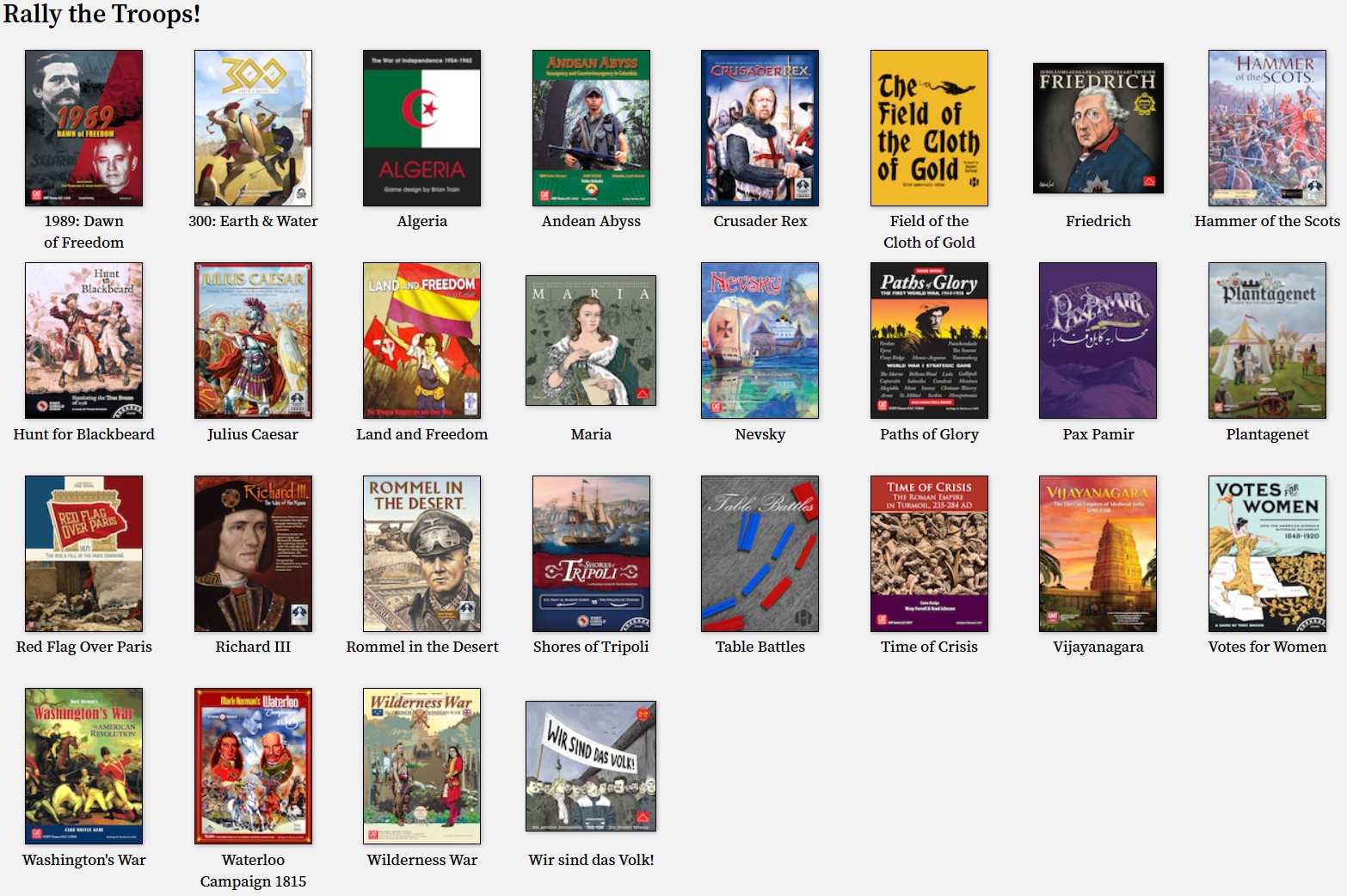
The platform develops and grows all the time. At the moment when I am writing this article, Rally the Troops consist of 28 wargames from various publishers (with recently added, super-hot Paths of Glory!); we have a pretty wide array of the most iconic and prominent designs in our hobby, but you can also find some of the less known. It is rapidly expanding, and we are getting a new position every couple of months – based on the bandwidth of its main developer, Tor Andersson. There is a forum and Discord server where you can discuss the next titles in pipeline, ask the rules questions or simply express your gratitude to the team!
The Game

A bit about the game now. Julius Caesar is a two-player block wargame from Columbia Games that tells the story of the Roman Civil War between 49 and 45 BC. One player commands Julius Caesar’s veteran legions, while the other leads Pompey’s forces, vying to control the fate of Rome as a republic or empire. The game board spans the Mediterranean, featuring 13 victory point towns and cities that players must capture to win.
Using the Columbia Block System, wooden blocks represent hidden unit strengths and types, adding fog-of-war and tactical uncertainty to every move. They are being revealed only during the battle. Card-driven mechanics dictate actions like movement, levying troops, or triggering events – the last being connected to Roman gods and adding some surprising moments to the play. With fast-paced naval maneuvers across the seas – fastest way to relocate troops although costly from logistics perspective – and deliberate land campaigns, each game unfolds quite uniquely. Which we shall prove in below session reports!
Session Reports
So let us jump now to the actual session reports – in a pretty abbreviated format, with key developments only. The idea was to play four times – first in historical set-up, switching the sides. Then with free set-up (you can reorganize units within the initial disposition of forces) and also switching the sides. That would gave us the maximum number of various combinations – and as you shall see, to say that each game was different will be understatement. They went sometimes really wild!
Game Set-Up
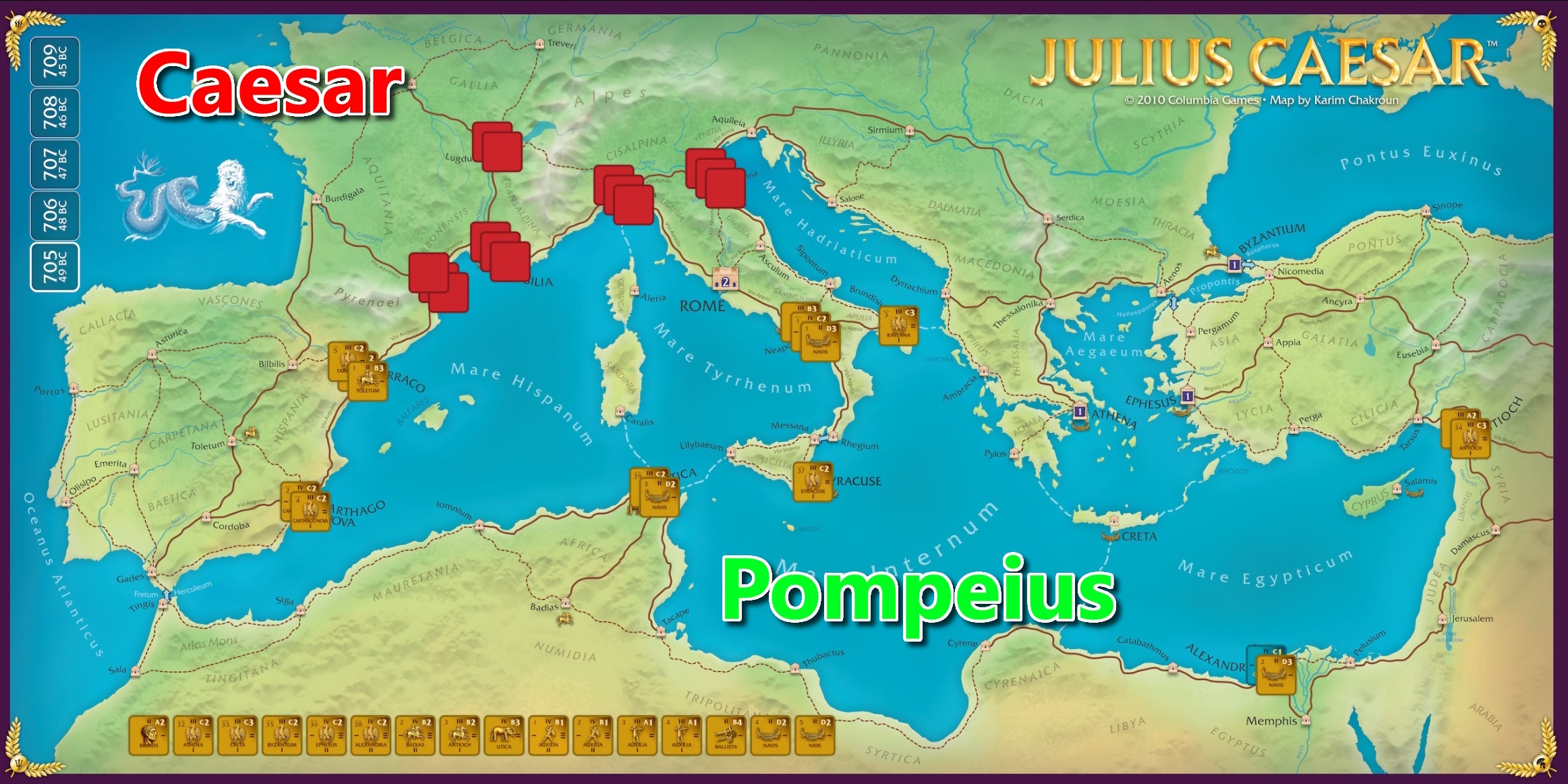
Let us have a look at the map at the beginning of each Julius Caesar game. As you can see, Rome is empty and Pompeian forces are in full flight. Still, when we look at victory points situation, Caesar has only 1 point while Pompey – 7. Yes, the initial score is 1-7! So what usually happens is for rebellious legions to quickly cross the Rubicon and take over the Rome. The real fun starts after that – the race to Greece where three juicy VPs are (Athens, Ephesus, Byzantium).
But enough of theory, time to practice!
Session 1

Session 2
Session 3
Session 4
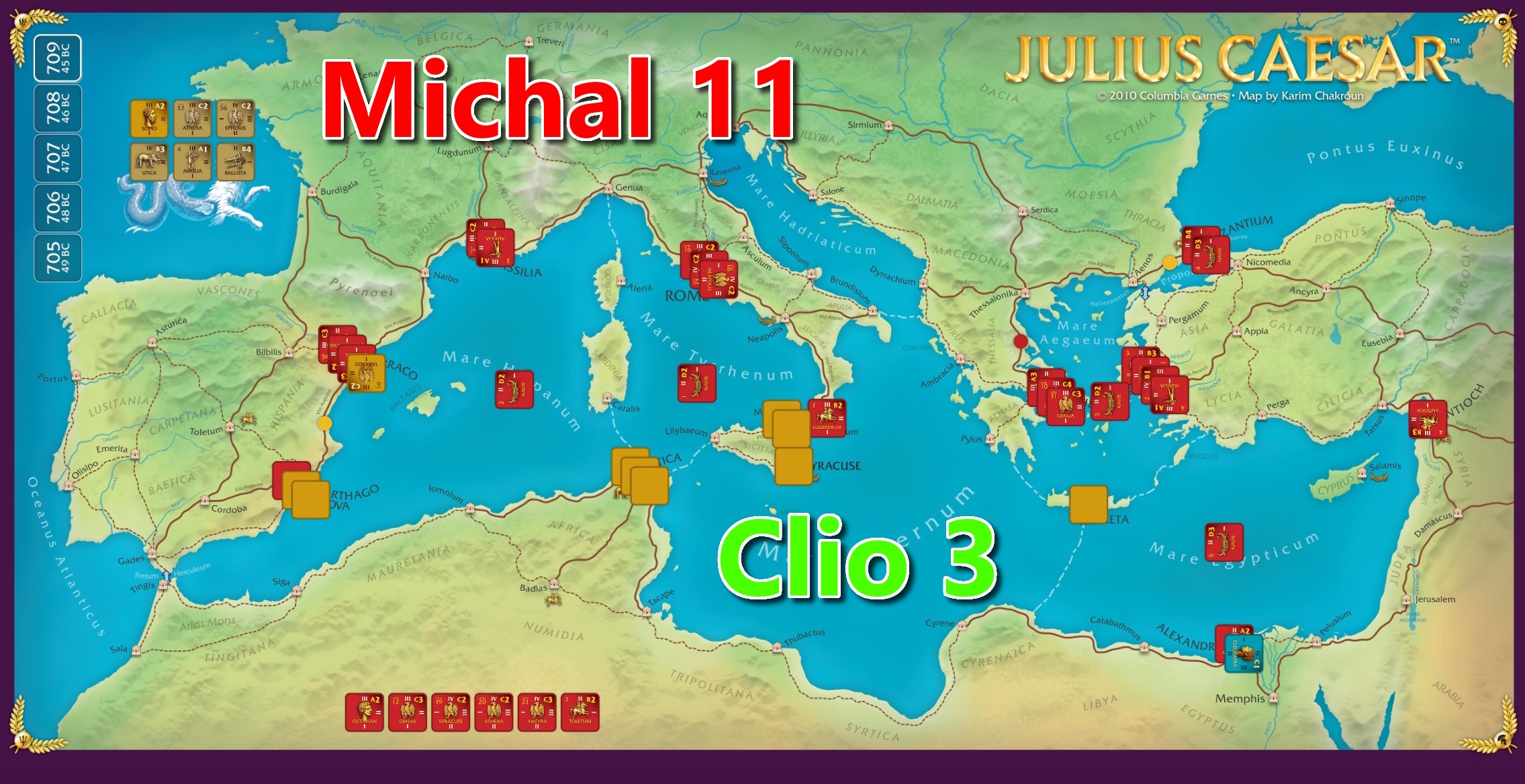
Summary
Now, let us look at the summary of our plays:
| Clio | Michal | |
|---|---|---|
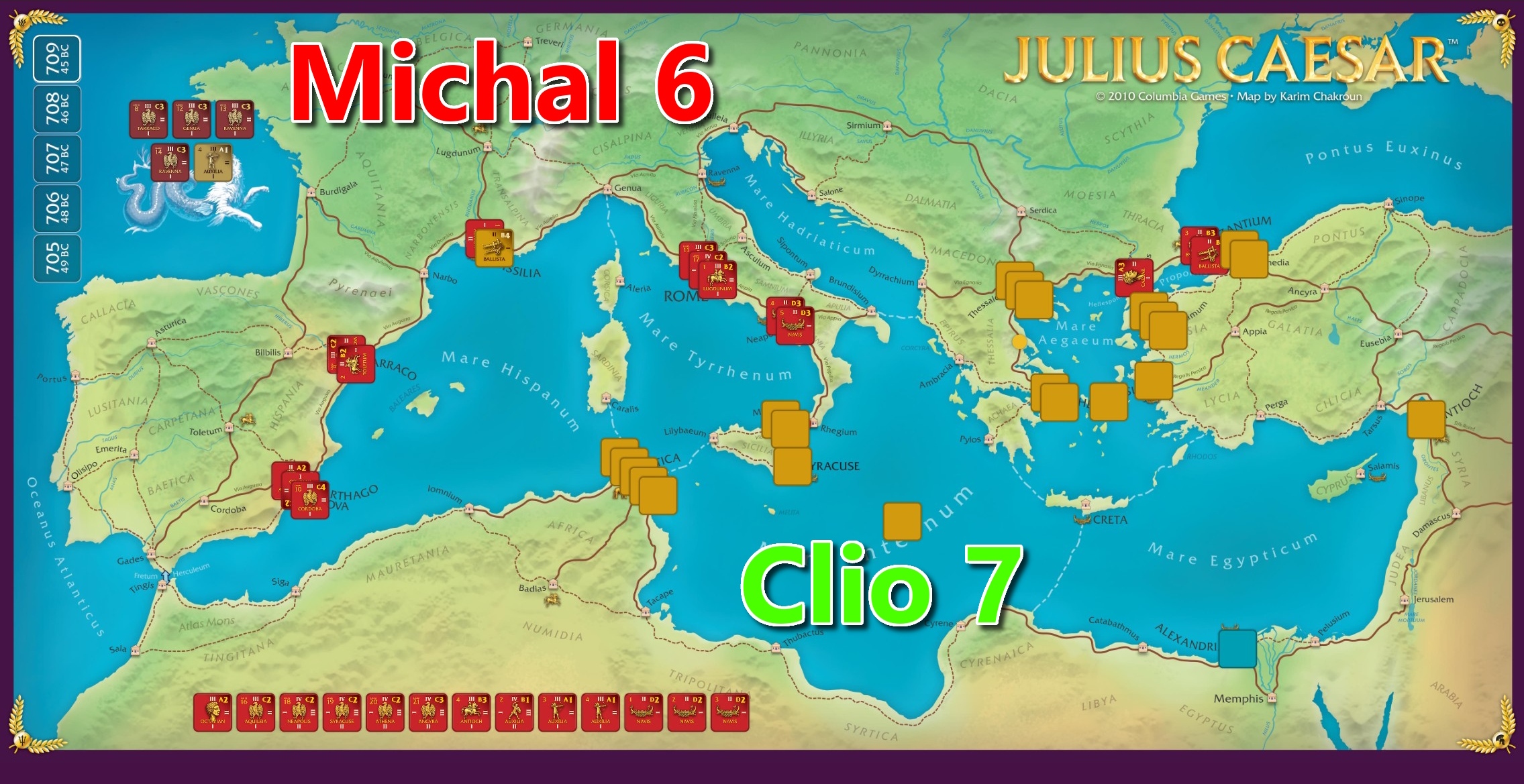
| Session 1 | 7 | 6 |
| Session 2 | 7 | 6 |
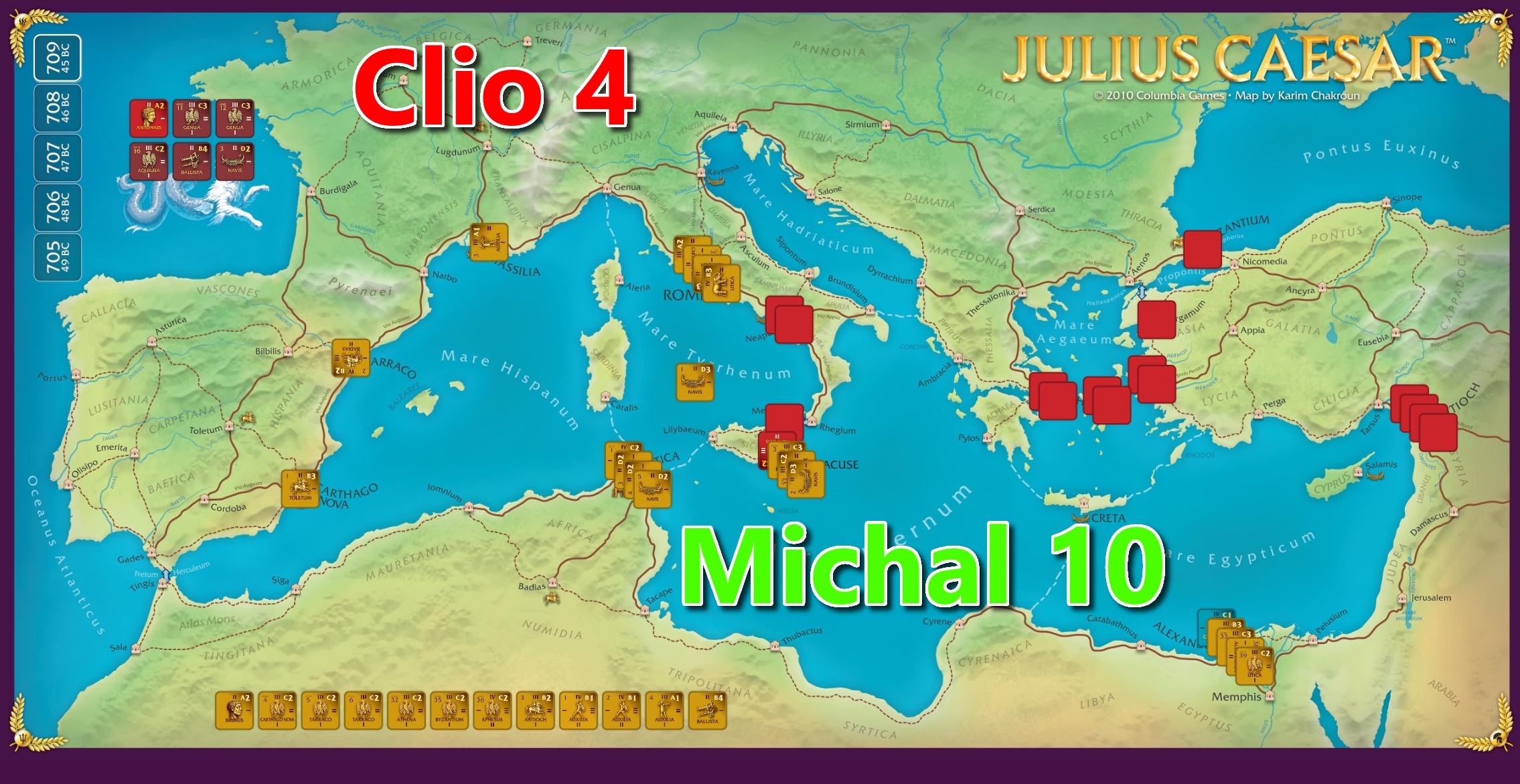
| Session 3 | 4 | 10 |
| Session 4 | 3 | 11 |
So two victories by Clio, two victories by me, two victories by Caesar and two victories by Pompey! Additionally the small points balance between Caesar and Pompey was just 28-26. That shows how balanced, close and well designed from that perspective the game is.
Conclusion
Playing Julius Caesar brought a lot of fond memories – I have a physical copy of this game and played extensively in the past. Thanks to Rally The Troops I can now play with my colleagues and friends from all around the world – which is such a fun! As for this title itself – it always amazes me how a one-scenario game can be so good, so replayable and exciting. Definitely worth trying!
 The Boardgames Chronicle
Such great games! Also interesting that you had more experience with the Historical Setup and I with the Free Setup, but we each won the respective other two games – shows how important a fresh perspective and the element of surprise is!
And, of course, our little series of games shows that Julius Caesar provides for both very close games that come down to the last battle and utter blowouts (which are both fun in their own right) 🙂
LikeLiked by 1 person
Agree on all points. What is great is that title – despite seemingly being a 1-scenario wargame, is such a replayable wargame.
LikeLiked by 1 person
Yes! Sometimes it’s careful maneuvering, sometimes bold moves, sometimes the defensive lines seem impregnable, and sometimes it’s a slugfest! …not to mention that every area of the map can turn into the one where the decisive battles will be fought!
LikeLiked by 1 person
Which makes it so much fun. Have a great time with your physical copy – playing live is always a blast!
LikeLiked by 1 person