
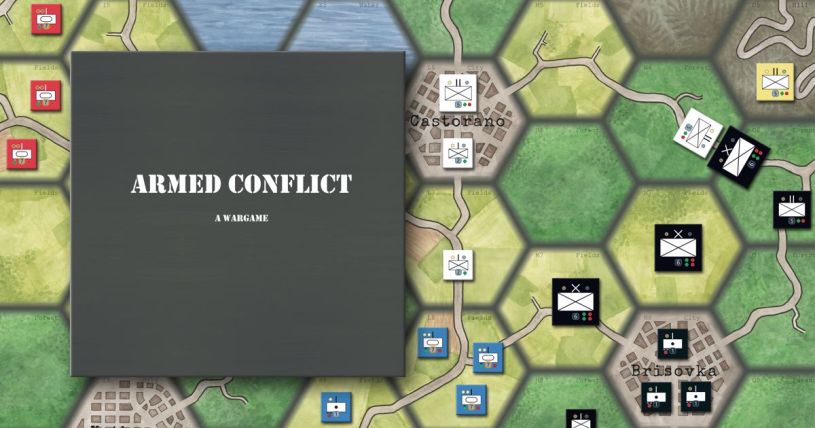
To immediately jump to the Gamefound page of the game go here:
Michal: Hi Sebastian and welcome to The Boardgames Chronicle blog! For those who do not know you, can you please tell us what do you do for a living, what games do you play? Also, what is your role in the design and publication of Armed Conflict?
Sebastian: Hi Michal, thank you! It’s a pleasure.
I’m a 39 year old entrepreneur from Espoo, right next to Helsinki, Finland, where I live with my wife, two kids and a bengal cat.
To summarize who I am as a board game designer I want to highlight three of my main interests that I have had since early childhood: The first one is arts, and especially drawing. I used to draw and paint every single day until early adulthood. The second is science in general, and in particular how phenomena in nature can be described by numbers, estimated, simulated and forecasted.
The third interest is military science, and anything related to it. I used to read every book I could get my hands on relating to military strategy, weapons and equipment, etc., and watch every war movie I could find. I did my mandatory military service in the Finnish Defense Forces and became a reserve officer, specializing in coastal warfare and reconnaissance (currently with the rank of first lieutenant). I was considering pursuing that as a career, but felt that I wouldn’t be able to utilize my two other interests in the military.
Instead I studied architecture for a while, before deciding to go to business school (majoring in financial economics), with the idea that this would give me the best opportunity to work in whichever field I wanted later on. So far I have been working with business development, analysis and management within the ecommerce industry, getting invaluable insights into how to run an online business.
Last autumn I made the decision to become an entrepreneur and test out all those ideas I have been working on for all these years, of which one is Armed Conflict. This May I founded Bockholm Games, and currently I work more or less full time on making this game a reality, with a crowdfunding campaign coming up on Gamfound shortly.
When it comes to board games in general I tend to spend way more time on developing new “house rules” and improvements, than the time I actually spend on playing the games (for better or worse 😅). I usually prefer games that are anchored in reality, with elegant rules that don’t leave room for interpretation. If the game teaches you an actual skill or knowledge that will benefit you in real life I think it’s a big plus.
Michal: Where does the inspiration for Armed Conflict come from? What kind of game is it?
Sebastian: The whole thing actually started as a project assignment in my elementary school, many, many years ago. I was basically interested in the military and wanted to create a wargame.

However, I wasn’t really satisfied with the result back then, so I continued to develop the concept for all these years. During my military service I got so many insights on how the game should work, what is relevant in a simulation and what is not, what are the approximate probabilities in different scenarios, and so on. During my architecture studies I understood how the whole thing should be visually represented, and my finance studies finally taught me how to calculate and simulate probabilities and complex processes, allowing me to get the last details right.
In other words I have designed both the game and made all the visuals for it, but at this point I also want to highlight that this is not a one-man show. We have a team of very skilled playtesters and advisors with different backgrounds ranging from history, to physics, who work part time on the project too, and who have been of tremendous help in developing it.
And to summarize the actual game, I would classify it as a medium weight wargame, with the characteristic that the game doesn’t depict a historical conflict and that it is partly cooperative within two alliances (when more than 3 players are playing). The main philosophy is to create a general warfare simulator, which is still straight forward enough for a casual board gamer to grasp and enjoy playing.
Michal: What are the key components of the game and what do they signify / represent?
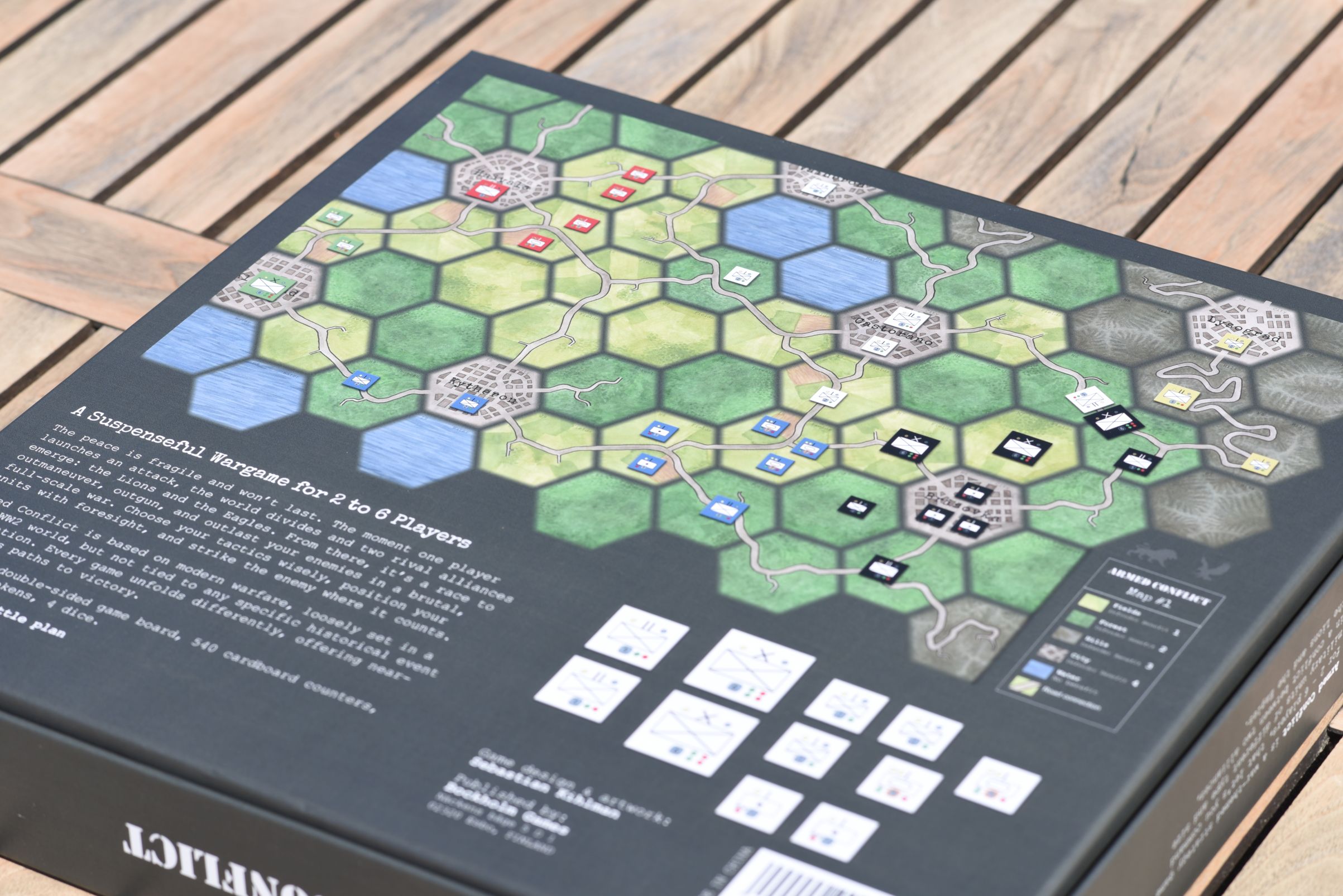
Sebastian: First of all there is the double-sided game board, featuring a different map on each side, each consisting of 16×9 hexagonal areas. The areas all represent one of five different terrains: cities, hills, forest, fields, or water, each giving a specific terrain benefit to a player defending the area. Although a hex map is always a simplification of reality, regardless if it depicts a real territory or not, we have put a lot of emphasis on making the geography look credible. The cities should be placed how real cities would emerge, and the roads connecting them need to go where roads would naturally be built, considering the surrounding terrain, and so on.

Then, of course, there are the military units, represented by 3mm thick cardboard counters (4mm counters will be available as a stretch goal in the crowdfunding campaign). There are six different armies (for a maximum of six players), each with their own color: black, red, blue, green, yellow, and white. Each army has five different units available: infantry companies, battalions, and brigades, tank companies, and artillery batteries. At the beginning of the game each player has about one to two divisions worth of units under their command.

The game also contains two d10 and two d12 dice, which are used to resolve the battles. In order to attack or move troops, the player needs to supply the troops with resource tokens (green cubes), symbolizing everything from ammo to food and fuel. In order to recruit new replacements (which is often a political decision) players need to have some success on the battlefield to earn reinforcement tokens (blue cubes), which can be exchanged for fresh units.
Finally there is an alliance chart with 6 discs in each player’s color to visually keep track of which alliance each player joins.
Michal: Can you elaborate a little about game mechanics – like sequence of play, key actions both sides can undergo and general flow of this title?
Sebastian: The game starts with players taking turns dividing the 12 cities among themselves. There is a big difference between the different cities in terms of how easy they are to defend and how good of a starting point for an attack they offer. No player will get all the cities they wanted, which means this is one of the factors that makes each game different.
Each subsequent turn consists of three phases: 1) Resource Distribution, 2) Move and Attack, and 3) Recruit and Regroup. The action happens during the Move and Attack phase, but in order to do anything the player first has to plan their actions, by supplying the units they want to use with resource tokens, of which they have a limited number.
A key feature (when playing with 4–6 players) is the alliances, called the Lions and the Eagles. In the beginning of the game no player belongs to any alliance yet, and nobody knows who will join which alliance, resulting in a tense opening phase, where you can’t trust anyone, but try to anticipate how everyone would prefer to align themselves. When the first battle occurs, the alliances start to form, and depending on who you attack or get attacked by then decides which alliance you join, leading to a more cooperative phase, where allied players try to beat the opposing alliance together.
Michal: Some of the interesting elements of the game are the resource tokens. Can you tell us how they help to limit what the players can do?
Sebastian: Sure, the resource tokens introduce the element of logistics in the game (which is absolutely crucial in warfare) albeit in a very simplified way. They also force the players to manage their resources and plan ahead.

But the resource tokens also play a very important secondary role in making sure that no units do more than one action during a turn, as a unit cannot do anything without being supplied with resources, and the resources only enables a unit to do one action, after which the resource token is removed.
Players earn resource tokens in the beginning of each turn, depending on the number of cities they control.
Michal: Now, something we all are interested in – how do players determine victory?
Sebastian: The objective for each of the alliances is to seize cities from the enemy players. As soon as a player doesn’t control any cities anymore the game ends, and the opposing alliance wins.
This collective victory forces the players to help their allies and makes the game engaging also when you are not in turn yourself, as every battle, every move has an impact on the alliance you are part of.
Michal: Based on the game description, it will feature a double-sided map. What are other ways to make the game replayable and fun for long?
Sebastian: The whole game is very open-ended making every playthrough truly unique. Each time you will likely start with a different set of cities, the alliances will form in a different way, and you have complete freedom in trying out your own strategies in order to secure victory.
There is also the social aspect: When you cooperate with your allies you are forced to adapt to and/or complement their playing style, which adds another exciting layer of variability to the game.
And on top of that, as soon as Armed Conflict is published, we are going to start working on expansions, including new maps, and more units, to further expand what you can do in the game.
Michal: Now, as for Armed Conflict itself, what makes this game unique?
Sebastian: I think the combination of open-endedness, a certain amount of realism (albeit with low granularity) and the alliance system, allowing up to 6 players, make the game clearly stand out. The particular representation of the map and scale of the hexes on the game board also differs from most other titles I’ve seen, as the hexes in Armed Conflict are comparably few and large in size. Our number one priority is to create a game that both looks and feels good to play.
Michal: How are you going to publish the game and where can the players interested in the project get more information?
Sebastian: The game will be published through crowdfunding on Gamfound, where the campaign preview is already live. There is a decent amount of information there, and if you have any questions about the game you are welcome to ask us in the comments section. Some more information is also available on armed-conflict.com.
Michal: Thank you very much for the interview! Any last word you would like to add?
Sebastian: Thank you, Michal, for giving me the opportunity to talk about Armed Conflict here on your blog, and thank you dear reader for your interest in this game! Remember to follow the project on Gamefound so that you don’t miss the crowdfunding.
Thanks!
 The Boardgames Chronicle