

Let us continue discovering the magnificent world of the Mediterranean Sea in the Sound of Drums beautiful History of the Ancient Seas (HOTAS) series. We shall remind everybody what this game is about, describe its three parts, present one of them in details based on recent session with my fellow boardgamers (Part II: Dies Irae) and share the impressions we were left with after playing it.
If you would like to see previous materials which I created – mainly on the Part I (HELLAS) of the series – please check my First Impressions article as well as How to Play video. They are also a good introduction into the world of HOTAS and its driving principles.
Enjoy!
About the Game Series
So imagine you are moved to the Mediterranean Sea during the ancient times – magnificent coasts to be explored and legendary civilizations that rose to power to meet. The game series History of the Ancient Seas is the journey through these exciting times – loosely referring to actual historical events. You will be building new fleets & armies in your cities in order to explore unknown lands, conquer islands and build a great economy and empire.
The campaign will cover three parts to the series:
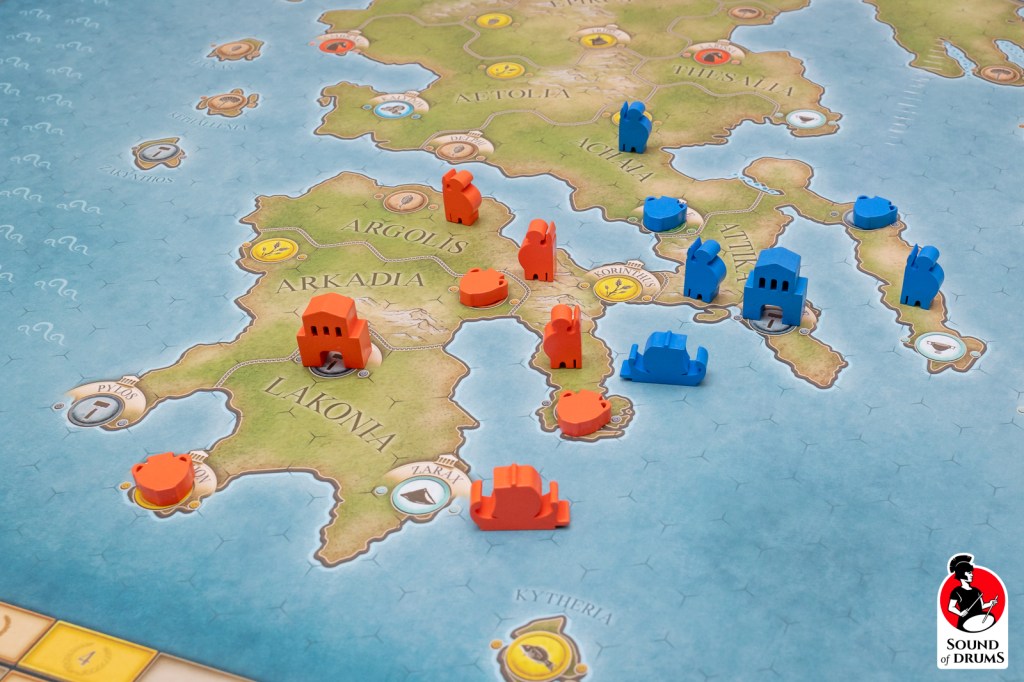


All actions will be driven by a very clever mechanics, in form of rondel, where only 3 actions of particular type per turn are allowed, no possibility to repeat what opponent just did and maximum 2 actions of same type per player. That really create some very interesting strategic choices!
Looks like a fun? Yup, it was!
Session Reports
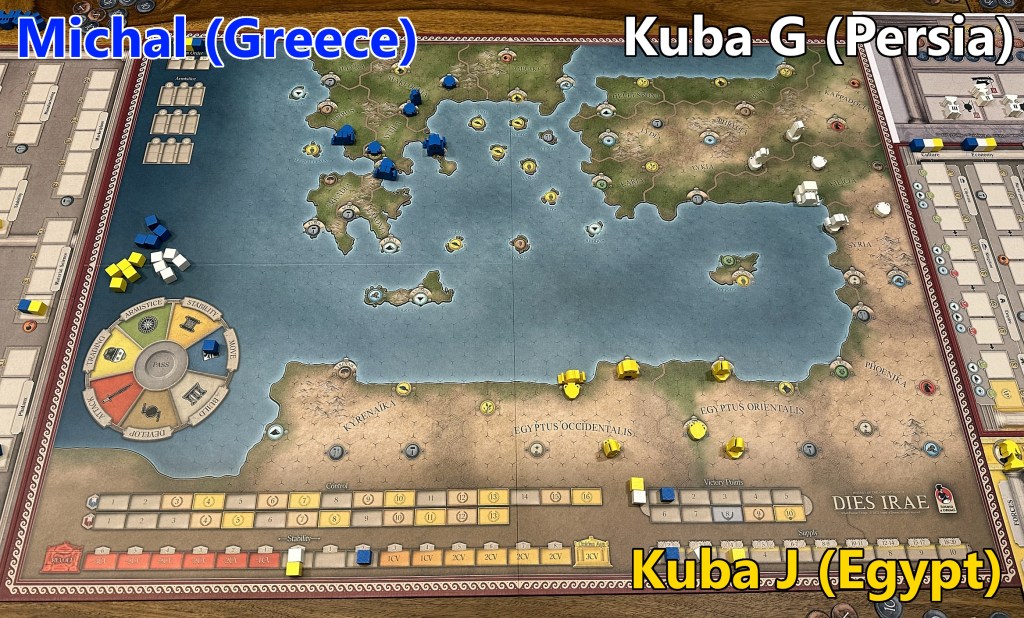
We decided with Kuba J and Kuba G to test this time the Part II: Dies Irae. As briefly mentioned above, this is game which places three great civilizations against each other:
- Persian Empire – Kuba G
- Greek city states – Michal
- Pharaonic Empire of Egypt – Kuba J
We have some flexibility as to the set-up – three locations to place capital and then its trading posts. That would of course define the direction we would like to develop to. The victory points are mainly scored for control of Islands and Regions, but there are also other ways to gain them. The full game last till somebody scores 10 VPs, but there are shorter games to 9 and 8 points.
What drives a nice asymmetry in the game is the composition as well as number of armies and fleets, the path each faction takes in on the technology tree or resources they are able to control. You very quickly feel like playing a completely different civilizations -as it should be!


First Impressions
That was a really fun playing Dies Irae. We focused a lot on economical development but some clashes were inevitable. What we took from the play are the following impressions:
- I love how the asymmetry was achieved in this game – by different composition of forces, starting positions and multiple possibilities to pursue on the technology tree. On one hand, the differences are subtle, on the other – significant enough to have a feeling like leading completely different civilization. This is good!
- Definitely the action mechanic is very cleverly designed – do not be confused, this is definitely not the regular roundel 🙂 Only 3 actions of particular type per turn, no possibility to repeat what previous player just did and maximum 2 actions of same type per player. That creates fantastic strategic dilemmas, tension and ability to influence what other can do.
- The components are astonishingly beautiful; the wooden cubes, armies, fleets are simply gorgeous. I also appreciate the map graphics – they are not only great but very clear and crisp – so there is no ambiguity as to what terrain is where, what resource, etc.
- You need to be aware that there is also an element of bookkeeping here – your income, number of particular resources you have, provinces, islands, etc. You really need to keep this up to date in every moment of the game as it impacts many elements of it. Still, I think this is just as much as I can take so I am fine with it.
- We felt that the game might be a bit too long – we definitely were inclined to play to 8 VPs but even with this, before you developed the economy and actually clashed with opponents, it was a lengthy process. We saw couple of scenarios which are added to the game (like Alexander the Great) and it seems that they might allow to jump into action almost immediately – we should try them!
To sum up, I enjoyed game very much. It is beautiful, asymmetric, allows both for peaceful and violent development and each time plays differently. Definitely you should try it!
 The Boardgames Chronicle
Love to try this one day!
LikeLiked by 1 person
That one is not only moderate complexity but also very beautiful!
LikeLiked by 1 person
Solitaire has the highest level on the back. I thought the bot could only take over one faction (=Hellas). Is it possible to make the bot play against both opponents?
Thanks for the good short overview of the game!
LikeLiked by 1 person
I have not checked if you can play against both opponents, but next time I am bringing this in solo mode to the table I will verify.
LikeLike
Thank you!
LikeLike