

There are games which I play sporadically, and there are titles / series which hit the table – be it digital or face to face – quite regularly. Also, most of my blog readers know my fascination with history, political aspects of the conflicts, especially when we have asymmetry in play. At the intersection of all those characteristics lays the COIN (COunter INsurgency) system created by Volko Ruhnke and now further developed by the group of creative designers.
Among the many titles in the series, Andean Abyss was the first to be published and set the standard to which many further positions were aspiring & referring to. But wait, it was quite recently released on one of my preferred digital platforms – Rally the Troops! That means I had to check it with my boardgames friends and play there.
The Platform

Rally the Troops is an online site where you can play board games in your browser, with fully automated rules enforcement. Play live or asynchronously with friends or strangers, or explore the games on your own. It is free to play, and you do not have to look at any ads – which is impressive.

The platform develops and grows all the time. At the moment when I am writing this article, Rally the Troops consist of 18 wargames from various publishers; we have a pretty wide arrays of the most iconic and prominent designs in our hobby, but you can find also some of the less known. It is rapidly expanding, and we are getting a new position every couple of months – based on the bandwidth of its main developer, Tor Andersson. There is a forum and discord server where you can discuss the next titles in pipeline, ask the rules questions or simply express your gratitude to the team.
The Game
Before going straight to the session report, let me spend some time explaining the Andean Abyss in more details. The theme is very interesting. Colombia in the 1990s hosted one of the world’s last Marxist guerrilla armies, brutal drug lords, and right-wing death squads and appeared close to failing as a state. A decade later, its Marxists had lost their top leaders and rural sanctuary, its big drug bosses were dead or in prison, and its paramilitaries were negotiating demobilization. The Government had extended its writ to most of the countryside, restored its popularity, and improved the economy and respect for human rights.
Mechanically, we have core of COIN system here: card driven game, with possibility to execute events, special operations, and actions (eligible player choice), huge asymmetry in capabilities and victory conditions as well as sudden Propaganda (victory check) phases. A lot of jockeying for the best position and skillful maneuvering between allaying with and/or confronting other factions.
The Sessions
We had like four sessions with random factions’ assignment. I had a pleasure to play with fellow bloggers and content creators Dave (dudetakeyourturn.ca/) as well as Alex & Grant (theplayersaid.com/). The async mode – especially taking into account our time differences – worked perfectly for us and allowed for pretty quick and streamlined gameplay. Let us have a look at one of the sessions – actually the third we played, and which was very tense, close, and lasted almost till we run out of event cards!
PS. As always, feel free to click on below images for full details.
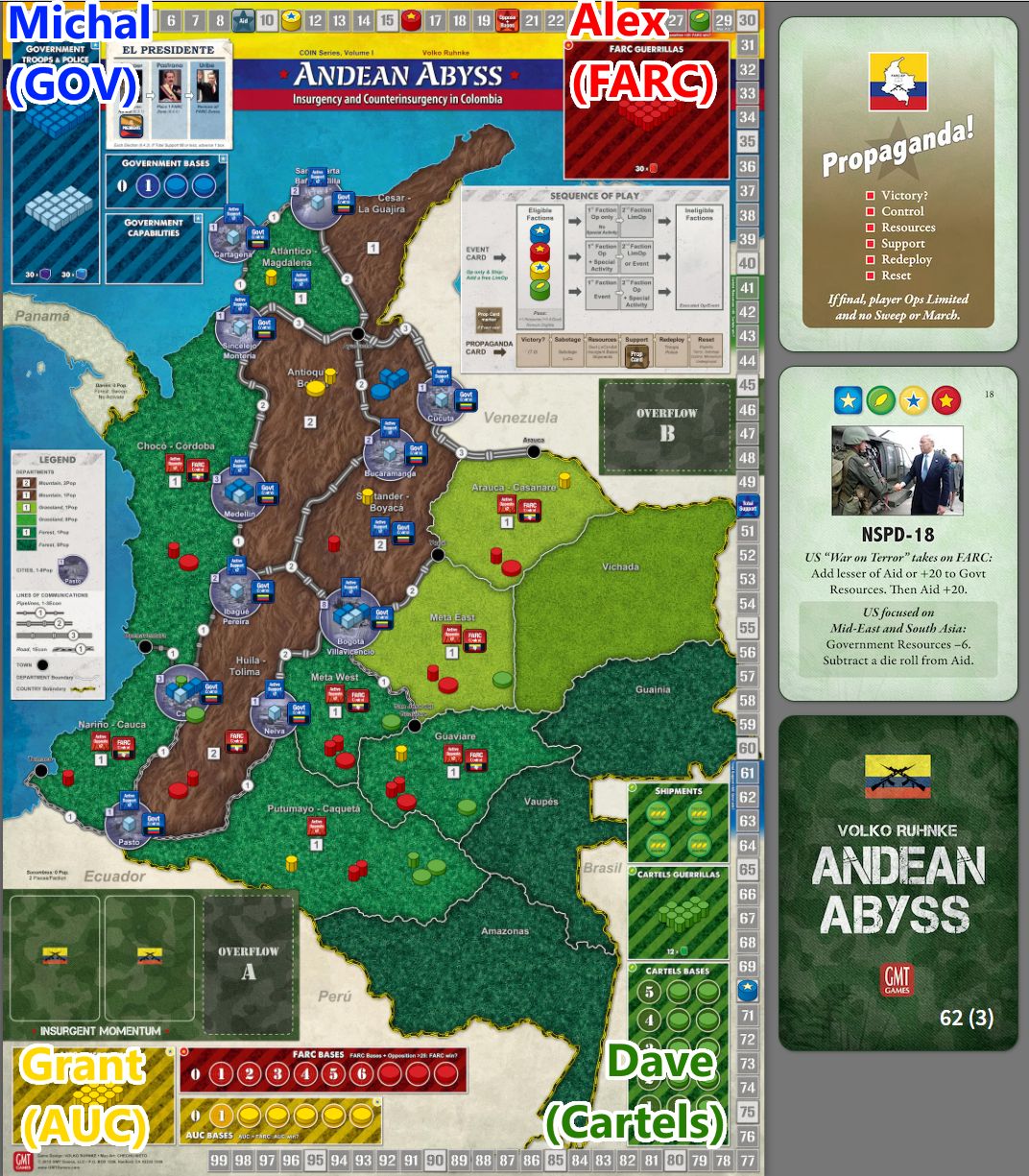

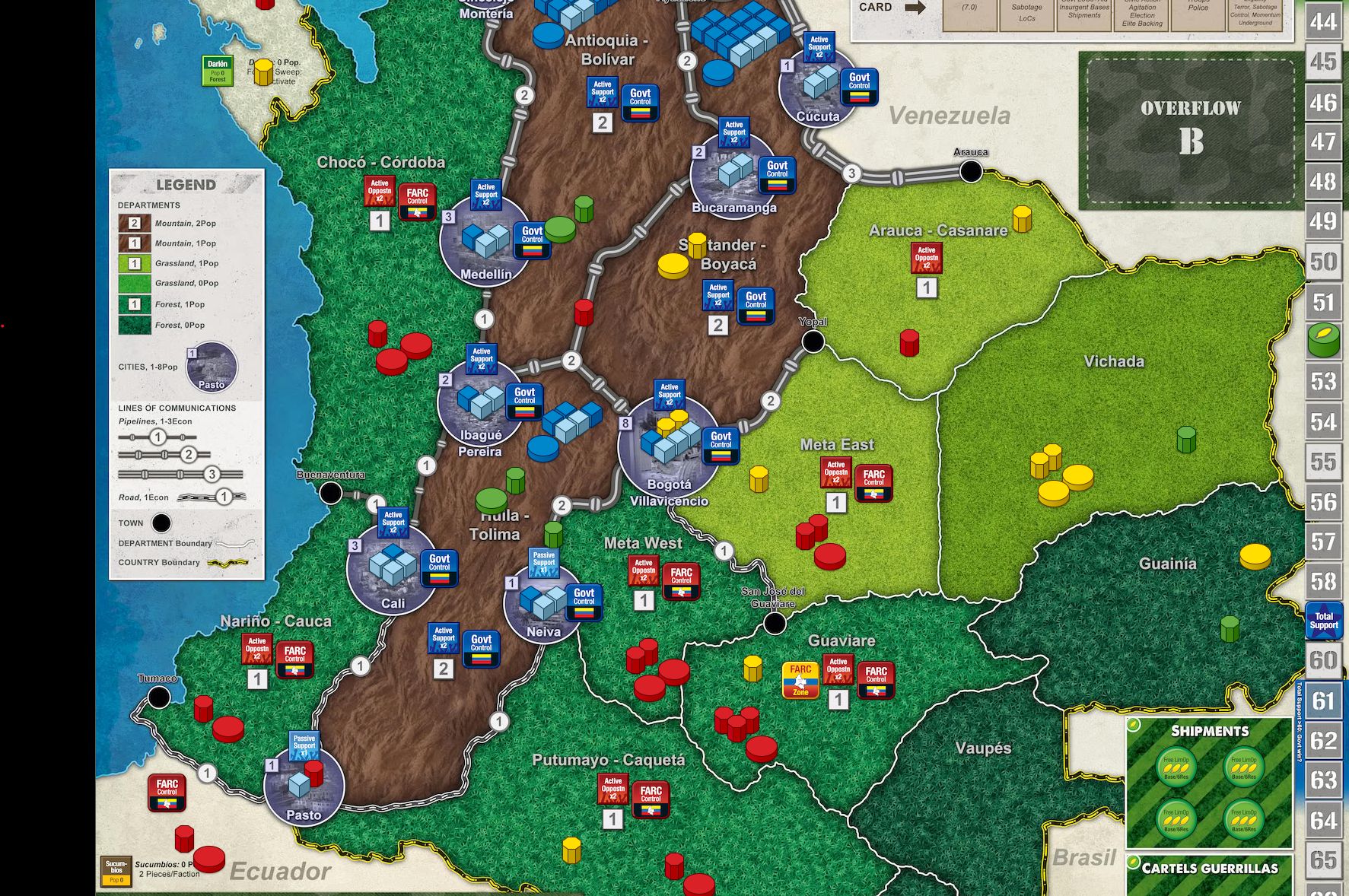
That was a very exciting session which kept in balance till last moments! In the end Alex won by 1 (!) point with my Government. During each of the propagandas somebody was close to victory but always we managed to prevent this from happening. Final results: Alex (FARC) 0, Michal (GOV) -1, Grant (AUC) -3, Dave (Cartels) -7). This is just one of the examples how great that title can be!
As mentioned earlier, we played four sessions and here are all the results just read from up (1st place) to bottom (4th place):
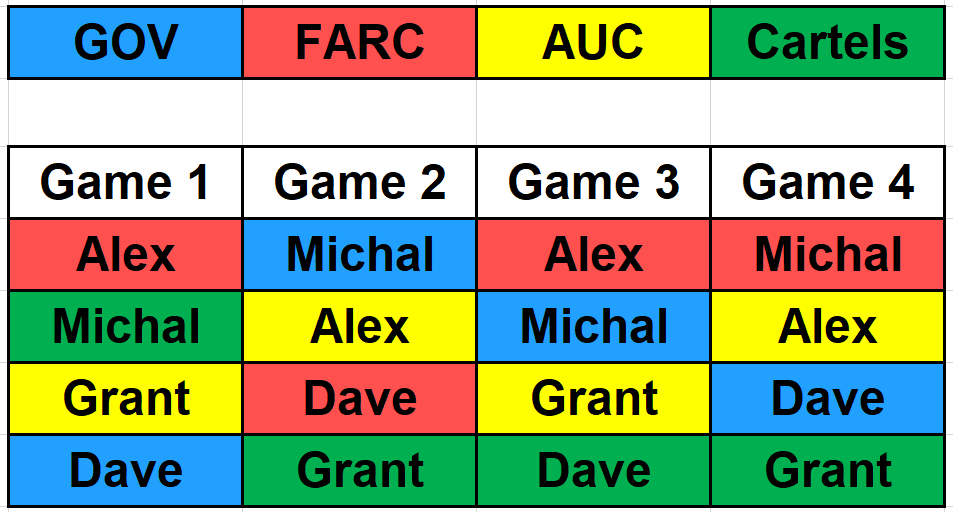
What observations can we make based on this small sample? It seems Cartels are most difficult to play while FARC seems to be easiest to get the victory (3 in above 4 games). Government definitely is hard to manage but if well established (three mountain areas in the middle of the map) it can vie for victory. AUC constantly achieved decent results but always lacked just that last piece.
The Impressions
Let me share now some of my impressions about the gameplay of Andean Abyss on Rally the Troops:
- First things first, accuracy of rules implementation in digital format. Guys, this is perfect – Tor does an excellent job, working directly with designers and publishers, getting quickly direct feedback and implementing fixes.
- Then, the game looks simply astonishing beautiful, with possibility to zoom into areas of interest.
- You are getting full set of materials (Rulebook, Playbook) in digital form within application.
- What I like – and used for above report – is great “review the game” functionality. Here you can analyze the session move by move or turn by turn from the beginning.
- Last but not least, you can play it from PC, laptop, tablet, or phone – very user-friendly and accessible.
Again, if you have not tried yet the Rally the Troops, give it a go – it is worth it! Highly Recommended!
 The Boardgames Chronicle
This was a lot of fun! A COIN game that I had never played before, and other than my first game where I had no idea what I was doing, I didn’t embarrass myself! I didn’t do well, but I felt I understood it a bit more.
I’m still not quite sure how to win as the Government. I kept missing how I was supposed to increase support and just felt like I was floundering.
But that was my first game, so that definitely contributed.
thanks to you, Grant, and Alex!
LikeLiked by 1 person
That was fun and we were both on learning curve of this COIN installment. It has its specifics but I believe after 4 session we grasped it well!
LikeLiked by 1 person