
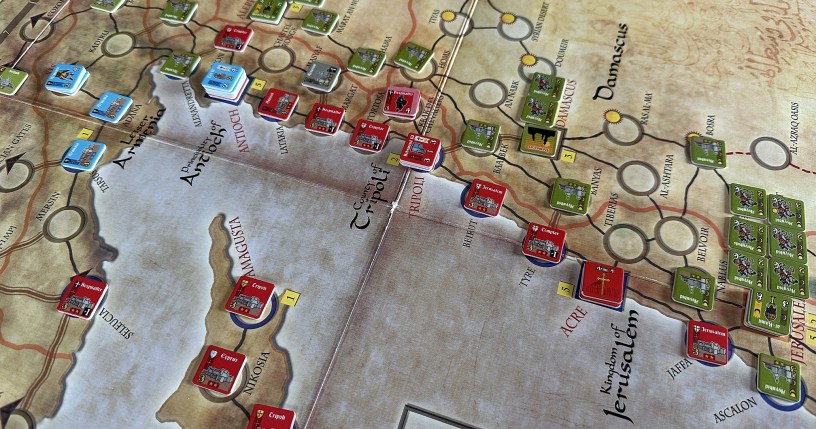
This was already our fifth session with Janek playing Kingdom of Heaven. It is remarkable how much this title has drawn us in and how consistently enjoyable each playthrough has been. The game captures everything we appreciate in board gaming: a strong historical theme, well-designed and suitably detailed rules (especially the sieges), appealing components (once clipped), and excellent use of card-driven mechanics. It also provides valuable historical insight while giving players the opportunity to explore alternative outcomes of events.
Scenarios we played so far:
Kingdom of Heaven – Scenario A – The First Crusade
Kingdom of Heaven – Scenario B – The Second Crusade
Kingdom of Heaven – Scenario C – The Invasion of Egypt
Kingdom of Heaven – Scenario D – The Third Crusade
During our regular monthly board game weekend, we decided to revisit this title. Below, you will find a detailed session report featuring an overview of the game, its historical context, concluding impressions, and plenty of (hopefully enjoyable) photos. Enjoy!
About the Game
In 1097, thousands of lords and knights, soldiers and camp-followers, pilgrims and prophets marched east in response to a Papal appeal, charged with the task of restoring Jerusalem and the Holy Land to Christian control. Their surprising victory led to the creation of the first overseas European colonies and the reshaping of Muslim power in the Middle East. The repercussions of their journey continue to live with us today.
In Kingdom of Heaven – The Crusader States 1097-1291 (KOH) two players use cards to activate forces, trigger random events, conduct diplomacy or prosecute siege warfare on a vast arena stretching from Antioch to Cairo and from Cyprus to Mosul.
Nine scenarios cover all the major campaigns of the era, from the First, Second and Third Crusades to the Mongol invasion and the rise of the Mamluk Empire. In addition to the ‘basic deck,’ each scenario adds different cards representing historical events unique to that campaign. Turns are yearly, and most scenarios can be finished in 3-4 hours.
Historical Scenario Background
Before jumping into the session report, let us talk a bit about the Scenario E – The Fifth Crusade – and its historical background. For me this is first and foremost a lesson in history, and the game allows me to reshape it or even change completely.
The Third Crusade had halted Muslim expansion in the Holy Land, but Jerusalem was still in enemy hands. After several small-scale attempts to recapture the city fell through, it fell to Pope Innocent III to proclaim a new Crusade in 1198. Scornful of secular powers, Innocent felt that the Fourth Crusade should properly be free of all influence by powerful monarchs. It was also secretly decided that Egypt, as the center of Muslim power in the Near East, would be the target rather than the hard-to-defend Jerusalem.
Many lesser lords joined the Crusade but in smaller numbers than had been expected. Thus, when Venice demanded the fee earlier agreed upon for transporting the army, there was not enough money to pay. The Crusaders were between a rock and a hard place. Long story short, the Venetians used their leverage to redirect the Fourth Crusade to Constantinople, capturing that venerable city in 1204 and creating a short-lived Latin Empire in the Balkans. Meanwhile, there was still no help for Palestine.
Undaunted, Innocent in his bull Quia maior launched a Fifth Crusade in 1217 to accomplish what the Fourth did not, and capture Egypt. He still refused to ask the secular monarchs to participate, but he had at least learned the importance of secure finances and undivided leadership. This Crusade would be paid for by the Church, transported by Frisian ships instead of the mercenary Venetians, and led by a papal legate, Pelagius. Innocent died in 1216, but his plan remained to be carried out by his successor, Honorius III. In addition, the Sultan of Rum, Kaikhaus, promised to invade northern Syria and distract the Ayyubids at the crucial moment. With the full resources of Mother Church behind it, the Fifth Crusade could not fail.
Set-Up
With the background done, let us now look at the scenario set-up. For this, we will need to cover several aspects.
Scenario Length: 1217-1221 (five turns)
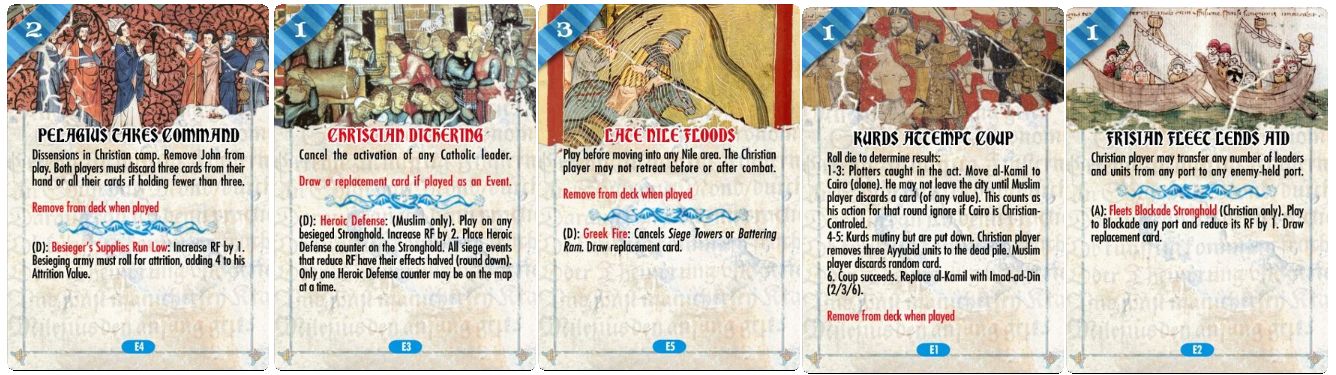
Scenario Cards Used: E1-E5 – those cards provide special historical events, specific to the scenario, which enhance the basic deck.
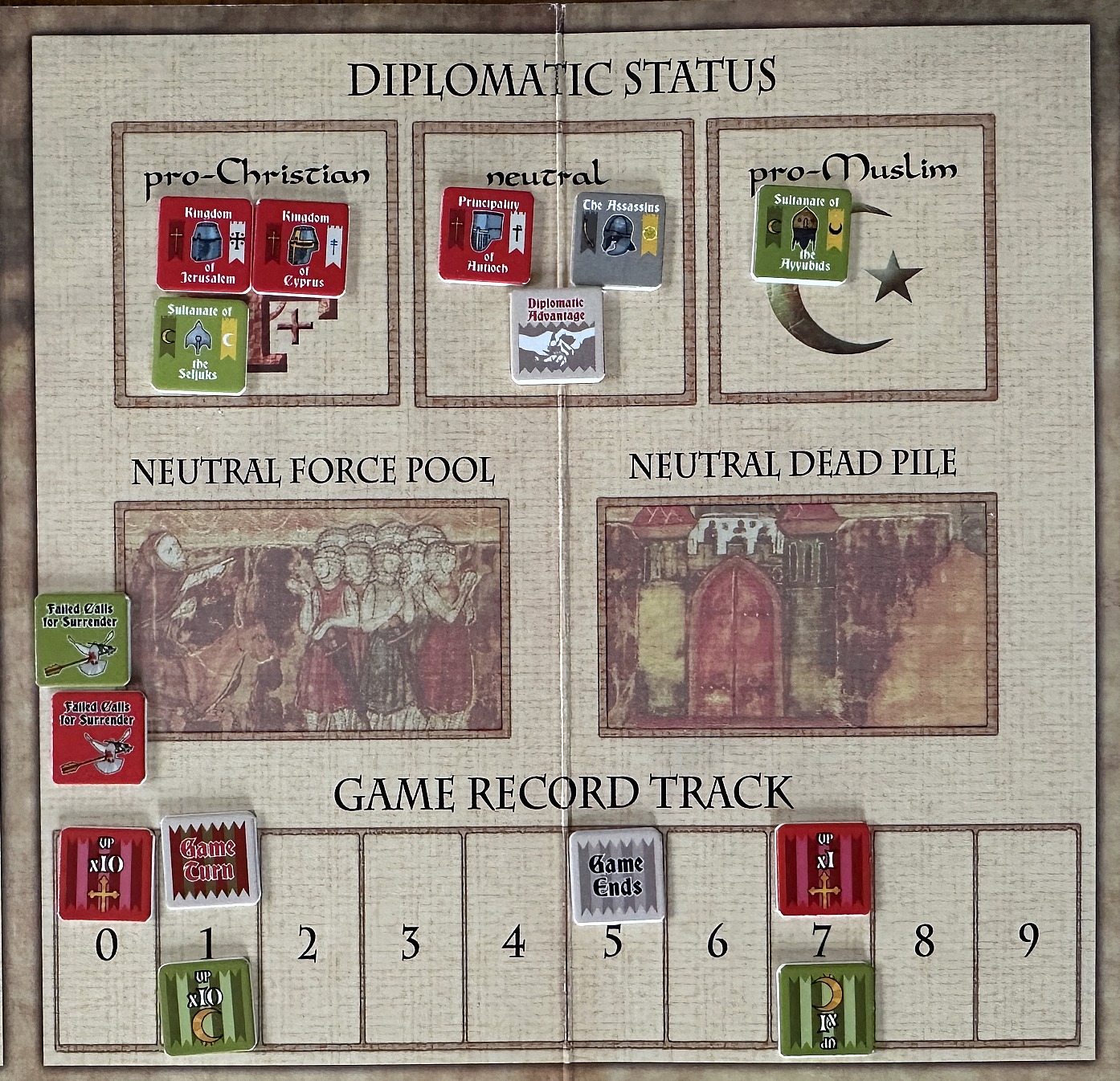
Powers and their initial alignment – some might be influenced during the game:
- Pro-Christian: Seljuk (!!!), Crusaders, Kingdom of Jerusalem, Kingdom of Cyprus, Templars, Hospitallers
- Pro-Muslim: Sultanate of the Ayyubids
- Neutral: Lesser Armenia, Assassins, Principality of Antioch
Special Rules:
- The Cypriot leader Hugh must be demobilized at the end of Turn. Thereafter, he must muster each turn in Cyprus. Simply use his in turn 1 or do not use at all…
Victory Conditions:
- Christian Victory: Christian Player has 12 or more VP and Cairo or 13 VP without Cairo (starts with 7 VP)
- Muslim Victory: Muslim Player has 17 or more VP (starts with 17 VP, needs to keep Status Quo)
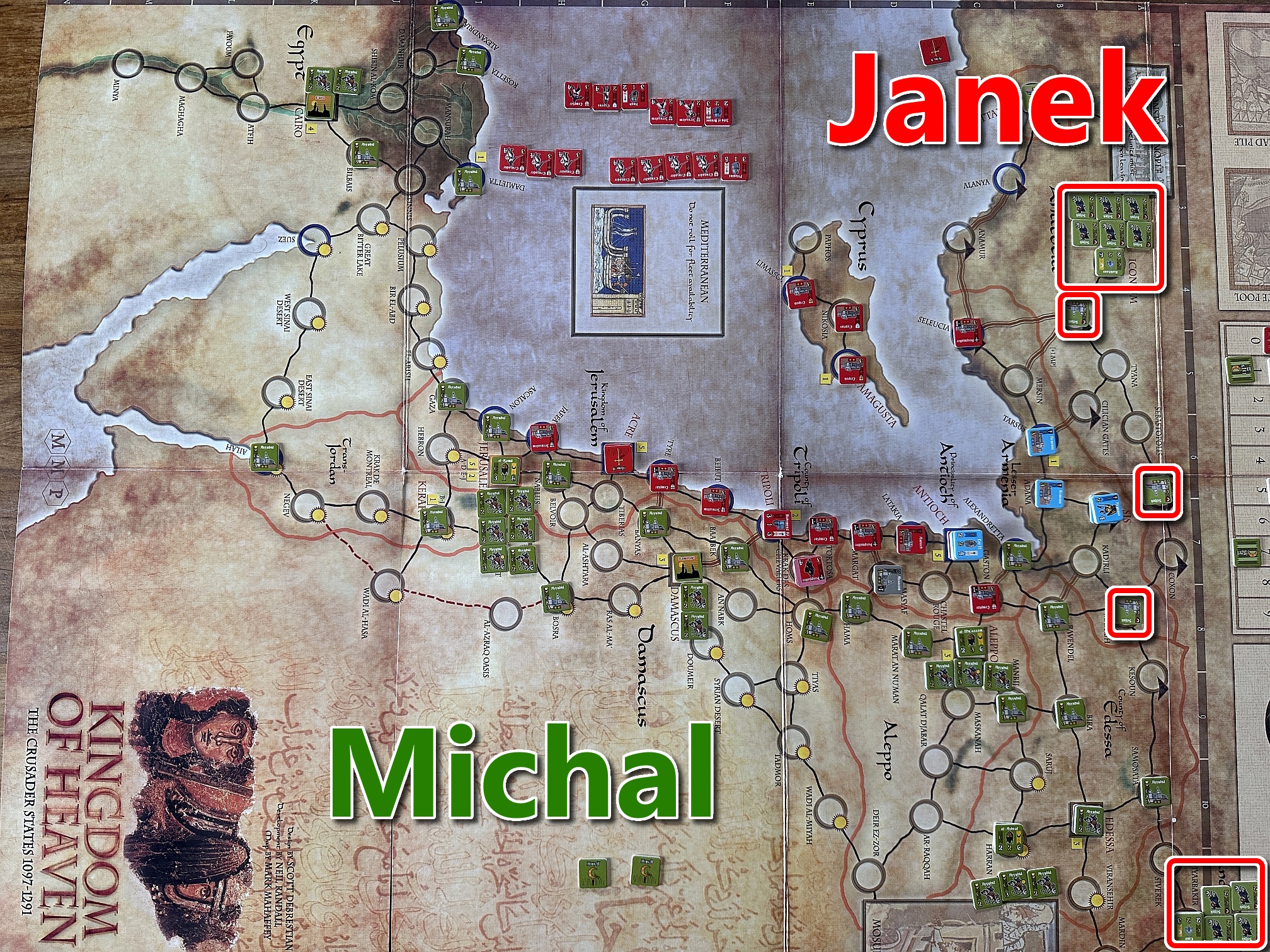
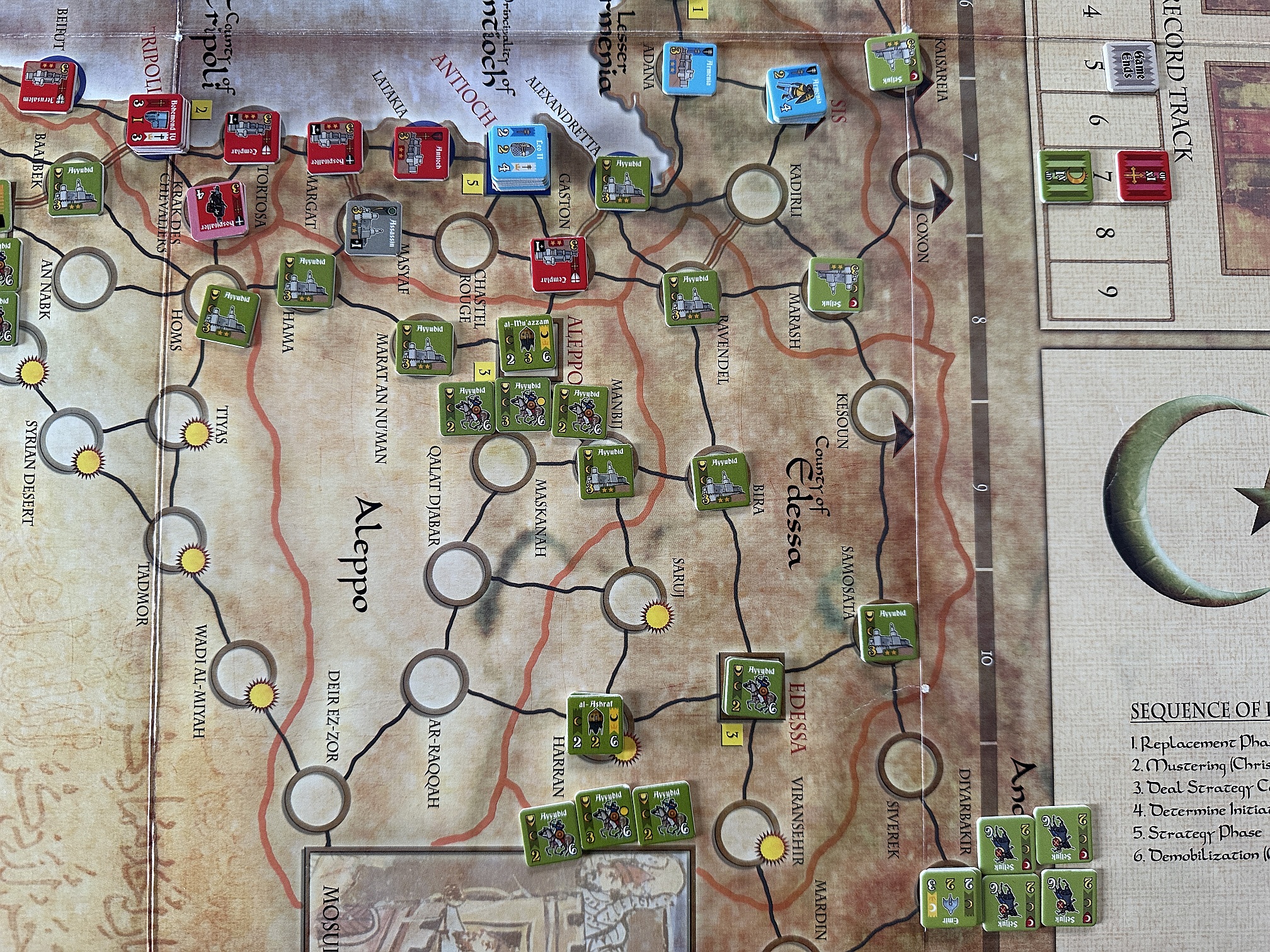
And of course, the initial Map and Forces:
Session Report
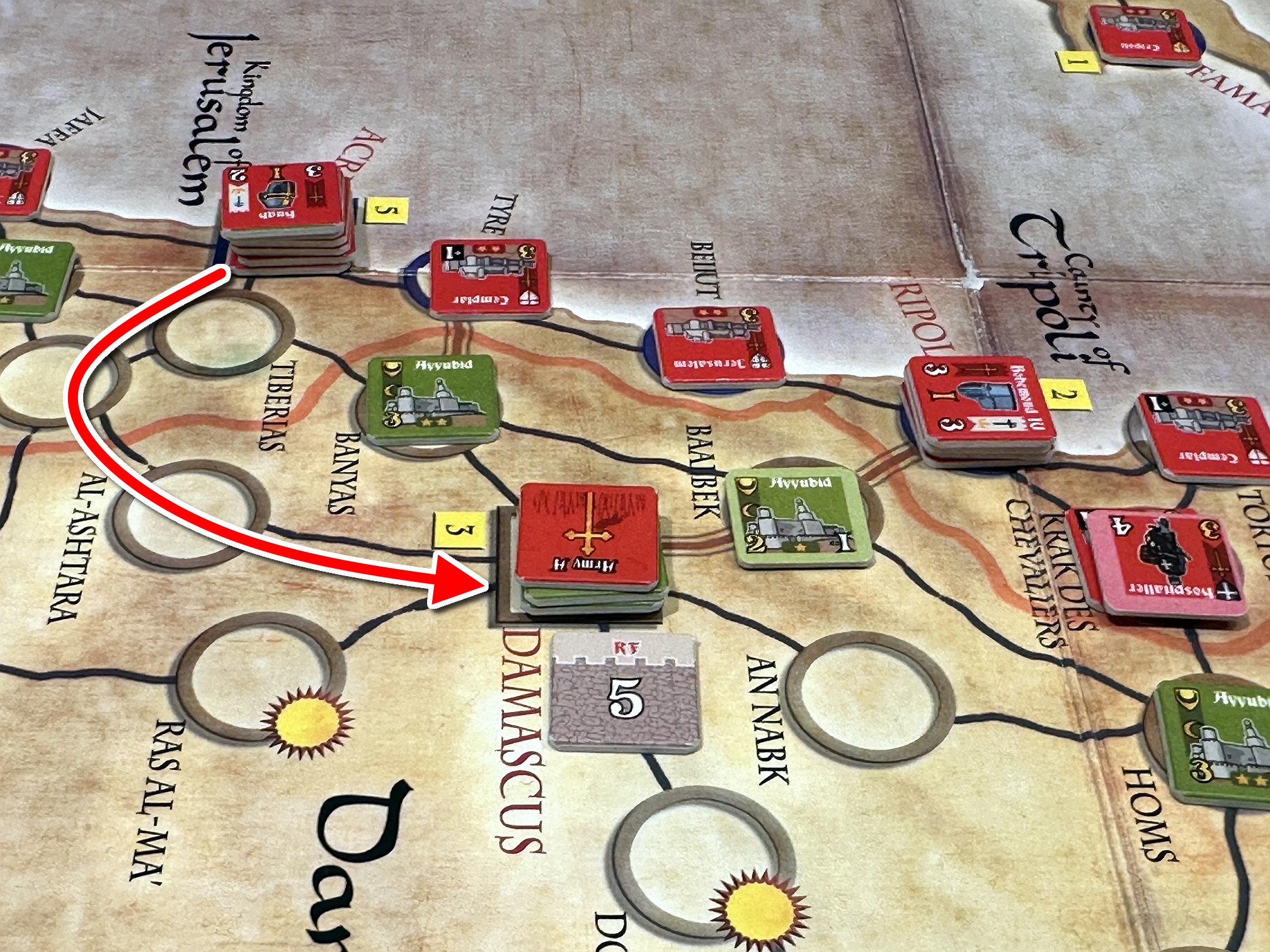
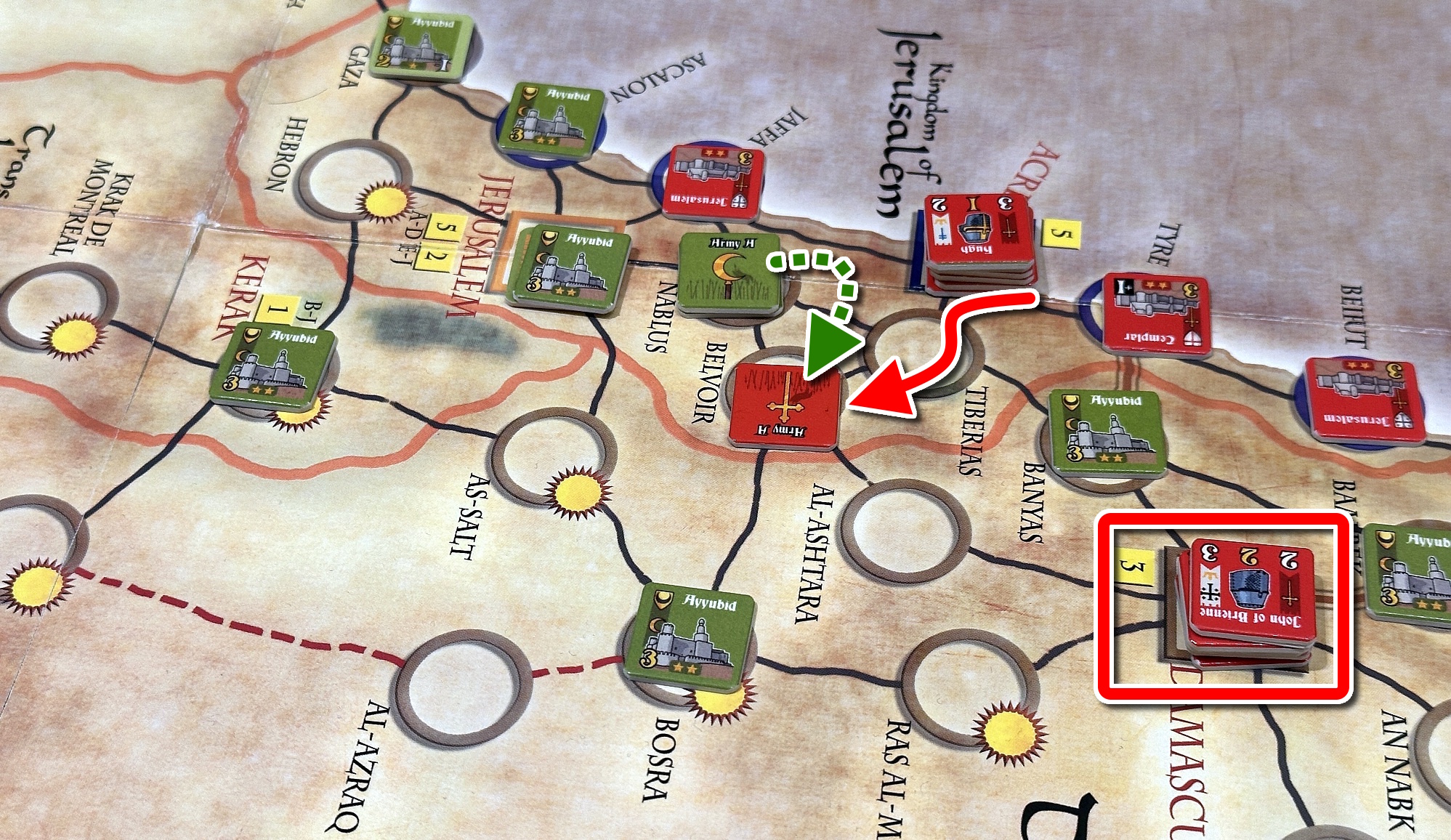
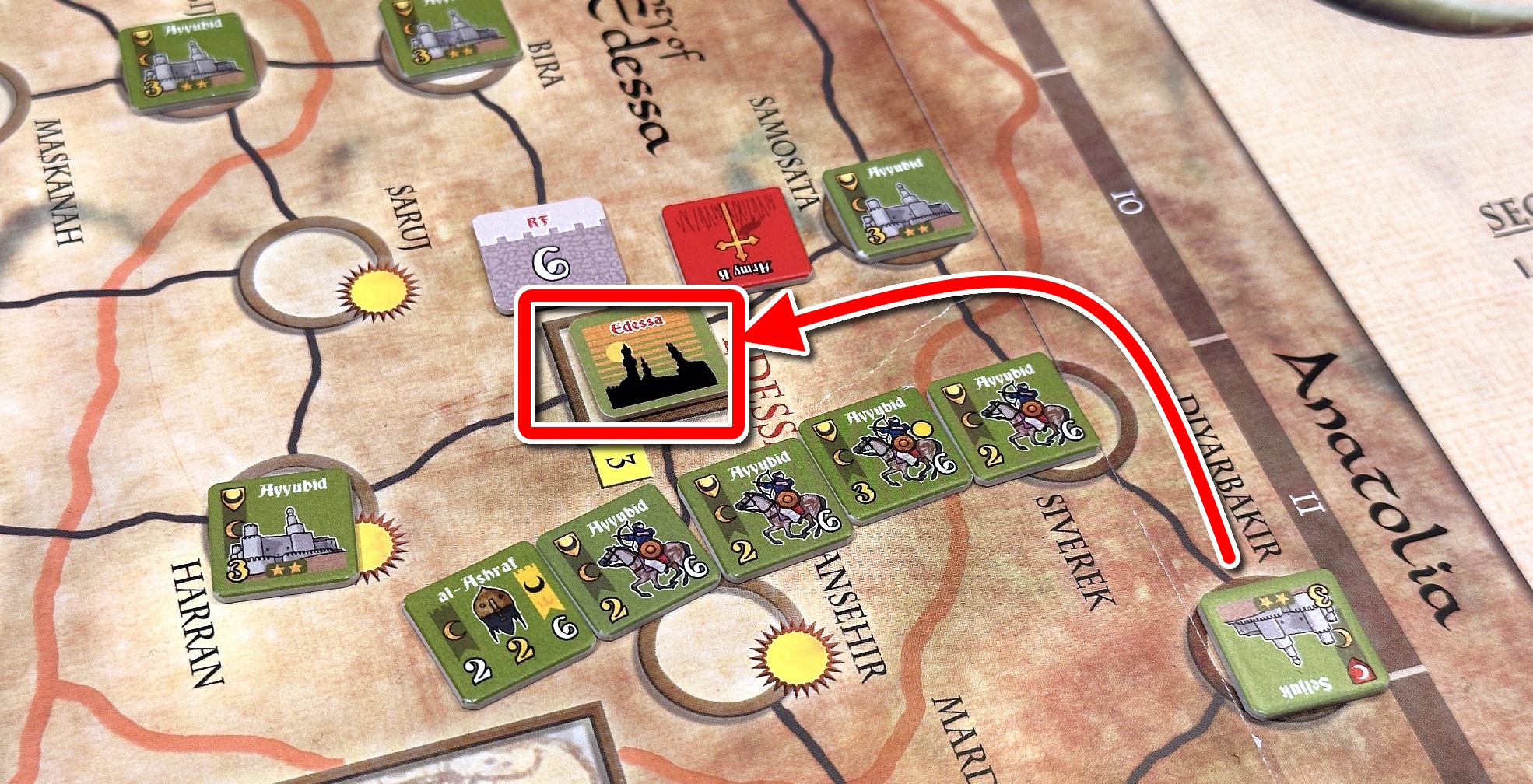
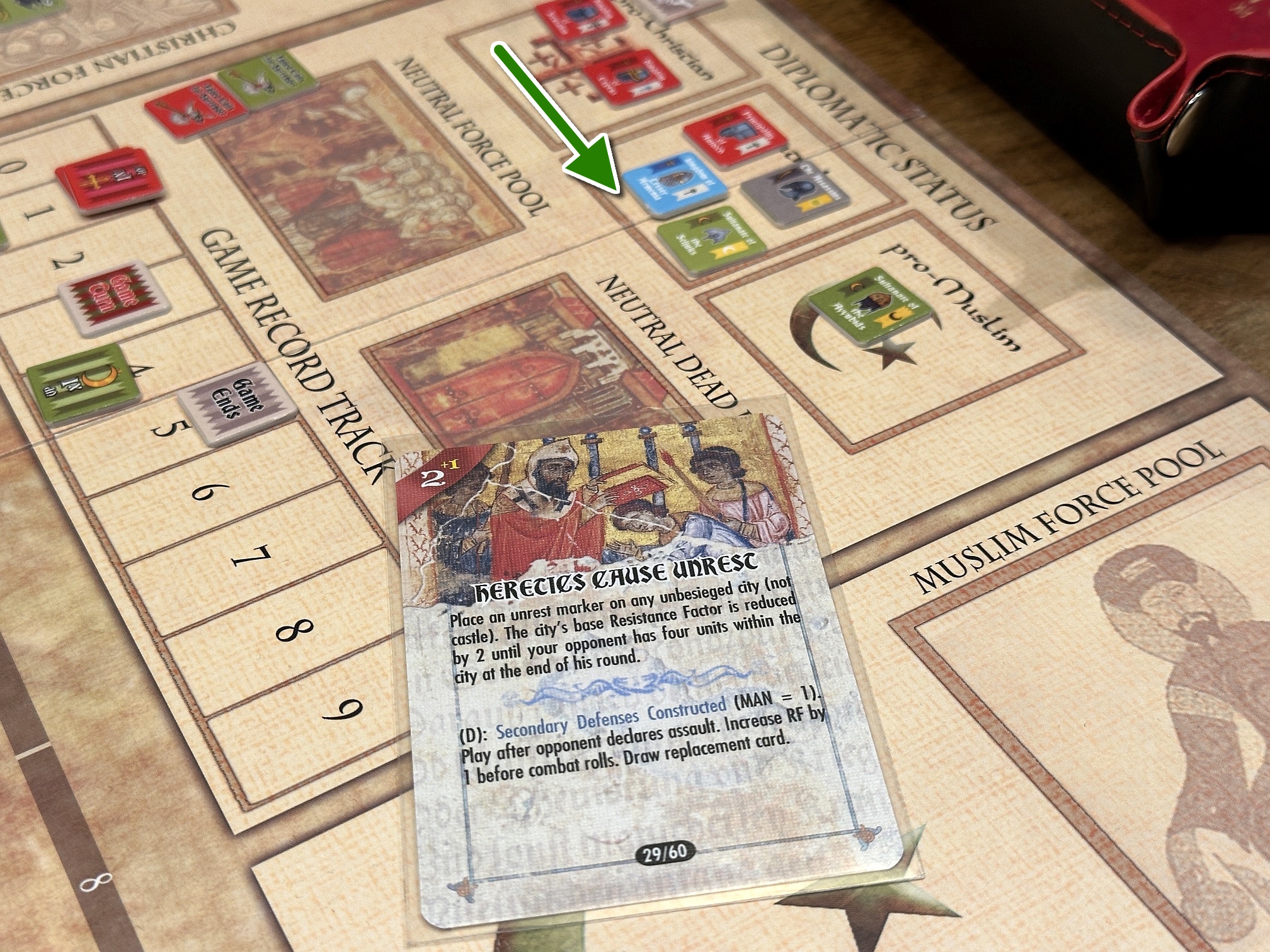
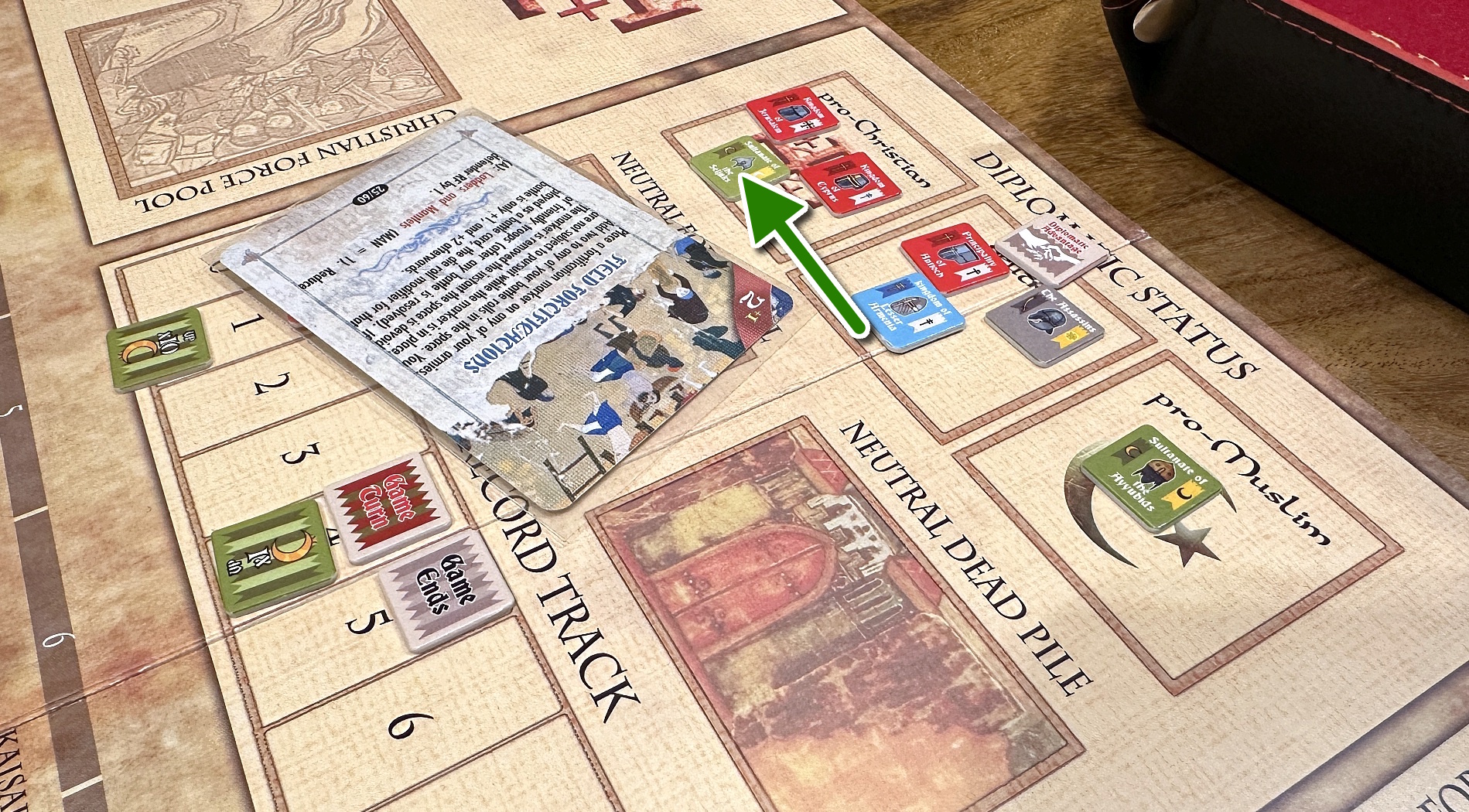
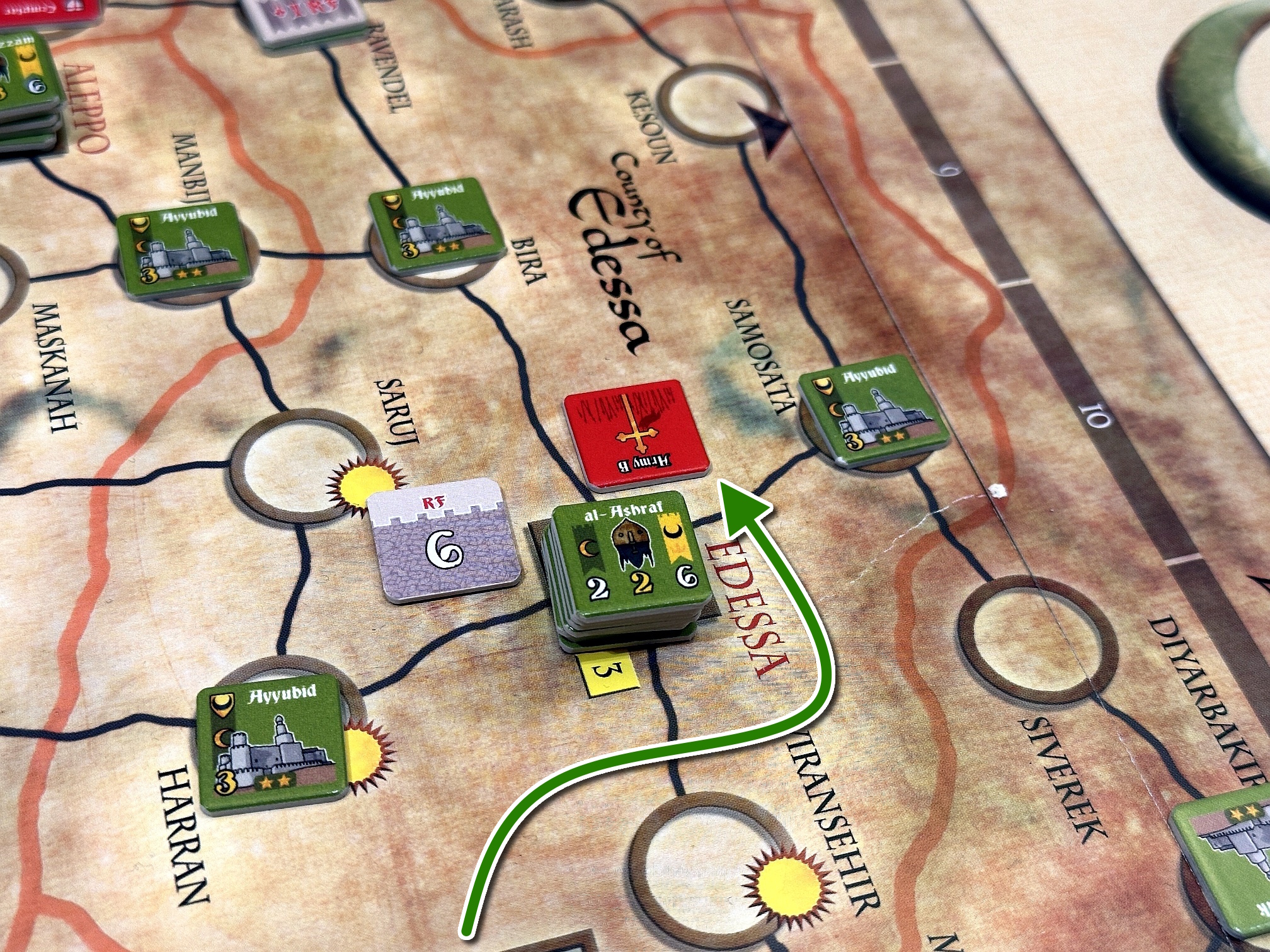
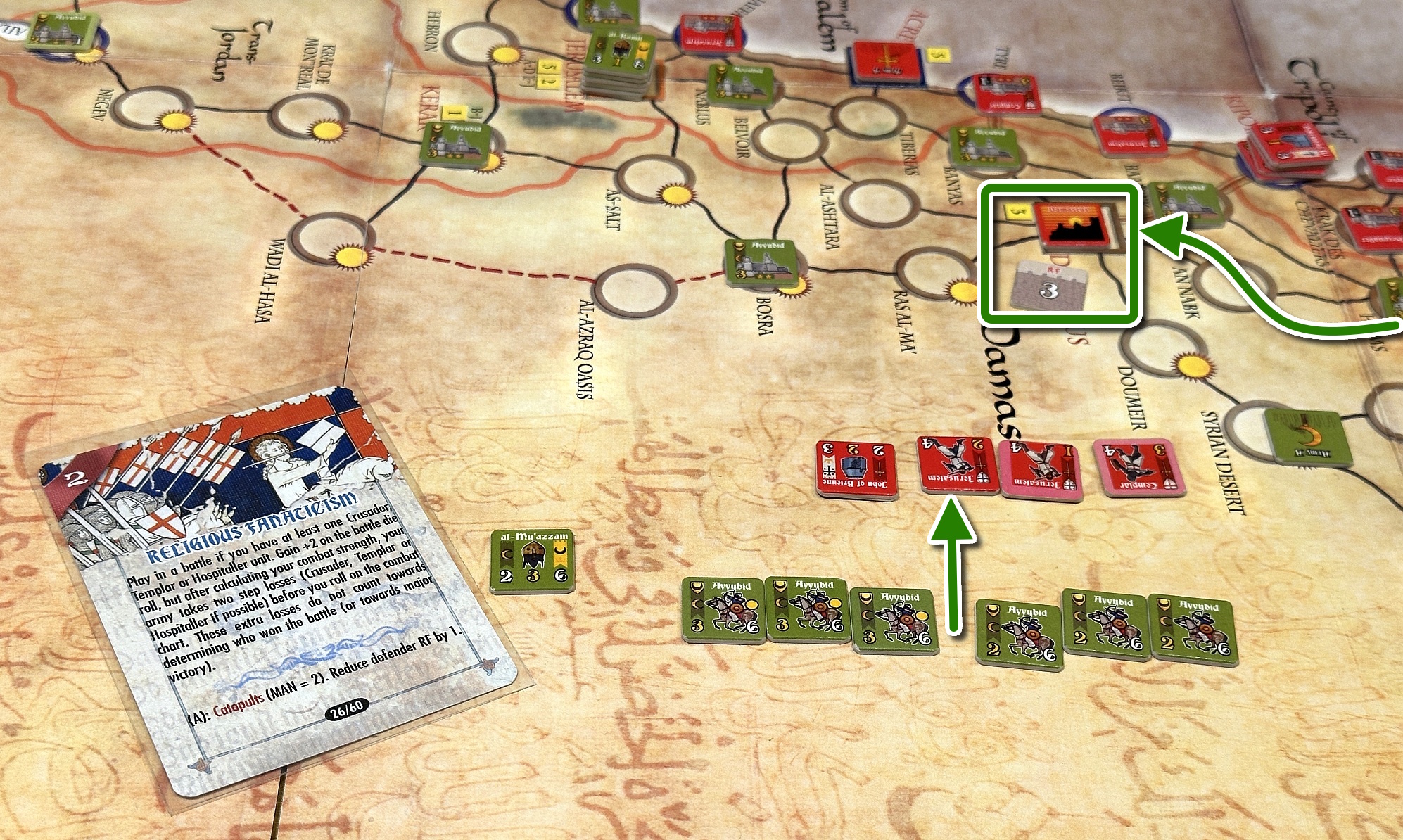
It was already fifth session with this game so it is obvious we were very well prepared rules-wise and simply, experienced with core mechanics. There was not so much looking up of the rules but more focus on strategy and tactics. Was it fun to play? Oh, definitely – probably the most exciting scenario played so far!
Our Session Conclusion
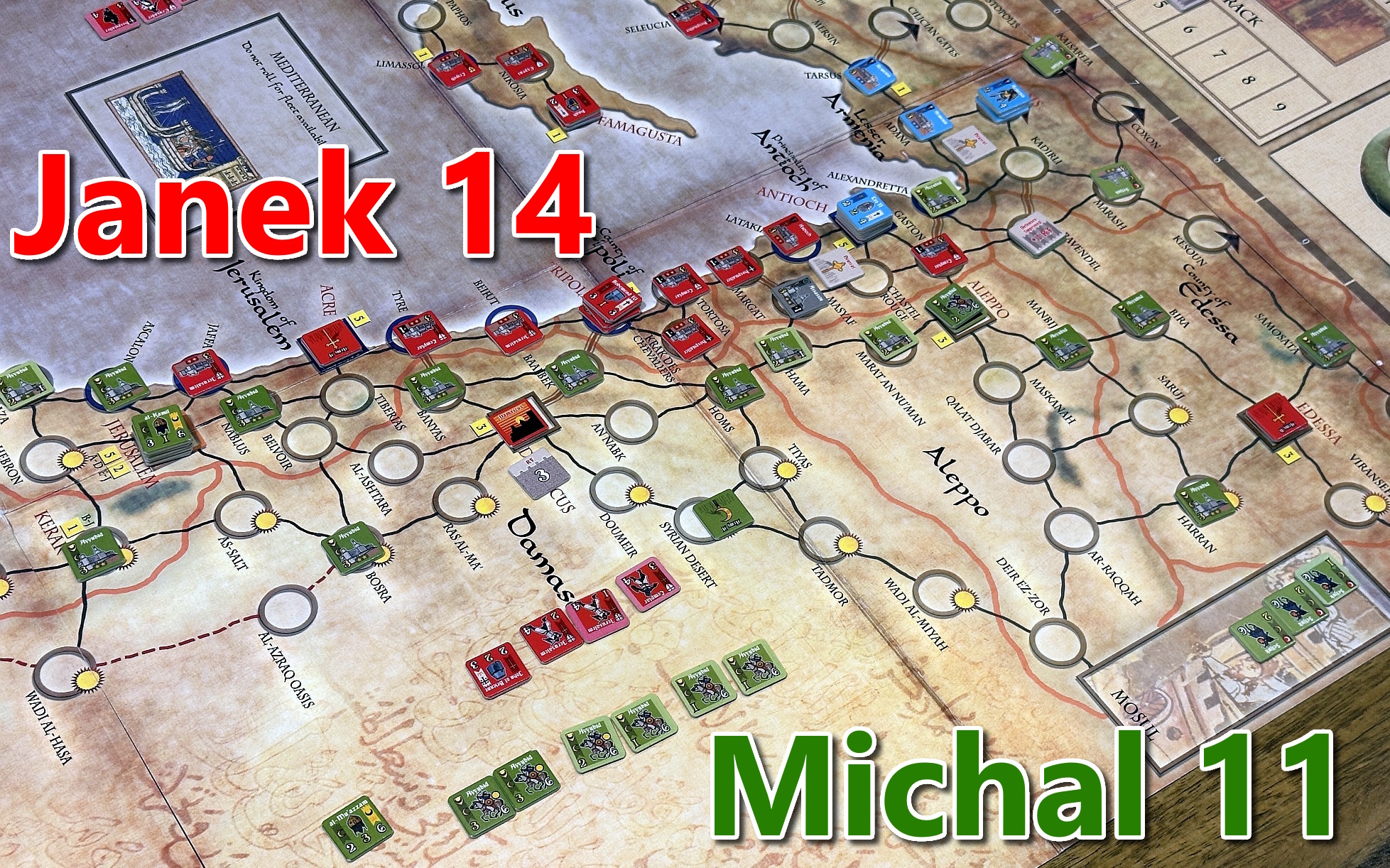
After about 4 hours of play the game ended in Christian victory. What and exciting session it was, full of the twists and turns!
Historical Conclusion
And how did it ended historically? I believe we all know, but why not to sum it up in a nice manner 🙂 So this is what happened:
Gathering at Acre, the Crusaders first moved against Nablus and Damascus, since the ships to transport them to Egypt had not arrived, but with little result. In 1218 the assembled Crusaders and allied forces took ship for Damietta. The defenders of that town fought heroically and many months were worn down besieging it. Meanwhile, Kaikhaus’ vaunted diversion in the north accomplished little, although it did tie down Ayyubid troops. Eventually Damietta fell in 1219, but the Crusaders continued to wait, hoping that Emperor Frederick II, who had vowed to go on Crusade, would show up. He never did.
Waiting was also fine by Al-Kamil, the new Sultan of Egypt, who feared the Crusaders and knew he was weak. He offered to return all the lost territory of the Kingdom of Jerusalem west of the Jordan, and throw in a cash ransom and the True Cross besides, but the Crusaders haughtily refused. Eventually, papal legate Pelagius took command, and John, king of Jerusalem, recognizing a doomed cause when he saw one, left in a huff.
Confidently the army marched down the banks of the Nile, whose flood was long-delayed, in the summer of 1221. They met up with the Sultan’s army at Mansurah. Kamil had been joined by his brothers, and when the Nile Flood finally rose, he broke all the sluices and caused the Christian army to be cut off from retreat. The Sultan offered the Christians their freedom to go home if they left Egypt and returned Damietta. For once, they did the smart thing and accepted. Thus ended the ignominious Fifth Crusade.
Summary
This was by far the most exciting Kingdom of Heaven scenario we played to this date. The fate of Seljuk Turk, who initially supported Crusaders, then switched to Ayyubids only to betray them again in crucial moment, was a great story to tell, The attacks and counter-attacks from both sides, sieges, storms and fateful events – this all added up to a very interesting narrative. We will continue further as Mongols are soon to appear in the Middle East!
More reports to come!
 The Boardgames Chronicle