
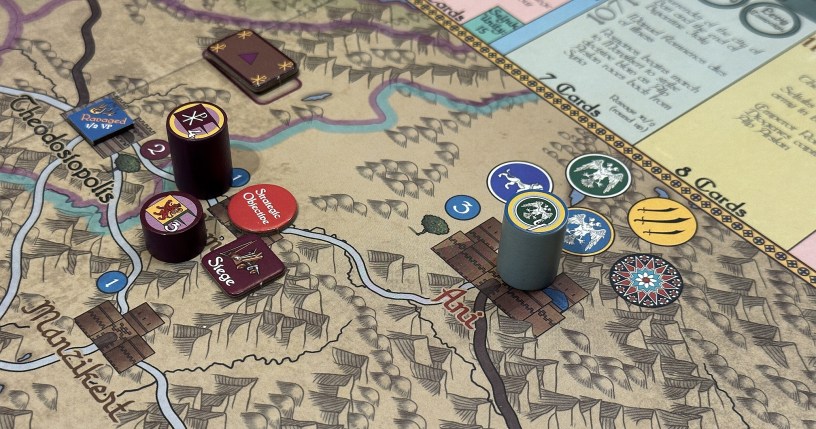
I must say I was anxiously anticipating publication of the fifth game in Levy & Campaign series. First of all, we come back to the roots of the system, with difficult supply situation, sieges, storms and sally – all of them being brutal affairs, with defenders having advantage almost always. Secondly, the topic & theme – I am fan of Rome and its continuation in the East – Byzantium. So seeing for the first time title touching this topics and that geographic area I knew I want this game.
Now, after several longer and shorter plays of this great position I can share my impressions (probably more than only first ones 🙂 ). I will do it of course presenting the actual session reports, bringing some historical context as well as briefly introducing the series and the actual game. So let us start!
Other Seljuk Materials:
- First Look at Seljuk
- Interview with Justin Fassino, designer of Seljuk
Game & Series Overview
Levy & Campaign series is quickly becoming one of the fastest developing genres of GMT Games. This is to large extent thanks to Volko, who managed to build a group of devoted designers, developers and simply enthusiast. That allows for simultaneous development of couple of projects, exchange of opinions, testing, etc.
The volumes in this series share similar core systems simulating medieval Levy of armies by individual great Lords and lesser Vassals, equipping of those armies with transport such as Carts and special Capabilities such as crossbowmen, trebuchets, or stonecutters, to name a few. For each Campaign, players then form stacks of Command cards to preset the order that Lords will March, Forage, Siege, and so on. Logistics are key, as Provender must be gathered and moved to Feed Troops in the field or suffer curtailed Lords’ Service and Disband.
But each installment of the series features widely different geographic, cultural, and political settings, each with twists on the core rules to help bring out these differences. In Seljuk: Byzantium Besieged, 1068-1071, already 5th title in the system, we are moving to XI century Anatolia where we will witness a clash between Eastern Romans and Seljuk Turks, leading to the famous battle of Manzikert. Let us see how it all started!
Historical Background
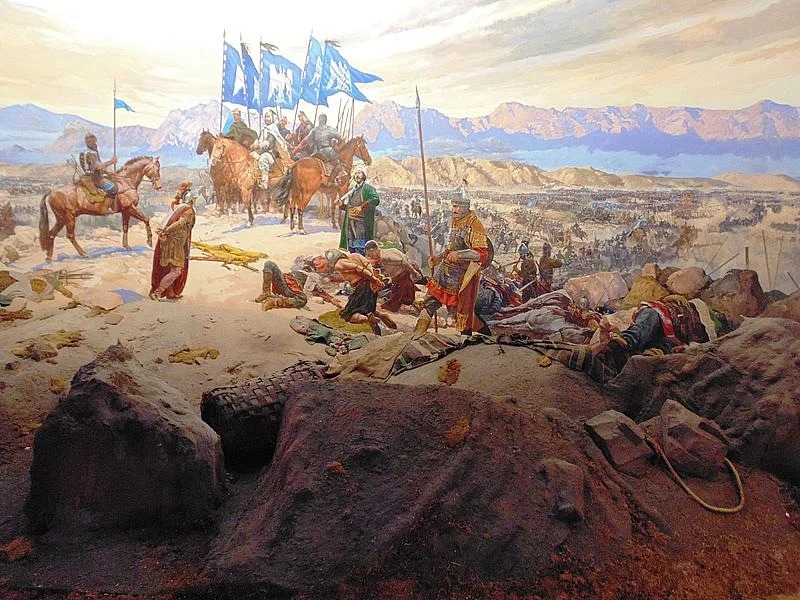
Romanos IV Diogenes rose to the throne in 1068 during a time of severe military and political crisis, and he devoted his reign to trying to halt the advance of Turkic forces under Sultan Alp Arslan. Alp Arslan, meanwhile, was expanding Seljuk power westward, capturing key fortresses such as Ani and later Manzikert, while also dealing with internal challenges from rivals like his brother Qavurt. Romanos launched repeated campaigns across Anatolia to secure the frontier, but Seljuk raiders – often led by commanders like Afşin Beg – outmaneuvered him and inflicted heavy damage on Roman territory.
In 1071, Romanos assembled one of the largest Roman armies in years for a decisive strike against Alp Arslan, unaware that his detached forces had already been driven off and leaving him far weaker than he believed. At Manzikert, Alp Arslan skillfully used mounted archers and tactical retreats to tire and disorganize the Roman army before launching a final assault after part of Romanos’ forces betrayed him. Romanos was captured alive and treated honorably by Alp Arslan, but after his release he was overthrown by the Doukas family, blinded, and died shortly afterward. The aftermath of their confrontation opened Anatolia to permanent Seljuk settlement and marked a decisive turning point in the decline of the medieval Roman Empire.
Session Reports
Playing game extensively gives you a lot of insight into its mechanics and concepts. And when it is yet another title in the series, the entry effort is limited, as you need only to catch-up with the new mechanics. As every game in the series, Seljuk comes with many smaller and larger scenarios, allowing you to fully appreciate both brief engagements as well as long, multi-year campaign. This game is also very solo friendly, so as you shall see below, some of the reports will be for solitaire play.
Enjoy the reports! PS. Remember you can expand on click each picture.
Scenario C.
Year of Treacherous Ambition (1070 AD, 3 turns)
Unavailable to campaign in person due to political maneuvering in Constantinople, Emperor Romanos assigns Manuel Komnenos the title of protostrator and command of the Roman armies with one mission: stop the Turks from ravaging eastern Anatolia.
Victory: The Seljuks win automatically if they have conquered Aleppo during any Winter Phase check after Aleppo Independence Event has been revealed. The Romans win immediately if Alp Arslan is permanently Disbanded. Otherwise, whichever side has more VPs at the end of Winter 1070 is victorious. In addition to normal VP rules:
- the Seljuks score 1 VP each for reaching Ikonion and/or Western Anatolia with a Lord,
- and the Romans score 1 VP if Arisighi switches sides.
- At the end of Winter 1070, both sides score one additional VP each for control of Manbij, Edessa, Khliat, and Manzikert.
Let us see how our introductory game went!
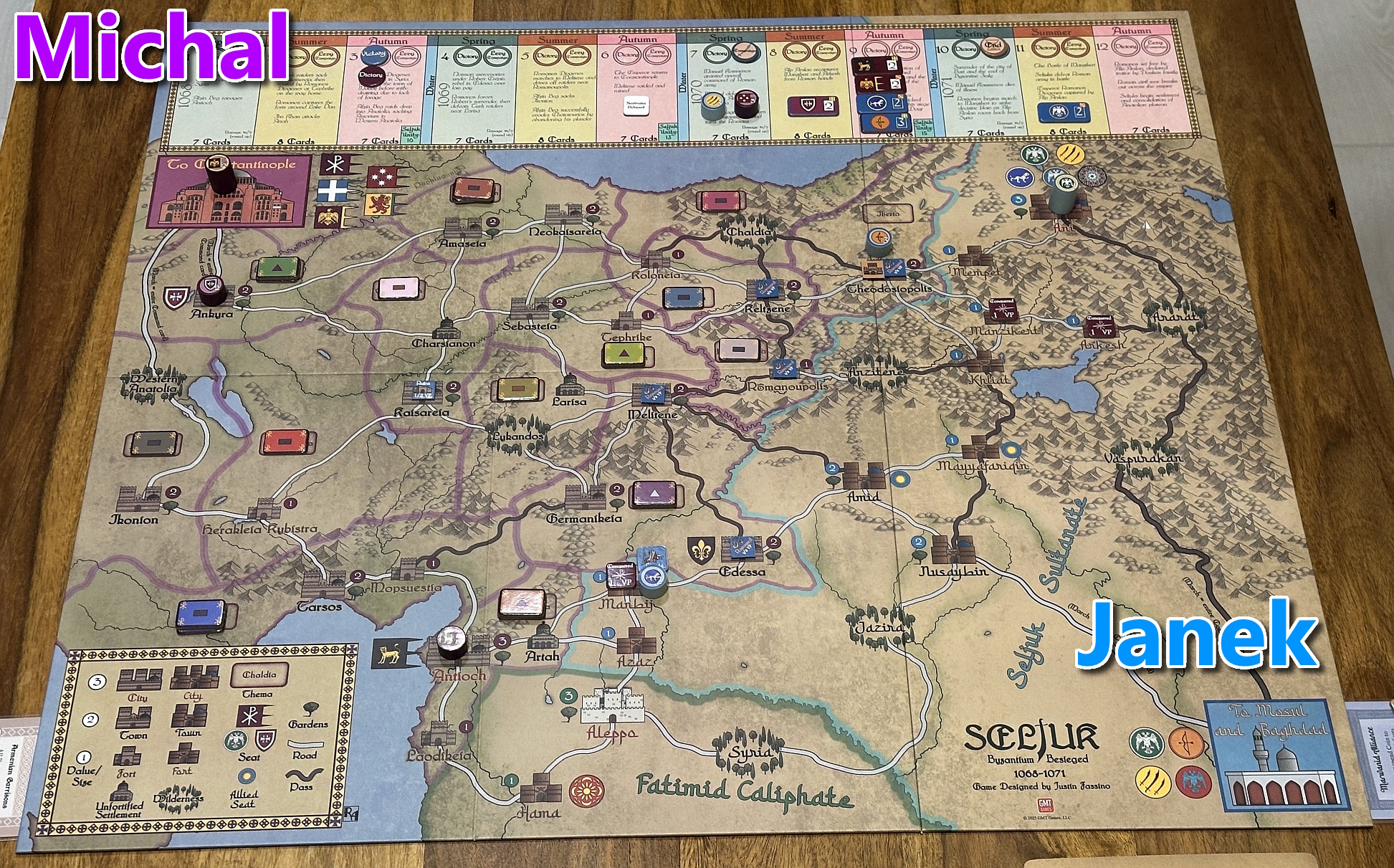
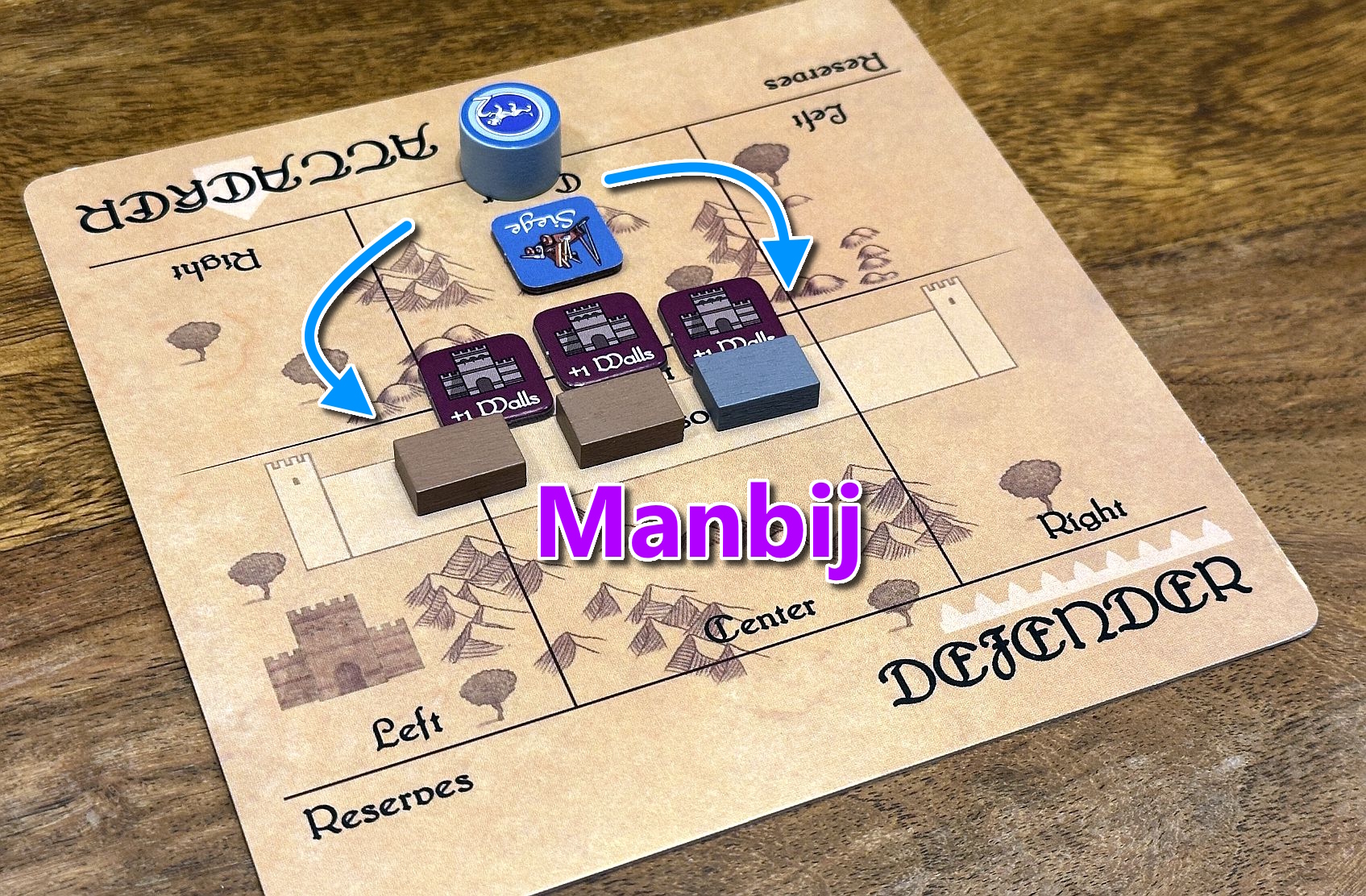
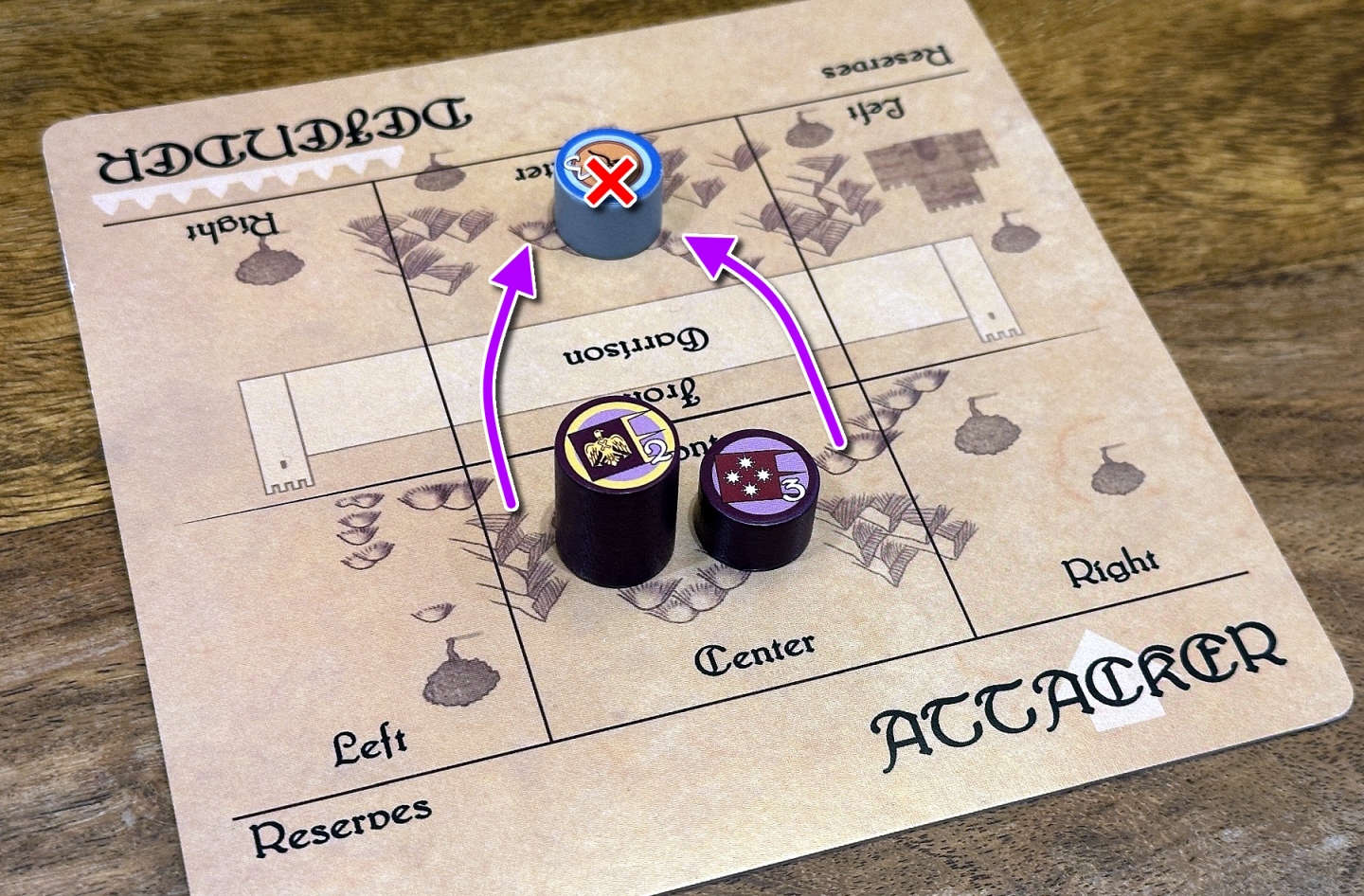
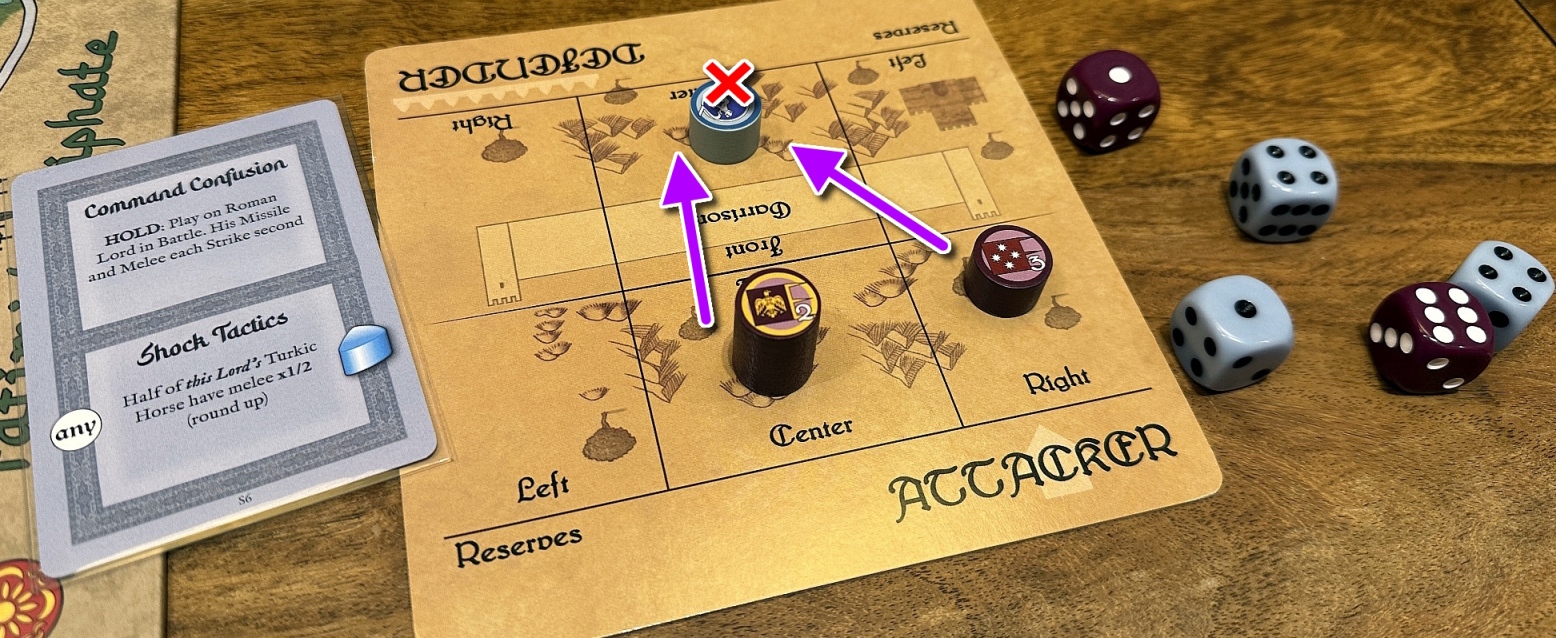
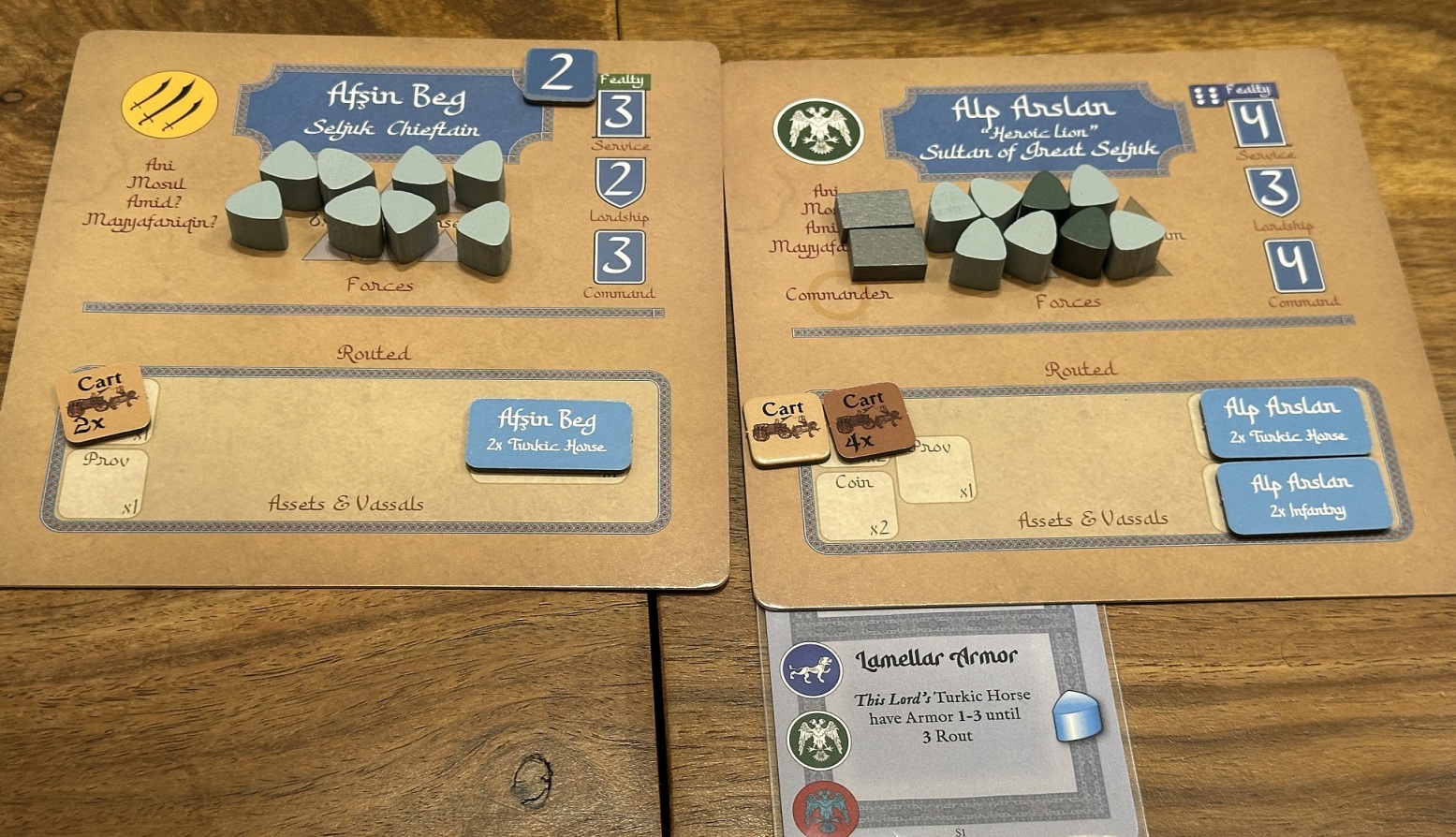
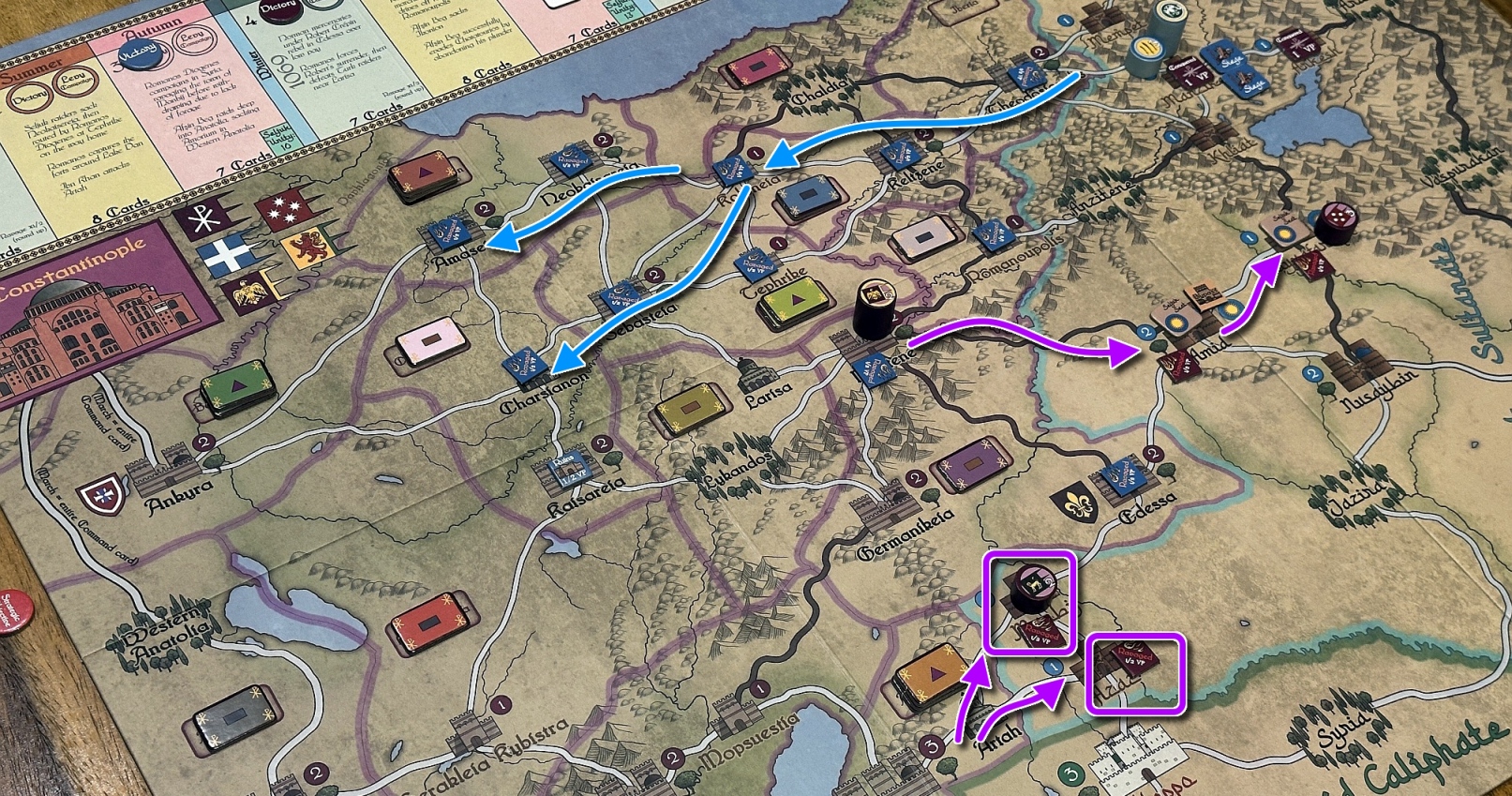
Summary: That was fun introductory session to play. We have experienced raids, storms, battles, we learned the rules (first Levy & Campaign game for Janek) and appreciated the design. The victory conditions were a bit artificial but this is normal in short scenarios and honestly, the final result (4-3 to Romans) is of secondary importance. The good things was that we both were hooked by the game and wanted more!
Scenario E.
Manzikert: The Fall of the Roman East (1071 AD, 3 turns)
As the Emperor assembles a massive multi-ethnic army from all corners of the empire, the largest seen in Anatolia in nearly a century, Alp Arslan and the military might of the Seljuk Sultanate is focused squarely on Aleppo and taking the city from the Fatimid Caliphate once and for all. But when Romanos breaks a previously agreed-upon truce with the Sultan and marches toward the eastern frontier around Lake Van, Alp Arslan rushes home to confront the Romans for one final climactic engagement.
Victory: The Seljuks win immediately if Romanos IV is permanently Disbanded, or Aleppo is Seljuk conquered at the end of Autumn 1071 (Aleppo Independence is considered to have been revealed). The Romans win immediately if Alp Arslan is permanently Disbanded, or Manzikert and Khliat both contain Roman Conquered markers and Aleppo is not Seljuk-conquered. Otherwise, whichever side has more VPs at the end of Autumn 1071 is victorious. Both sides scores 1 VP for each permanently Disbanded Lord of their opponent.
That sounded like intense scenario with significant decisions to be made early on!
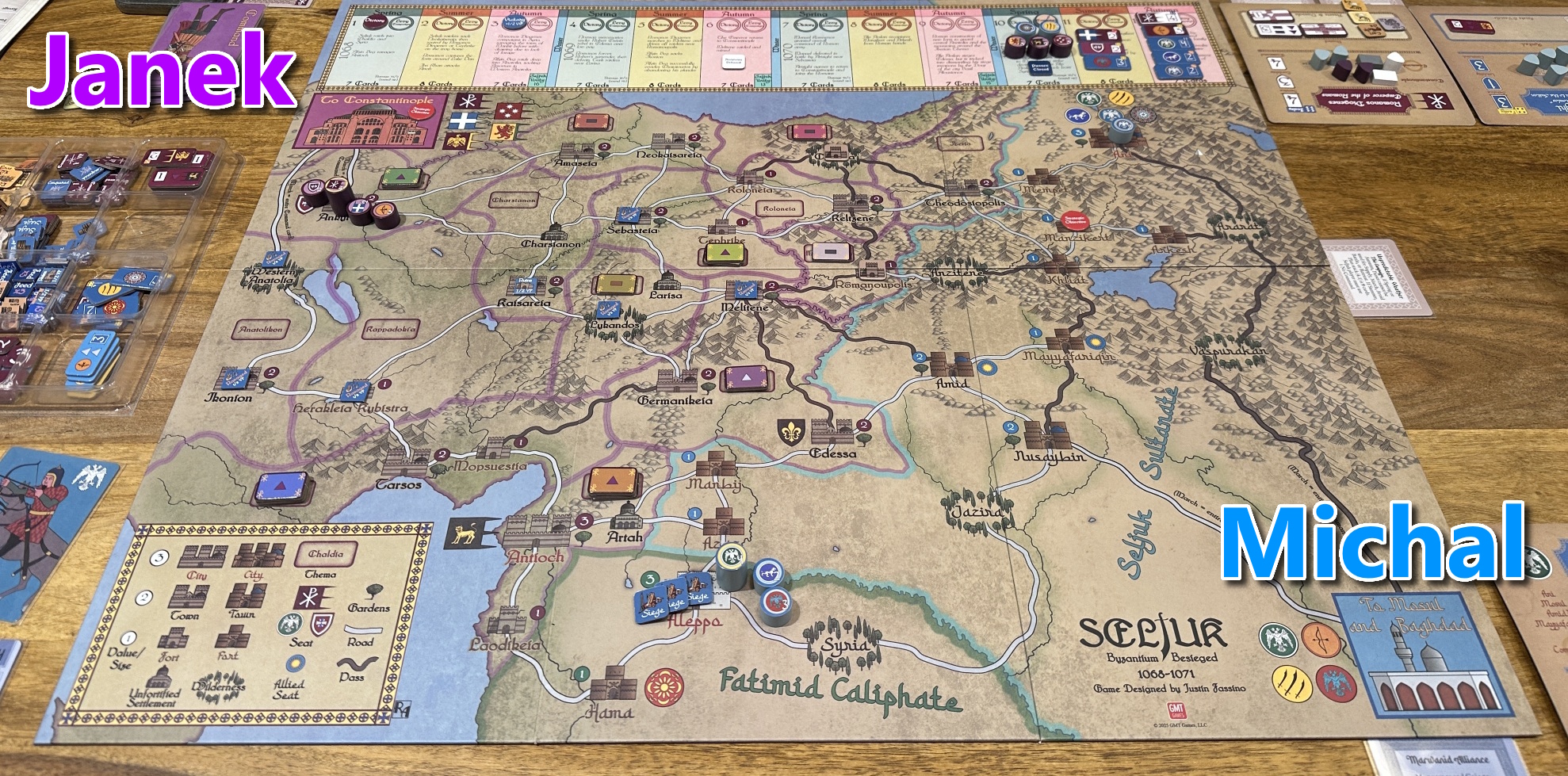
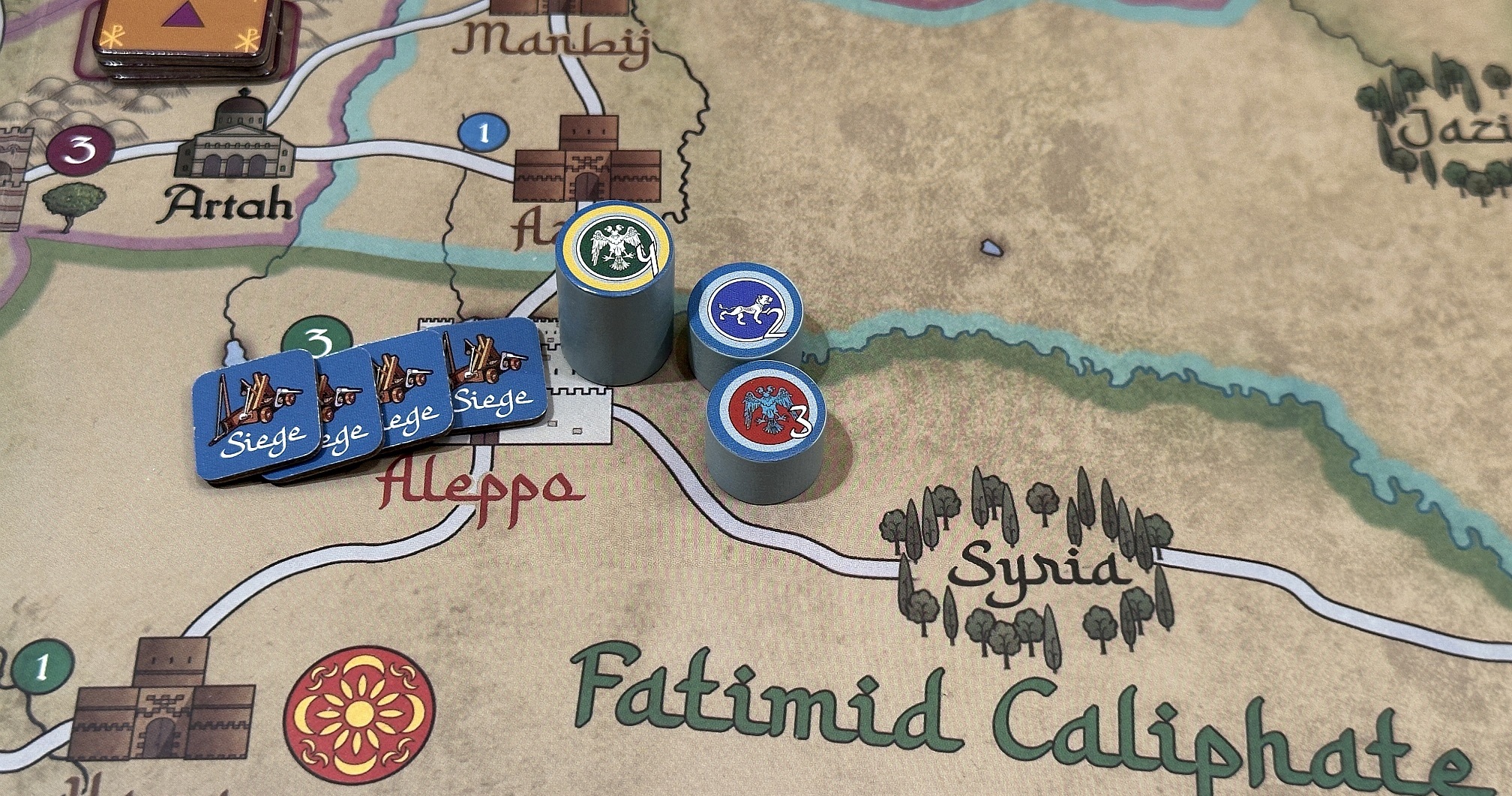
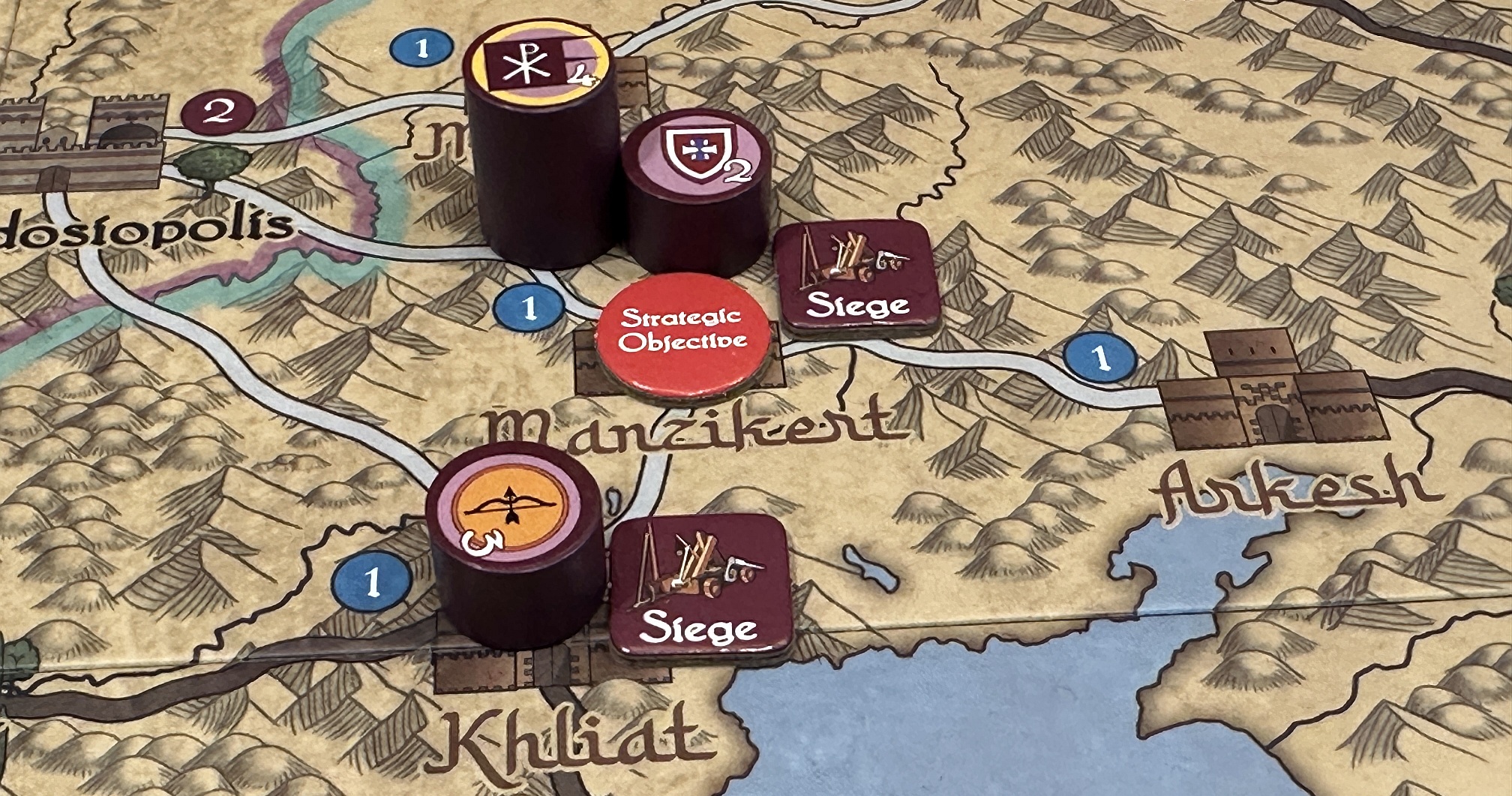
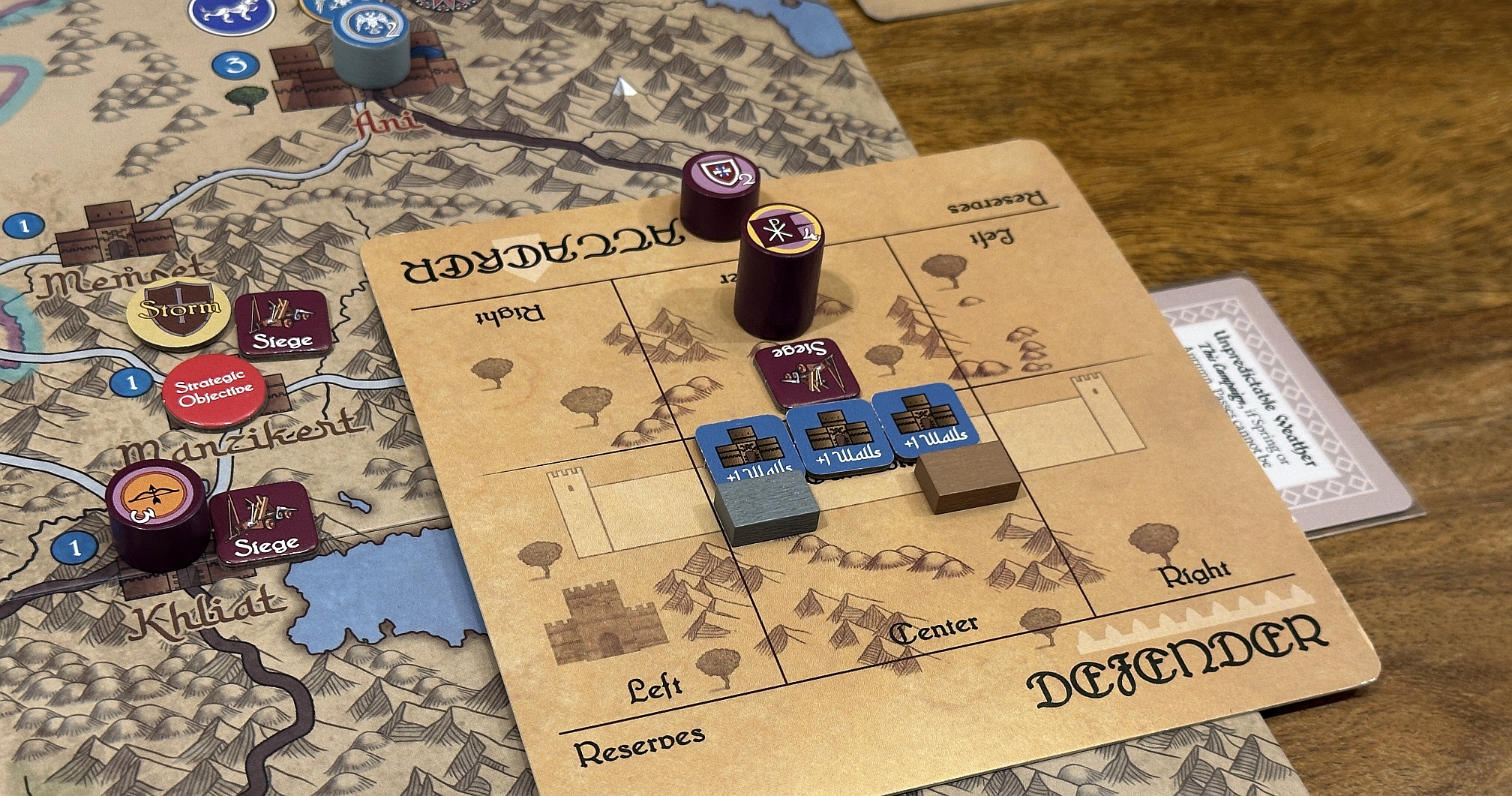
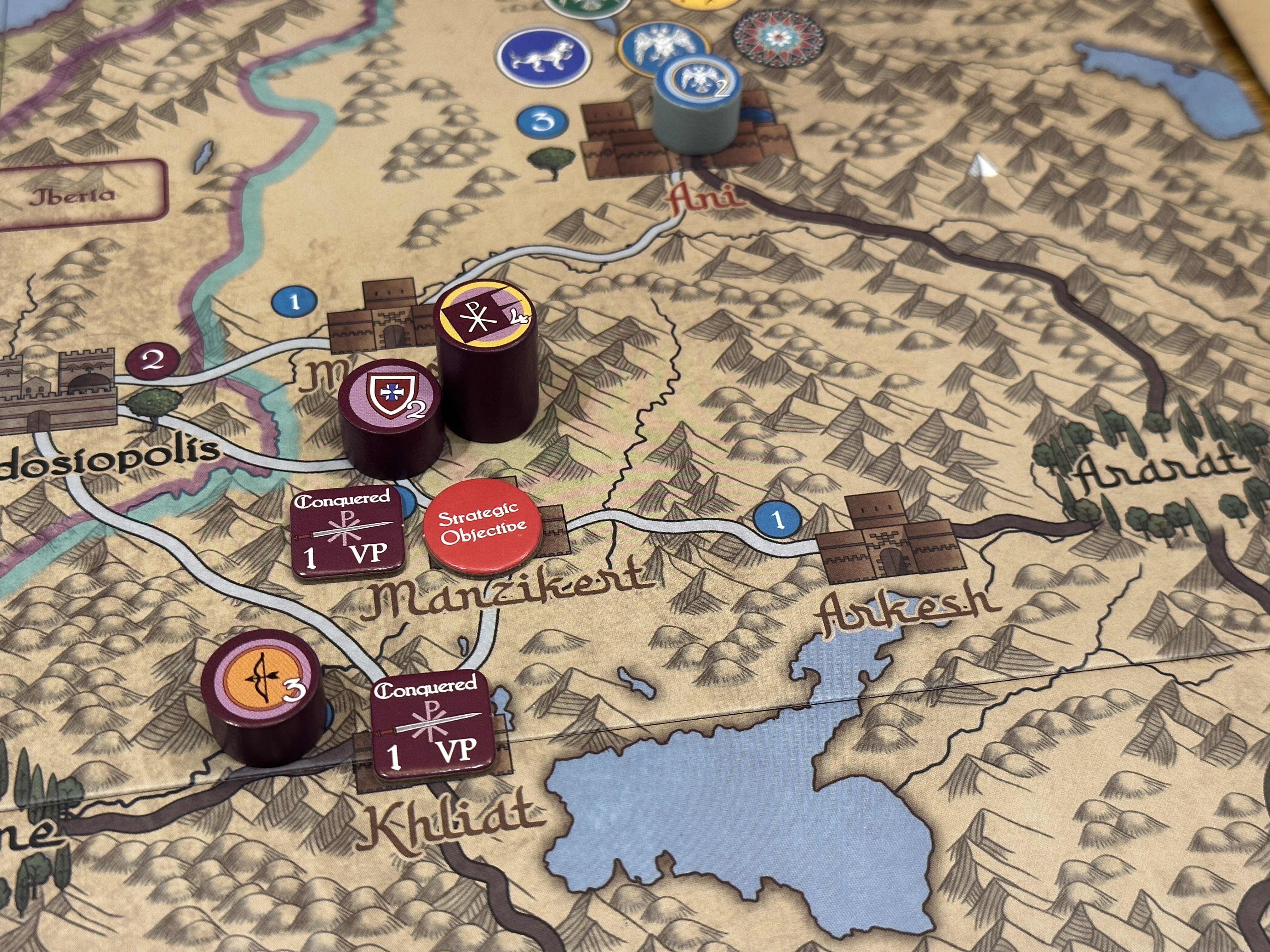
Summary: That scenario was a crazy ride for both of us and definitely, a race with time. You can play it only in two ways – either try to achieve victory by siege (as we above tried) or by the major battle (as it historically happened). Well, it seems Arp Arslan was more forward-looking than I did as Romans under Janek command got the Auto-Victory 🙂
Scenario A. Full Campaign.
The Emperor and the Lion (1068-1071, 12 turns)
Newly coronated as Roman Emperor, Romanos Diogenes begins a rapid mobilization and reorganization of the Roman army in the wake of Seljuk incursions that are devastating the frontier. His first mission: wrest away control of the Syrian border citadels to secure his southern flank and inflict a defeat on the Sultan’s armies they won’t soon forget.
Victory: The Seljuks win automatically if they have conquered Aleppo during any Winter Phase check after Aleppo Independence Event has been revealed. The Romans win immediately if Alp Arslan is permanently Disbanded. Otherwise, whichever side has more VPs at the end of Autumn 1071 is victorious.
This is exactly what I was waiting for – during our third meeting we played a full-campaign which is a great sandbox as you can pursuit various strategies and ideas. We had really a lot of fun with it!
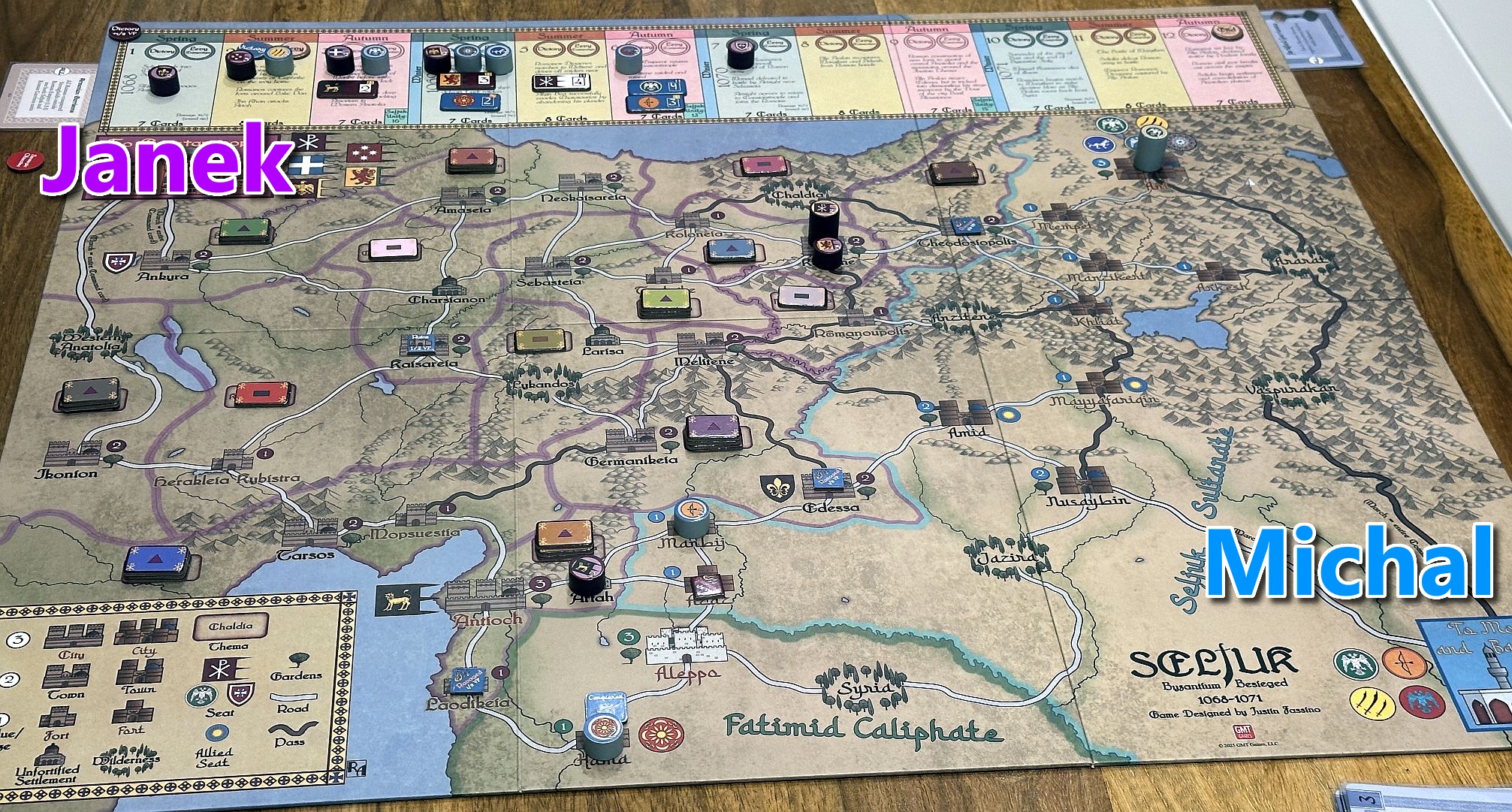
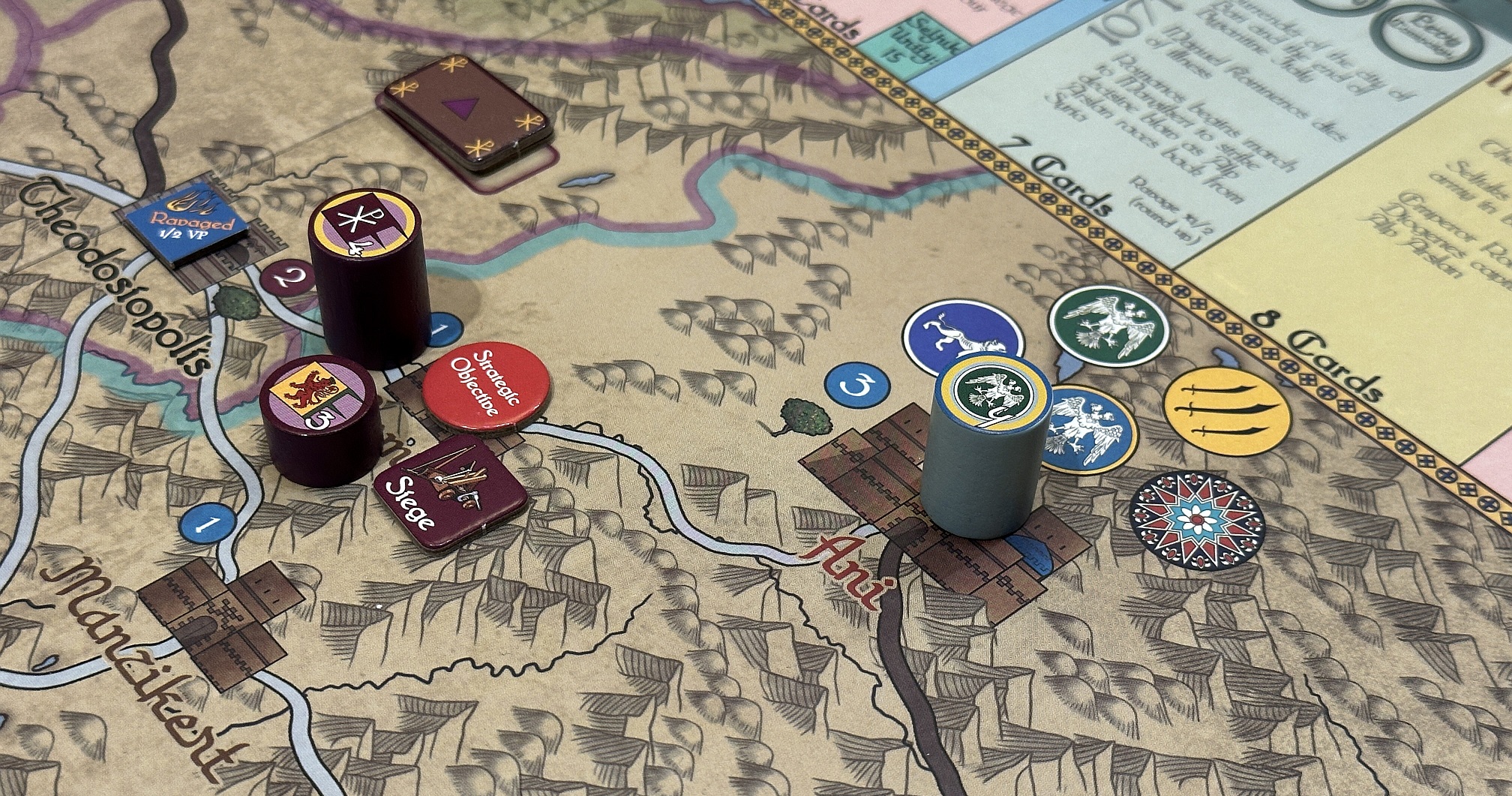
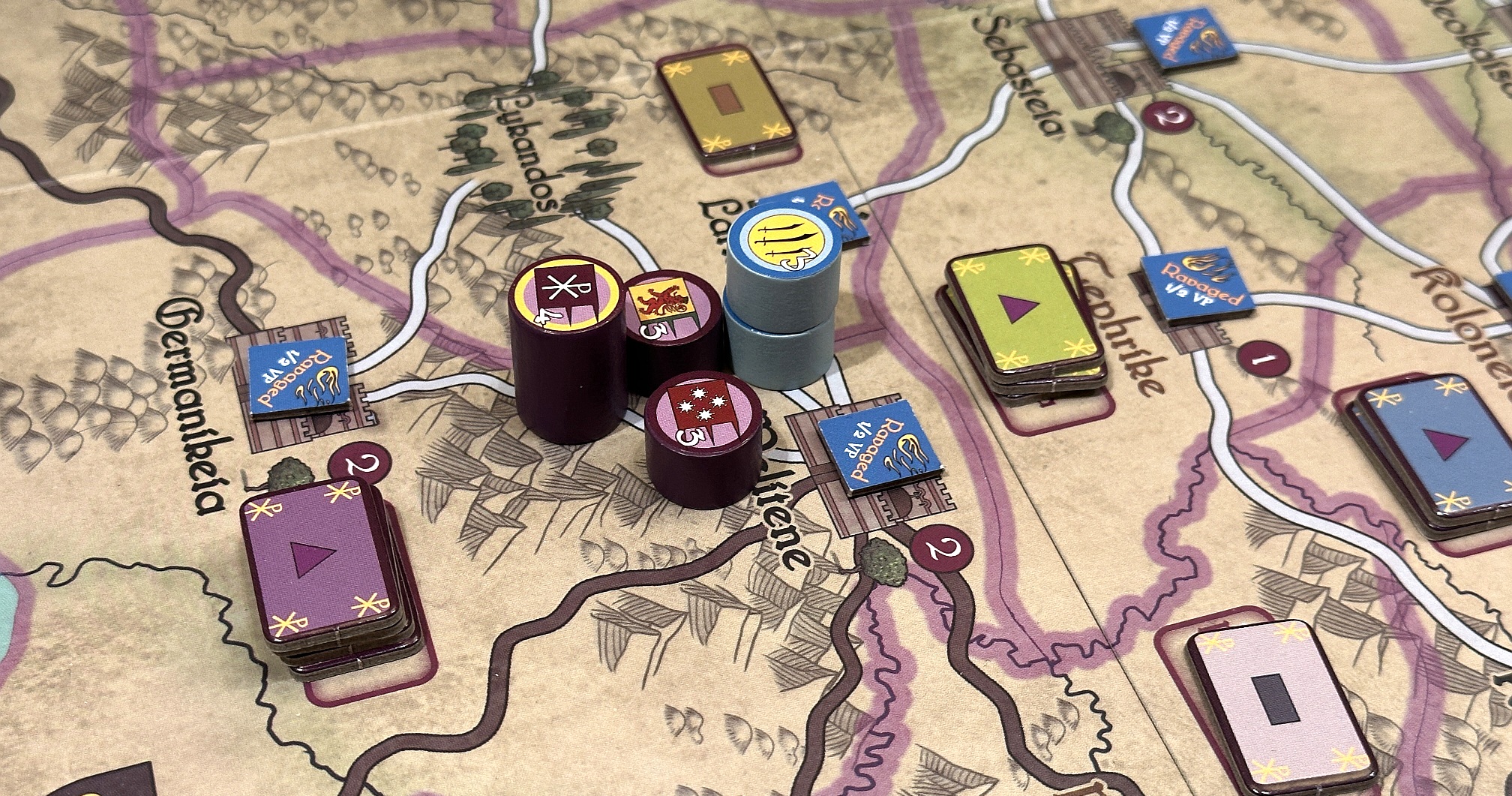
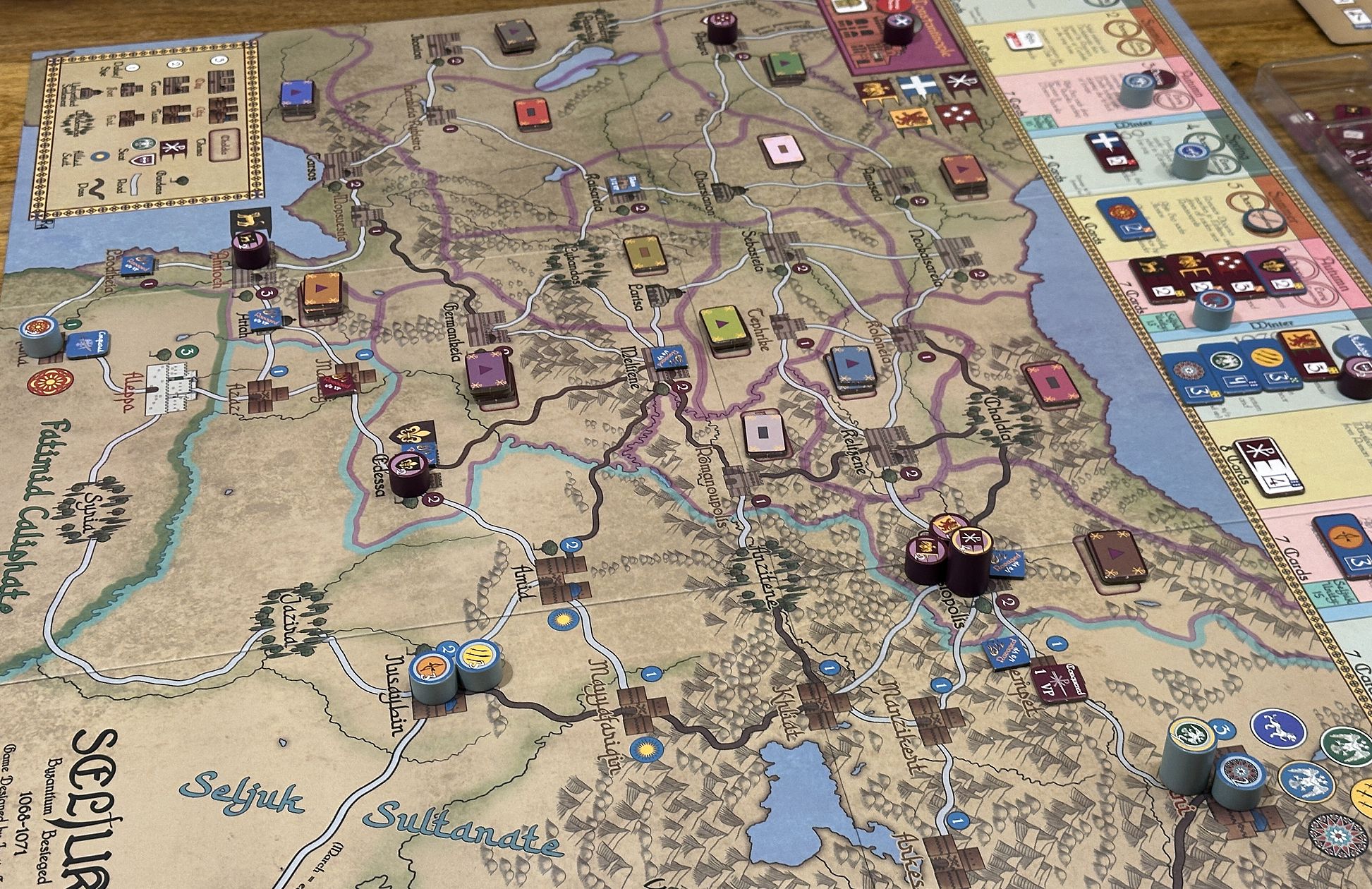
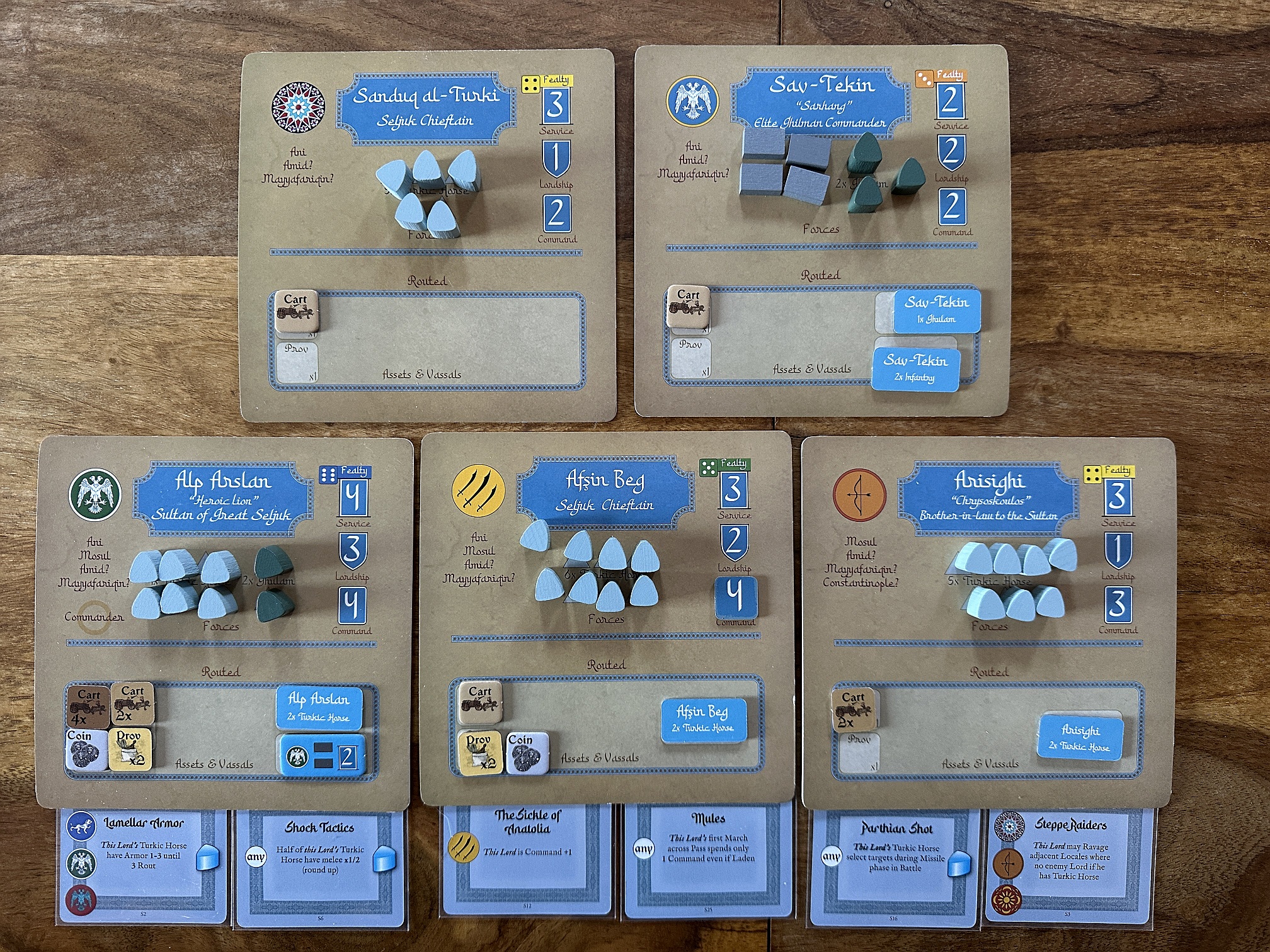
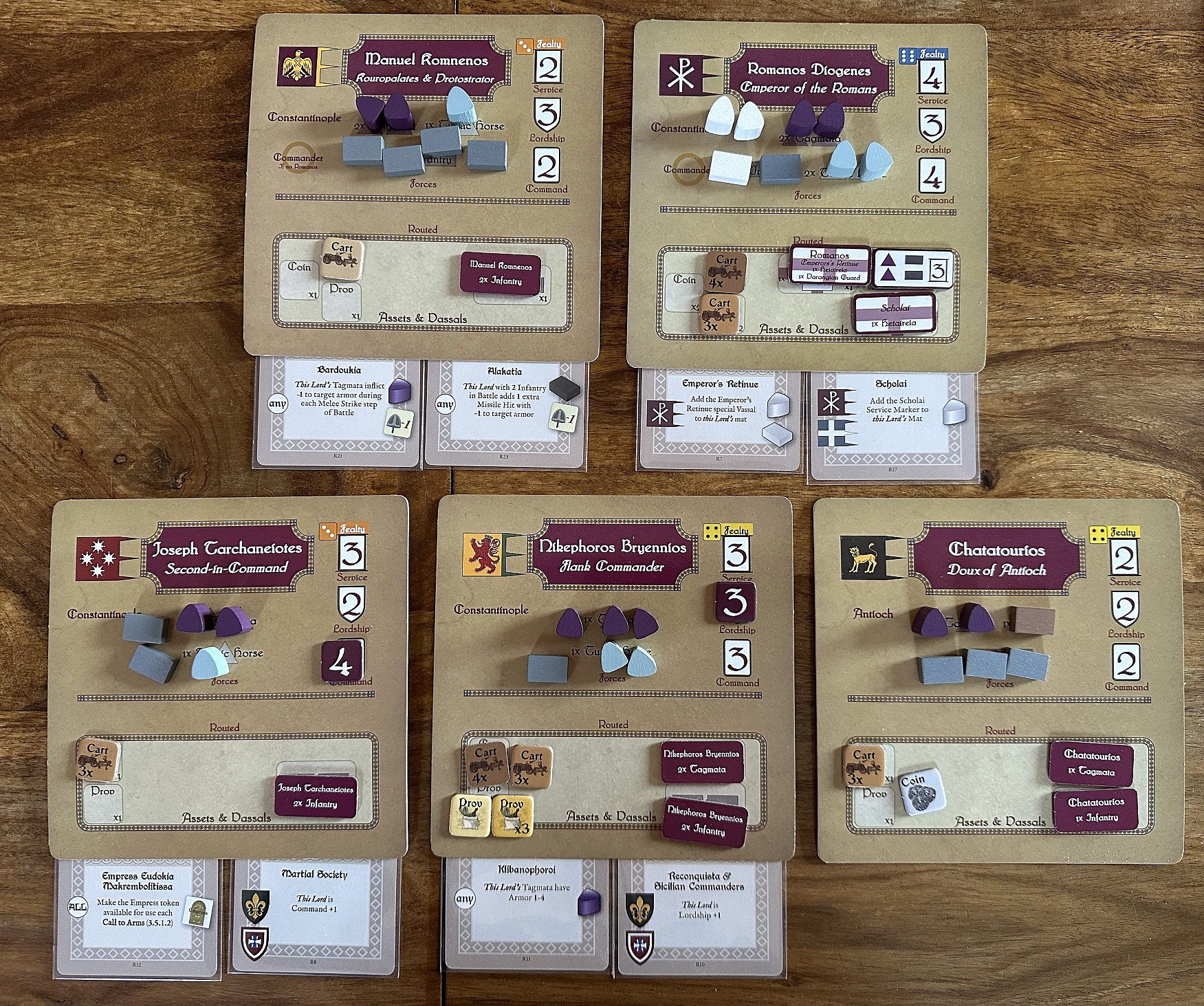
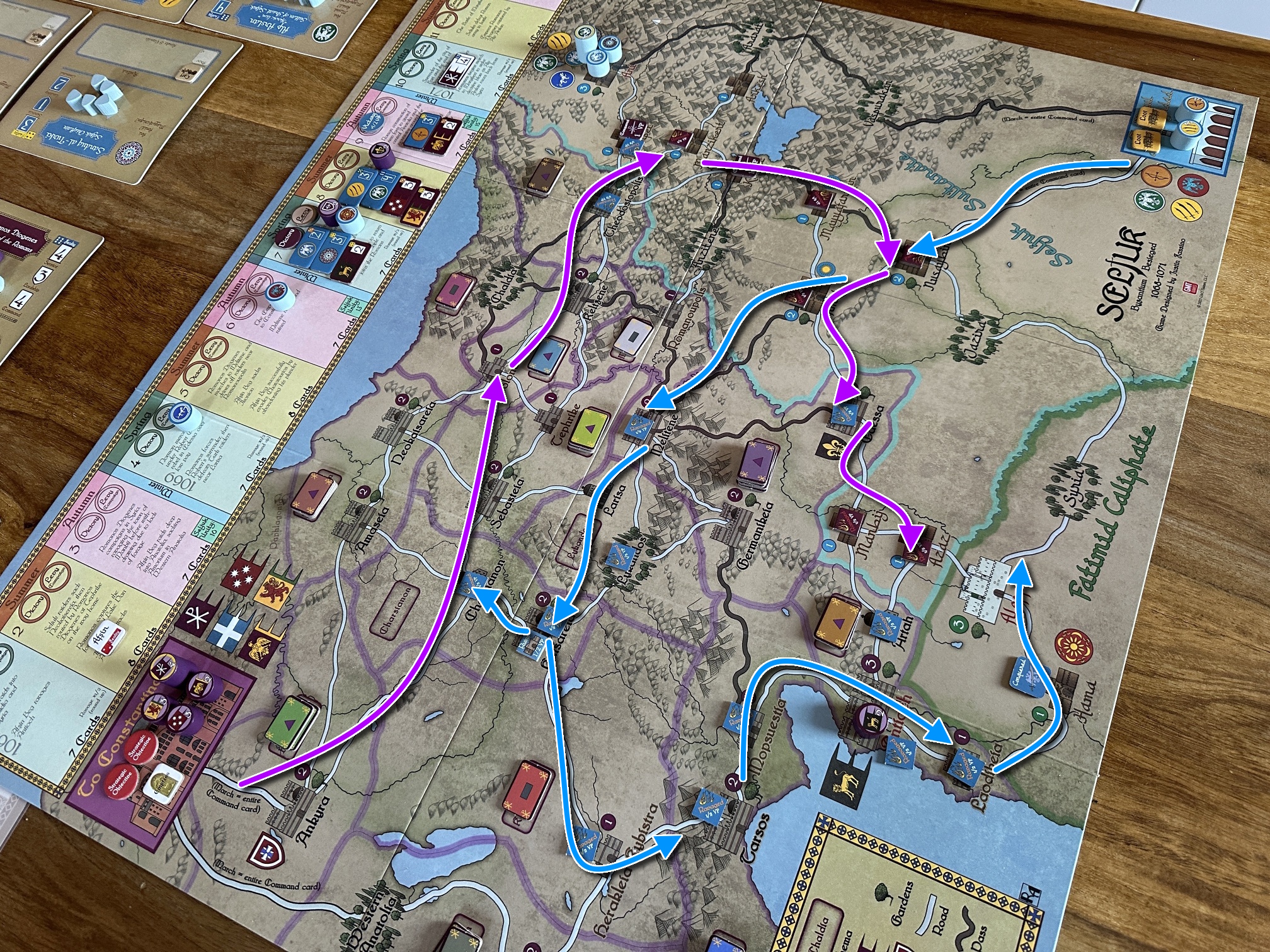
Summary: Full campaign is definitely how the Levy & Campaign games should be played. This gives you enormous freedom, possibility to test various tactics, allows for long-term planning rather purely short-term gains. Final score (9.5 to 7 for led-by-me Turks) represents a small but not crushing advantage by Turks.
First Impressions
All of those were very enjoyable sessions and showed me the game from multiple dimensions. Thanks to them I have a good insight into the game mechanics, how they influence each other as well as the flow of the gameplay. The especially insightful was the Full Campaign. So let me share my impressions now:
- As an ardent supporter and fan of Levy & Campaign system I truly appreciate how the system is evolving. At one side we have return to its origins, with all the supply issues, bloody battles and storms. On the other hand, it brings a lot of novelty (there will be separate material on this) focusing on strong scoring asymmetry, introduction of Seljuk unity mechanic (which forces them to constantly attack and ravage), bringing Roman Themata Troops to the picture or one-time powerful events.
- The game is very, very thematic and you can feel it. Playing with both sides feels completely different, as we face various problems and challenges. Asymmetry of forces, events and capabilities – with strong focus on history and great explanation in Playbook – allows us to immerse in the epoch.
- Hallmark of the series is that we are getting multiple scenarios – of various length, complexity – to familiarize with the game. Still, I believe that if you would like to experience the game in full, make sure that at some point in time you play full campaign.
- GMT’s standard for components is remarkably high. Still, Levy & Campaign gets best out of it. Following the examples of Nevsky, Almoravid, Inferno & Plantagenet, we are getting beautiful map, great cards, nice troop tokens as well as superb player aids. It is such a pleasure to play with them!
- I love to explore and experience games on my own, before playing with colleagues. So, I am really glad to see how suitable for the solitaire play Seljuk is. You can play it alone with random campaign cards or you can invite children as great randomizes!
To sum up, I can wholeheartedly recommend Seljuk to any fan of Medieval history – especially focused on eastern part of European continent and conflicts there, involving Roman Empire. Fans of Levy & Campaign will get some new, unique mechanics which will allow them to feel both familiar and refreshed. Also, if you never played game in this system, that might be good place to start.
See you in another review!
 The Boardgames Chronicle
What do you think about solo mode from P500 of these games?
LikeLiked by 1 person
What do you think about the solo expansion from P500 of these games?
LikeLike