
To immediately jump to the Kickstarter Campaign page of the game go here:
Michal: Hi Vincent and welcome back to The Boardgames Chronicle blog. Really glad to meet you again! May I ask you, for those who do not know you, to tell the Readers about what you do for a living, what are your interests, hobbies and what games do you play? Also, what is your role in the design and publication of the Merville Battery?
Vincent: I am originally from London, England, but I now live in Fukuoka, Japan. I have three jobs: I work as an English teacher 3 evenings a week, as a Wedding Conductor on the weekends, and the rest of the time I fill up with wargame design.

I have a very strong interest in Japanese martial arts and the relationship to Zen. I love ultra marathons, hiking and road cycling. I watch the whole road cycling season every year. I am very active, and usually do some kind of exercise twice a day.
I also read a lot, love eating out, love having a drink (preferably while watching some kind of sport), and of course, game.
I prefer game on the heavier side that form part of a series, so stuff like Simonitch’s 40X series and Ruhnke’s COIN series.

My favorite designer though is David Thompson, and in particular, the Valiant Defense series!
I am the Lead Designer of Merville Battery, but I heavily rely on a very competent and creative design team made up of Shane Freshwater, Martin Fenwich Charlesworth and Glenn Saunders.

Michal: Please tell us a bit more about what historical events inspired Merville Battery. For us wargamers, theme & background is as important as the mechanics.
Vincent: The Merville Battery was located in Normandy, approximately 6 miles/10 kilometers east from Sword Beach and less than 12 miles/20 kilometers north east from Caen. It lay directly east from Ouistreham and north east of Pegasus Bridge, on the eastern side of the River Orne. The battery was an important part of the Atlantic Wall. The four massive casemates were believed by British Intelligence to house 150mm guns, which were more than capable of causing massive disruption to the British landings at Sword Beach. In fact, it turned out that the artillery pieces were 75mm French howitzers dating from the First World War and captured during the occupation of France. Nevertheless, the site was identified early on in the D-Day planning as a critical target.
The RAF bombed the compound on several occasions, with one attack killing the original commanding officer, Hauptmann Wolter, on 19 May, 1944, leading to Oberleutnant Steiner replacing him (Steiner features heavily in the game). The bombs though had no effect on the casemates and just disrupted and delayed the rapid fortification of the area for short periods of time.
A land-based attack was necessary to ensure the (assumed) heavy guns were fully neutralized and the task was given to Lieutenant Colonel Terence Otway and the 9th Parachute Battalion.
Otway’s plan called for the battalion to drop close by in the night of 5-6 June, form up, march to the battery and assault the base just before dawn on 6 June, 1944. Offshore, HMS Arethusa had orders to open fire on the compound if no success message was received. The plan, often criticized for being too complex, immediately went awry with the parachute landing being scattered.
Of over 600 men in the battalion, Otway marched to the battery with only a quarter of that. Much of the heavy weapons and the explosives needed to destroy the guns was missing, as were all of the expert combat engineers who knew exactly how to disable the German weapons. The equipment needed to signal the HMS Arethusa had also been lost in the drop. The paratroopers therefore had to get in and out quickly before they ran the risk of being blasted by friendly fire. Given the encroaching deadline, Otway had no choice other than to order the desperate attack.
The defenders, no more than 150, of the battery were led by Oberleutnant Steiner. The men were not trained for close quarters combat and were almost entirely artillerymen or engineers. It is doubtful that few, if any, were psychologically prepared for a fire fight within the compound itself. They did however have the use of a 20mm Anti-Aircraft gun and several machine guns (the precise number is disputed). They were, in short, more heavily armed than the depleted 9 PARA.
Furthermore – an event which to this day remains unexplained – a Horsa glider had crash-landed inside the perimeter during the night of 5-6 June. This was not part of any recorded operation and no one knows where the glider came from, who was in it or what the mission was. All the occupants were gunned down and this, along with the paratroopers dropping all around in the darkness had put the defenders on high alert.
Michal: What are the key components of the game? What factions do it depict?

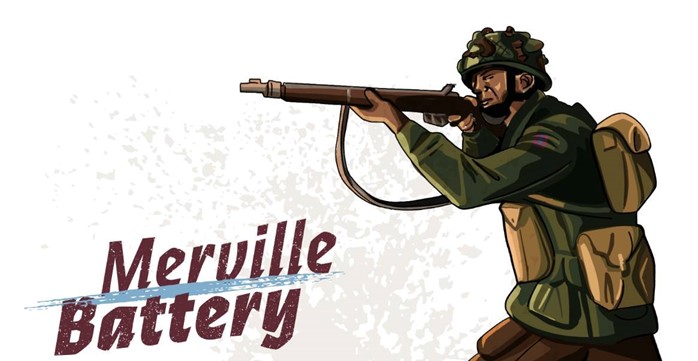
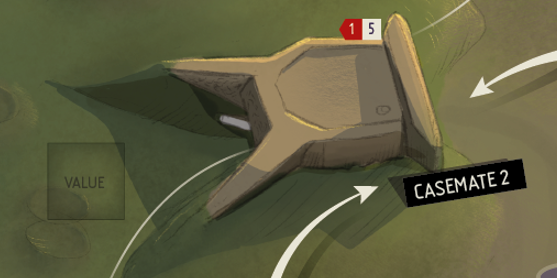
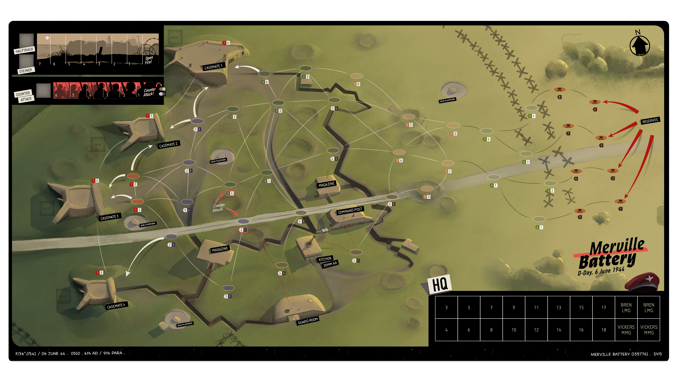
Vincent: The Player commands 9 PARA – the 9th Parachute Battalion – in their attempt to cross a minefield and assault and capture four casemates defended by the guards, gunners and engineers of the 1st Battery. Once the casemates have been secured, the guns must be disabled and the paras must make their way out of the compound while picking up wounded comrades along the way.
The problem is that Steiner and the roving Half-Track will arrive on-site at some point, at which time the withdrawing paratroopers will come under artillery fire (called in by Steiner from a neighboring battery) and the AA weapon on the Half-Track.
Michal: It seems that we are getting some very thematic graphics – who is the author?
Vincent: Wouter Schoutteten is a full-time illustrator and graphic artist. He is the designer of Dreaded Flags and has done the art for 1812: Napoleon’s Fateful March, Corvette Command and Nightfighter Command among others.
Michal: Can you elaborate a little about game mechanics? One can’t miss some similarities with the Valiant Defense series, however here we will be on the attacking side in this game.
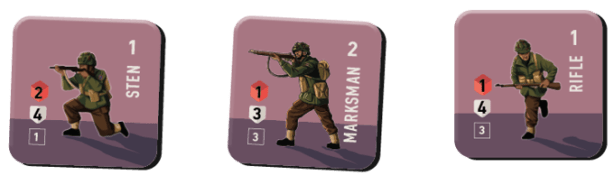
Vincent: The core mechanics replicate those of Valiant Defense games. David Thompson has very kindly given his blessing 🙂 The mechanics are fairly simple: Each Para has an Attack Value that determines the number of Attack dice rolled (d6 or d4 if a counter moved). You compare the result to the Defense Value of the 1st Battery target, and if the result is equal to that Value, the 1st Battery counter is Wounded (something new) and if the result is higher, that counter is Destroyed.
Merville Battery however introduces Range, with Rifle and Marksman counters having a longer range, but Sten Gunner counters having a shorter range but generating more Attack dice.
The mechanics remain almost the same when a 1st Battery counter is attacking a para: Roll a 1d6 Attack die. If the result is equal to or higher than the Defense Value of the target para, place a Disrupted token on that target. If para counter suffers a second Disrupted token, it is destroyed.
The familiar actions of Recover and Command allow Paras to remove Disrupted tokens (and recover from being Exhausted and – also something new – remove Delayed tokens).
Those are the core mechanics.
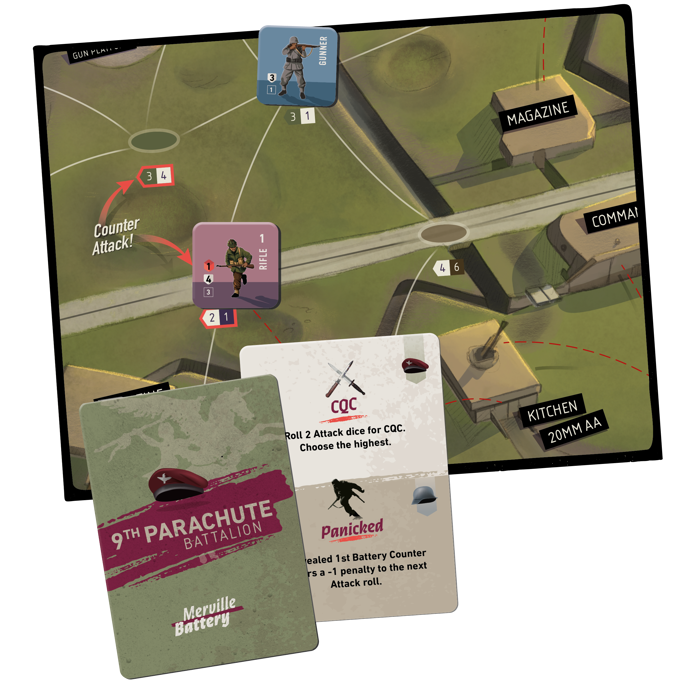
Merville Battery also introduces Battle Tokens. These represent one-off effects that impact game play, such as support fire from Bren and Vickers Machine Guns, or bonuses to Close Quarters Combat.
Battle Tokens are selected in a manner that players of Pavlov’s House and Guadalcanal will be familiar with: by drawing three 9 PARA cards, selecting two of them, and then choosing one of the two Battle Tokens available.
Michal: How do players determine victory in Merville Battery? What is our goal?
Vincent: The goal is to disable all four guns, rescue at least four groups of wounded Paras (increased Difficulty Levels increase this number) and withdraw from the compound with as many survivors as possible. The Player scores points depending on what he does and does not achieve, and at the end of the game he can compare his total to the historical total and determine his result.
Michal: One of the key things which players look for in solitaire designs is a challenging but winnable experience and replayability. How are you achieving this in Merville Battery?
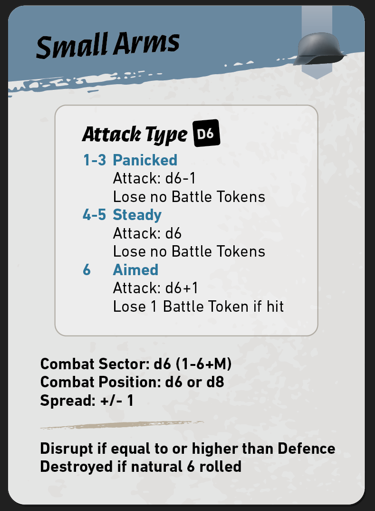
Vincent: As with Guadalcanal, there are all kinds of options to introduce that can make the game easier or harder. Tactics cards, for example, give turn-by-turn bonuses to the 1st Battery defenders, while Minefield cards (and custom dice!) can make it easier for the player to cross the minefield safely. All of these optional rules can be combined together in various combinations to make sure each game is unique.
To reflect the disastrous initial parachute drop, the player will also start each game with a random pool of 9 PARA counters to select and deploy, and the 1st Battery defenders will also occupy different positions. There are also Bomb Crater Positions which slow the player down in his advance, but also provide important cover. These Bomb Craters also shift from Position to Position from game to game.
Michal: If you would like to look at Merville Battery and answer the question – what makes this game unique? What would you like to call out?
Vincent: The most unique aspect – and the part of the design that took the most play testing – is that there is no set number of turns (as is typical with most wargames) nor does the 1st Battery deck expire to signal the end of the game (as is the case with Valiant Defense games).
Instead, the 1st Battery deck becomes depleted as casualties are inflicted on the defenders and they – abstractly – retreat to the safety of the casemates (reflected by an increasing Casemate Defense Value). At the same time, cards controlling the return of Steiner and the arrival of the Half-Track are placed into the Main deck, and as they are drawn, both Steiner and the Half-Track move closer.
This provides the player with a very unique challenge. And while I don’t want to give the game away, the player must be aggressive and try to get to the casemates as quickly as possible, disable the guns, and withdraw. The arrival of Steiner and the Half-Track is NOT predetermined and each game will be different.
Michal: How are you going to publish the game and where the players interested in the project can get more information?
Vincent: The game will be published by DVG and is currently on Kickstarter.
You can follow this link:
Michal: What are the future plans for you? Any new designs / games in preparation?
Vincent: T-34 Leader will follow soon after Merville Battery. This is a spin-off of Tiger Leader and Sherman Leader, but with new Units and some new rules.
Following that I will launch a new game series: Epic Battles.
The first title will be Epic Battles – Kursk, to tie in with T-34 Leader. Kursk will provide the player with 1-player Soviet, 1-player German and 2-player Soviet vs. German game options.
Epic Battles utilizes the Combat mechanics of the Tank Leader games from DVG, but dispenses with the Asset Management side of things and focuses purely on the battles.
As a result of this I will be able to give players what they want: Hordes of Tiger Is, Elefants and Panthers going against even larger groups of T-34s and SU-152s, along with all kinds of other historical armor.
There will be a total of three scenarios in the Core set and two expansions, with a scenario in each.
Thanks!
 The Boardgames Chronicle