
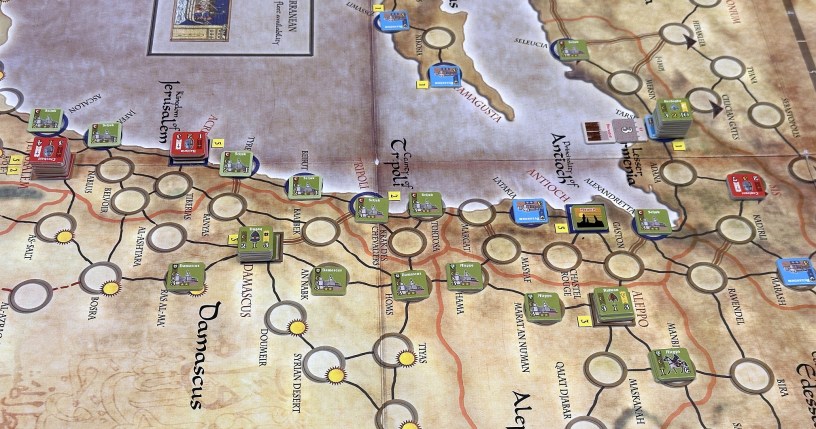
Today, let me take you guys on a journey to the events almost one millennia old. To the times of Crusades, large battles, fierce sieges and such prominent antagonists like Richard the Lionheart, Saladin or Barbarossa. We shall do it using one of my discoveries in the boardgames area of this year – namely Kingdom of Heaven!
I am grateful to Janek, who convinced me to try this title, bring this to the table several times and not only appreciate great design, but learn a lot about history. What I am planning to do, is report on the sessions we had, explaining as always the historical background of particular scenarios, how they developed on the board and of course, what was the real conclusion in the history. All of this as always strongly supported by numerous images which will depict our struggles best.
So, let us start this wonderful journey!
About the Game
In 1097, thousands of lords and knights, soldiers and camp-followers, pilgrims and prophets marched east in response to a Papal appeal, charged with the task of restoring Jerusalem and the Holy Land to Christian control. Their surprising victory led to the creation of the first overseas European colonies and the reshaping of Muslim power in the Middle East. The repercussions of their journey continue to live with us today.
In Kingdom of Heaven – The Crusader States 1097-1291 (KOH) two players use cards to activate forces, trigger random events, conduct diplomacy or prosecute siege warfare on a vast arena stretching from Antioch to Cairo and from Cyprus to Mosul.
Nine scenarios cover all the major campaigns of the era, from the First, Second and Third Crusades to the Mongol invasion and the rise of the Mamluk Empire. In addition to the ‘basic deck,’ each scenario adds different cards representing historical events unique to that campaign. Turns are yearly, and most scenarios can be finished in 3-4 hours.
Historical Scenario Background
Before jumping into the session report, let us talk a bit about the Scenario A – The First Crusade – and its historical background. For me this is first and foremost a lesson in history, and the game allows me to reshape it or even change completely!
In 1025 the Eastern Roman Empire, also known as the Byzantine Empire, was the most powerful nation on Earth. Then disaster hit. In 1071, at Manzikert, the Emperor Romanus III and his army were wiped out almost to a man, and the Turks occupied central Asia Minor. This crisis coincided with growing prosperity and power in Western Europe.
Pope Urban II, in particular, felt that the new strength of the Catholic powers ought to be turned against the heathens wherever they might be found, extending Christendom and saving souls at the same time in a form of armed pilgrimage. So when appeals from the Byzantine Emperor Alexius I reached his ears, he decided to address the problem on a grand scale. At Clermont, in 1095, Urban declared what would be the first of many Crusades: an appeal to the rulers and knights of western Christendom to fight in the East in expiation of their sins.
The response was beyond even Urban’s expectations. From France, Flanders, the Norman possessions in Italy, and elsewhere in Europe, lords, men-at-arms, and unarmed pilgrims massed for the journey. The most important leaders were Raymond of Toulouse, Godfrey of Bouillon, Baldwin of Flanders, and a pair of Norman brothers: Bohemond and Tancred. One byproduct of this enthusiasm was that the goal of the Crusade bit by bit shifted from helping the Eastern Empire against the Turks to recapturing Jerusalem and the other holy places in Palestine.
In Constantinople, Alexius watched the approach of this mass with great trepidation. He didn’t have the resources to feed the large number of military men, not to mention the tens of thousands of unarmed pilgrims. He tried to manage the situation by shipping the Crusaders over to Asia piecemeal, as they arrived. He also required them swear oaths to return any Byzantine territory they recaptured. The Crusaders felt mistreated – after all, they had come to help the Empire, in response to appeals – and later most of them used this as an excuse to forswear their oaths.
The first group to cross to Asia Minor consisted of largely unarmed peasants led by the visionary Peter the Hermit. They soon succumbed to starvation and the Turks. The main body of troops crossed over in late 1096, accompanied by a modest Byzantine escort. What lay ahead none of them could tell.
Set-Up
With the background done, let us now look at the scenario set-up. For this, we will need to cover several aspects.
Scenario Length: 1097-1099 (three turns) – this is shortest, learning scenario.
Scenario Cards Used: A1-A6 – those cards provide special events, specific to the scenario, which enhance the basic deck. Some of the more prominent are discovery of the Holy Lance, Crusaders disputes with Byzantium or counter-attack by Turks – Kerbogha Marches!

Powers and their initial alignment – some might be influenced during the game – but not in this training scenario:
- Pro-Christian: Crusaders, Byzantium, Lesser Armenia
- Pro-Muslim: Seljuk Turks, Aleppo, Damascus
- Neutral: Caliphate of the Fatimids
Special Rules:
- The Christian Player must keep a leader at all times in every city he takes (that reflects fact that Crusaders were newcomers and the population does not necessarily treated their arrival as “liberation”).
- The Christian Player may not use Naval Movement except via Event Card (to limit potential options and make it more historical).
- Fatimid Diplomacy card (changing the aliment of Fatamids) might be played in Turn 2 but is subject to dice roll; this might make each game a bit different.
Victory Conditions:
- Christian Victory: 13 or more VPs and Jerusalem (starts with 2 VP)
- Draw: Christian Player has 11 or more VP
- Muslim Victory: Christian Player has <= 10 VP. The Muslim player does not track VP in this scenario
And of course, the initial Map and Forces:


We rolled for sides and Janek got Crusaders while I was leading the Seljuk’s defense. We agreed that we will be swapping sides between scenario (with nine in total, there will be a lot to play), so everybody can taste specifics of both Christiaan and Muslim forces.
Session Report
That was a learning experience for both of us, so we treated the game with proper distance and helping each other in interpreting the rules – or sometimes even chasing what is best course of action in particular situations. Let me now provide the report in as always, picture-rich format.


Historical Conclusion
And how did it ended historically? I believe we all know, but why not to sum it up in a nice manner 🙂 Not so far from what we have seen above 🙂
The Crusaders met the Seljuk army of Anatolia at Dorylaeum in 1097 and dealt a decisive defeat. They arrived at Iconium in August. After brushing aside another Seljuk force at Herakleia, the bulk of the Crusader army decided to take the longer but safer route around the Taurus mountains.
Meanwhile Baldwin and Tancred split off and took the shorter route. Tancred busied himself taking Tarsus, while Baldwin marched to Edessa and made the confidence of the local Armenian ruler, the elderly Thoros, whose daughter he married. The main Crusader army marched on Antioch, arriving there in early 1098. The siege of Antioch was a particularly hard one. There was much bickering among the Christians. Eventually, on June 3, the city fell to the besiegers, although the garrison held out in the citadel.
The Crusaders’ rejoicing was short-lived, however. The Great Seljuk Sultan, Kerbogha, had arrived just too late with a large army raised from his Mesopotamian possessions, and swollen with allies from Damascus. In desperation, a relic was ‘manufactured’ by parties unknown: the Holy Lance, said to have been the spear that pierced Christ’s side on the Cross. This discovery raised the spirits of the Crusaders and enabled them to scatter Kerbogha’s army.
Many Crusaders, including Bohemond, stayed around Antioch to form a new state of their own. The rest, led by Raymond and Godfrey, continued marching south. When the tattered Crusaders arrived before Jerusalem, they were but a shadow of the force that had set out from Constantinople. The city was lightly defended, yet it still required much courage, fortified by a pilgrimage around the city, to successfully storm it in The resulting slaughter fueled bad blood between Christian and Muslim for centuries, as nearly every Jew and Muslim in the city was cut down.
But the Crusaders could not rest yet. Al-Afdal, the Fatimid Vizier, had set out from Cairo to the relief of Jerusalem. At Gaza at the end of the year his forces were defeated. Antioch, Edessa, and Jerusalem had been liberated from the heathen. Other cities soon followed. The Crusaders look on their successes as blessings from heaven. Now, they had to defend their new possessions.
Summary
I can honestly say that the game – after first scenario – really enamored us. It was not a typical blast, it was slowly and gradually growing admiration for the depth of design, interaction and connection of the rules, historical accuracy, attention to details – and what is most important, genial depiction of siege warfare and attrition armies were suffering during those times.
We immediately knew we shall continue – and that we need to re-read the rules, as there were areas a bit unclear for us. But the charm stayed and soon we brough Second Crusade to the table. However, this is a story for another time. Stay tuned!
 The Boardgames Chronicle
We are playing this game, and are through to Scenario H
It has been a great set of scenarios, and I’m particularly impressed with the Siege mechanism. This seems to me to be a highly under rated game.
LikeLiked by 1 person
Hi Mark,
could not agree more! This game in such a wonderful tells the story of crusades, using the CDG mechanics and special cards for each scenario. And as mentioned by you – the siege mechanic is probably the best I have seen in any medieval game of this scale.
We are now after scenarios A-C and can’t wait for scenario D (Third Crusade) with Barbarossa, Richard the Lionheart and Saladin!
LikeLike
Intriguing game! I’m already looking forward to the next session report!
LikeLiked by 1 person
I believe this is one of the more underrated games – it does wonders with its siege mechanics and how it reflects the specifics of the medieval warfare. Pity it went out of print and no new edition is on horizon. Would be also great to see the digital implementation…
LikeLiked by 1 person