

To immediately jump to the Kickstarter page of the game go here:
Michal: Hi Francisco and welcome to The Boardgames Chronicle blog! Please tell us a little about yourself. What do you do for a living, what games do you play? Also, what is your role in the design and publication of the game?
Francisco: Hi, it’s a pleasure to be here. I am a Philosophy teacher at High School. I have been teaching for 31 years. As a night job I founded in 2008 Bellica Third Generation, along with my wife and other friends, to design, develop and publish wargames of our own. I am 56 years old and I have been playing wargames for 45 years, so I have a lot of baggage. I also write military history books for a Spanish publisher, HRM Ediciones, so I am very adept at learning about military history and melting it into new wargames. I love designing about obscure topics and with different and original mechanics.
I have already published 5 other games and this “Castelnuovo 1539” is a sequel of another design from Iván Caceres called “Santa Cruz 1797”. Luis, Draco Ideas man, approached me asking for a design and I, knowing the catalog of Draco Ideas, thought it would be a good idea designing for him another “Desperate Battle”. That is what I call “Santa Cruz 1797” and all the games I designed following that game system. They are not a system but a family of games, about furious battles, full of alternatives and tense. I have already published another called “Von Manstein’s Triumph” with another Spanish publisher, NAC Wargames, and two more will be published by my own company in the upcoming years. I am the author and developer of the game. Luis is the publisher.
Michal: Now, as for the game, what historical events inspired Castelnuovo 1539?
Francisco: The game depicts the epic siege of Castelnuovo (actual Herceg Novi, in Montenegro), that took place during the summer of 1539. In 1538, Venice, being attacked by the Ottoman empire, accepted to enter a Holy League with the Pope and the Emperor -and king of Spain-, Charles V. They mustered a big fleet and army and sailed to defeat the Ottoman one, led by the ablest of naval commanders, Hayreddin Barbarossa. The Christian fleet was defeated by the Ottoman in the naval battle of Preveza and they tried to amend the campaign by conquering an Ottoman fortress on the Adriatic coast. Castelnuovo was the chosen one. It was taken with ease, as it was only garrisoned by 600 ottoman troops.

The letter of the Holy League treaty gave all the conquest that would be done to Venice, but the Emperor refused to give Castelnuovo to Venetian control. This upset them and led to the breakup of the League. Francisco Sarmiento and his fourteen Spanish companies plus artillerists and one Albanian horse company were left to their fate, 4.000 men, women and children, including the non-combatants. They were well supplied from the fleet with shot, powder and food, but anyway they raided and fought the neighboring Ottoman garrisons and settlements all along the winter. With the coming of the campaign season they knew an Ottoman counterattack would come, so they strengthened the old medieval walls of Castelnuovo with earthen works and artillery platforms. On July 12th an Ottoman vanguard arrived at Castelnuovo for watering and reconnaissance. 1.000 Ottomans disembarked in two different occasions just to be mauled by Sarmiento and his enterprising captains.
On July 18th the full Barbarossa navy arrived and the siege began. Another Ottoman army came by land led by the Bosnia governor, Ulema, rising Ottoman numbers up to 50.000 men. The odds were against the Spanish and Barbarossa offered terms, but they were turned down by the Spanish with the mythical sentence:”Venid cuando queráis” (Come whenever you dare). Siege work, skirmishes, bombardments and bloody sallies from the defenders and assaults continued till August 7th, when the last defenders were overwhelmed. Nearly a month of bloody combat spoiled the Ottoman campaign season, as Barbarossa fleet never undertook its main objective for 1539, laying waste the Italian Adriatic coast. Too many casualties -especially among the elite Janissaries-, too much powder spent, too much suffering for just gaining a ruined small town on the Adriatic coast…
Michal: What are the key components of the game?

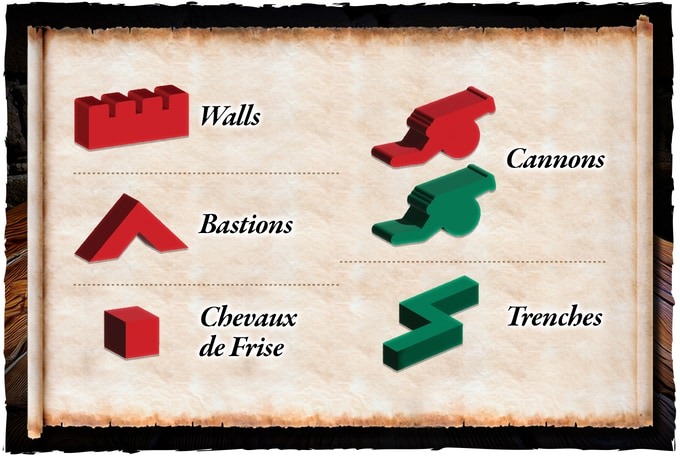
Francisco: Like the other games in the “family” is a card-driven block game. Blocks and cards allow for a certain amount of uncertainty to appear in the design, contributing to the stimulating decision making process of players with partial information and unknown events in your enemy’s hand. Also other elements are made of wood: there are wood pieces for Ottoman siege trenches, Ottoman and Spanish artillery batteries, Spanish redoubts, Chavaux-de-Frise and the city walls. There are also wooden disks depicting each side leaders.
Michal: Can you elaborate a little about game mechanics?
Francisco: You will play turns with several Phases. First comes the Ottoman Phase, in which the Ottoman player will play cards to do actions with their blocks and provoke other effects. During the Ottoman Phase the Spanish player could react to Ottomans moves and attacks by playing reaction cards from his hand, so the gameplay is very interactive and tense. At the end of the Ottoman Phase BOTH players draw new cards to refill their hands. Then follows the Spanish Phase, which mirrors the Ottoman one. Then you finish the turn with a Reinforcements Phase for the Ottomans: they will receive the bulk of their forces during the first two turns. One important point to highlight is that BEFORE both players draw new cards at the end of the Spanish Phase, the Ottoman player has to decide what type of turn the next one will be: it can be a SIEGE turn, that sets both sides hand size to 4 cards, or an ASSAULT card, that gives 7 cards hands to each player. And this is a very important decision to be taken, as both types of turns allow or forbid different actions.
Also another important mechanic is the resolution of combat. As all the games in this “Family” are focused on combat the combat mechanics of each one are typically unique and tailored to each one. In this one, like a kind of paper-rock-scissors, the combat sequence allows some troops to inflict damage before others and this is determined by the type of troops. In open country cavalry rules, unless opposed by pikemen, in which case the pikemen would hurt the cavalry before they could hit. Then, firearms take precedence over hand to hand combat and other missile weapons troops -like Ottoman archers. Spanish arquebusiers always strike first, then the other infantry. Both sides can also play Combat cards to enhance their chances of killing enemy troops.
Michal: How do both sides determine victory?
Francisco: This is a very interesting question as this is one of the unique mechanics in the game. We have no turn limit, so each side can manipulate the time to their advantage. Ottomans have more conventional victory conditions: killing all the Spanish or occupying the three victory areas at the end of a turn. The Spanish are doomed from the beginning, so they cannot prevail, how can they win? By killing a lot of Ottoman troops; by making so costly the victory for the Ottomans that it becomes a wasted victory -as historically it was. So, we have an Ottoman Casualty Track that runs from 0 to 12, and the Spanish player wins only by making the track reach 12. The track advances one space by each Ottoman block and leader that is killed AND for each time the Ottoman player chooses a turn to be an ASSAULT. So, Spanish players have to be very aggressive and bold, regardless of losses. It is a very uncommon goal for a player to accomplish.

Michal: Now, as for Castelnuovo 1539 itself, what makes this game unique?
Francisco: As Castelnuovo 1539 is part of a Family it has the same characteristics of that family: a tense gameplay with lots of interactions and clear objectives for each side; many combats and tough decisions to be taken. Also this is a siege game, it is not only about moving blocks to enter combat. As the Ottomans you will set the pace of the game, and you have to siegecraft correctly or you will lose to Spanish raids and counterattacks. As Spanish you deploy on fortified places, but if you are not aggressive and bold you will never do the Ottomans pay dearly for their victory. And also, this is a short game: you can fight a real siege game in just 60-90 minutes. Also the aforementioned victory conditions, especially the Spanish ones, and lack of turn limit gives the games a very different flavor.
Michal: Some of us had the pleasure of playing another of your designs, where siege warfare was a key topic – Von Manstein’s Triumph. What are the differences between that previous title and Castelnuovo 1539?
Francisco: As I have designed four games in this family I have tried to create different but similar scenarios. Santa Cruz 1797 was a game about an amphibious night assault on a fortified city, so it traced the path for future games: desperate battles has a lot to do with depicting siege and urban warfare. Anyway each game is unique and offers a very different situation for the players. Von Manstein’s Triumph is about an assault, not really a siege. Of course, an assault on a heavily fortified and garrisoned fortress.

Set in a different era you have different tools to fight the battle and you need to use different tactics. As I do not design only games but “cardboard simulators” you are placed in both games on the same seat: the overall commander of each side. But the situation and tools are very different, reflecting the diverse situations to be simulated. I design setting the level of resolution of the game to fit the role I assigned to each player. So in Von Mantein’s Triumph you maneuver divisions to fight the battle, blocks in that game are regiments and brigades, the building elements of divisions.
In Castelnuovo 1539 you are moving around companies (flags in the military terminology of XVI Century). In this game you have to manage the whole siege from the beginning. The Spanish have set their defenses and positioned their troops. As the set-up is free you can experiment with different possibilities, especially regarding the redoubts and artillery batteries placement. As they are fixed defences and cannot be moved once placed you have to be very careful about them and place them in the most useful manner. Also the deployment of the blocks gives you a wide range of possibilities: spreading them thin, concentrating on several points, creating from the beginning a “killer stack” with Sarmiento, deceiving the enemy by placing Sarmiento with any other block…

Then, the Ottomans arrived and you have to manage an active defence: sallies, counterstrikes, use of artillery and Camisados as often as you can without destroying yourself to kill as many Ottomans as you can before the Ottomans reach their goals. In Von Manstein’s Triumph you also have to be aggressive as a defender, but usually the Soviets trade space and units for time, as there is a fixed number of turns. Here, time is not on your side, as once the Ottoman deck is reshuffled it adds the “Storm” and “Civilians” cards to it making a Spanish sudden collapse more likely.
So, you better win as fast as you can or maybe you will not be able to. The Ottomans, on their part run the pace of time: too many “siege” turns and the Spanish would play more “Camisado” cards than desired, too many “assault” turns and you will destroy yourself. As the Ottoman side you have to run a regular siege: open trenches, sitting batteries, bombarding, making branches and assaulting, besides fending off enemy sallies and reaping each opportunity you find along the way to inflict losses on the Spanish troops. Both sides have to count on time as many Spanish reshuffles means more “Camisado” slaughter. A tough task for the Ottoman.
Michal: How are you going to publish the game and where the players interested in the project can get more information?
Francisco: The game will be published by Draco Ideas, a Spanish publisher. They can get more information on the website of the publisher:
They just launched a Kickstarter campaign on June 17th.
Michal: What are the future plans for you? Any new designs / games in preparation?
Francisco: Oh yes, as I am a designer, developer and publisher I have plenty of projects in progress in all these roles. Following a timeline the next one to be released will be An Impossible War, from David Gómez Relloso -author of the famous Crusade and Revolution, published by Compass. This will be as publisher and you can take a look at the game here
Soon we will open an early birth discount purchase opportunity to the public in our website: https://bellica3g.com/es/. As an author I will publish with my own company -Bellica Third Generation- the fourth volume of my Campaign Commander Series called White Sea, depicting the struggle between the Ottoman and Habsburg empires in the Central and Eastern Mediterranean from 1565 to 1574. We have no link yet to the game as this will be released next year.
And as developer I am finishing a game from a Danish author, Rasmus Larsen, called Disasters of War, about the war against Napoleon in the Iberian Peninsula, from 1808 to 1813. A single deck card-driven block game for two players. It will be published by Bellica too.
And many more games are coming…
Michal: Thank you very much for the interview, Francisco! Any last word you would like to add?
Francisco: Thank you for giving me this opportunity and giving visibility to my “cardboard” simulators.
 The Boardgames Chronicle