
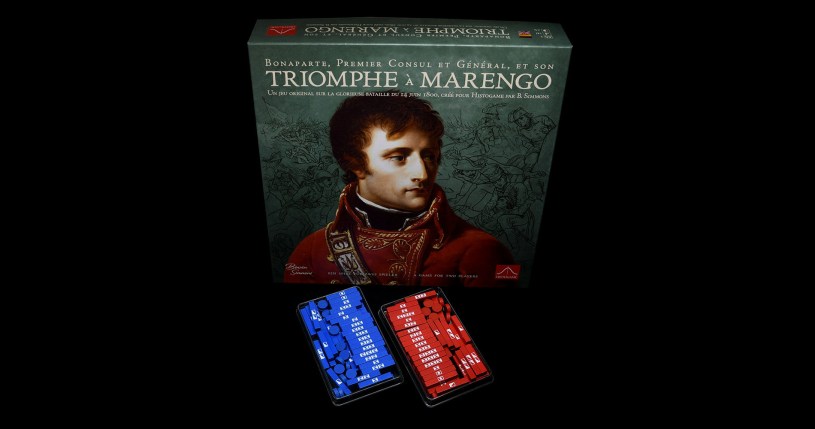
| About game: | Triomphe à Marengo (Triumph at Marengo) – a game designed by Bowen Simmons and published by Histogame – recreates that dramatic battle which took place in June 1800, during Napoleon Italian campaign. It was one of the more decisive Napoleonic victories, although definitely did not looked that way at the onset. One player takes the role of Bonaparte whose troops are scattered at the beginning, while the other attacks with the Austrians. He has to defeat the French, before they can strike back with their reinforcements. The game is fast playing and definitely departs from almost all wargame conventions – no dice, special battle & morale mechanics as well as hidden information. On top of it, it brings the look of the 19th century linear warfare onto the table. This new version of classic Bonaparte at Marengo (2003) has the redesigned map which gives you wide open spaces for various maneuvers; the modified combat system is full of drama and hidden information; and the novel locale-based morale system brings additional tactical considerations. Since fights are resolved without dice, luck is very much limited and it is the skills which counts. So would you stand-up to the task and as Napoleon revert the initial disastrous situation? Or maybe you will achieve the victory as Austria, that historically was so close? |
| Number of players: | Of course, first and foremost, this is a perfect title for two players. However, to some extent it is possible to play it also solo – this is not a perfect solution as some hidden information is lost – in that case, especially, as to the strengths of the units and their disposition. However, as a learning experience – or to present the titles to others, as I did in my materials – this should still be ok. |
| Playing time: | I am glad to say this is one of those wargames with a very reasonable time to play. First of all, the set-up will take like 5-10 minutes. Then, the actual session – most probably up to 2 hours – especially after one or two introductory games. |
| Complexity: | While the game is by no means complex nor difficult, some of the rules are explained in pretty vague terms. Also, you will encounter several exceptions which are important. All in all, I would treat this as medium-complexity wargame. |
| What I like: |
|
| What I do not like or would like to see in the game: |
|
| For whom? | I believe each person who had at least some exposure to historical, political or war boardgames would both enjoy and grasp that game. However, there is an additional bonus here for all those seeking new and fresh designs – this game, although new edition of 20 year old title, is still very innovative and strays away from set paths in wargaming industry. |
| More about the game: |
|
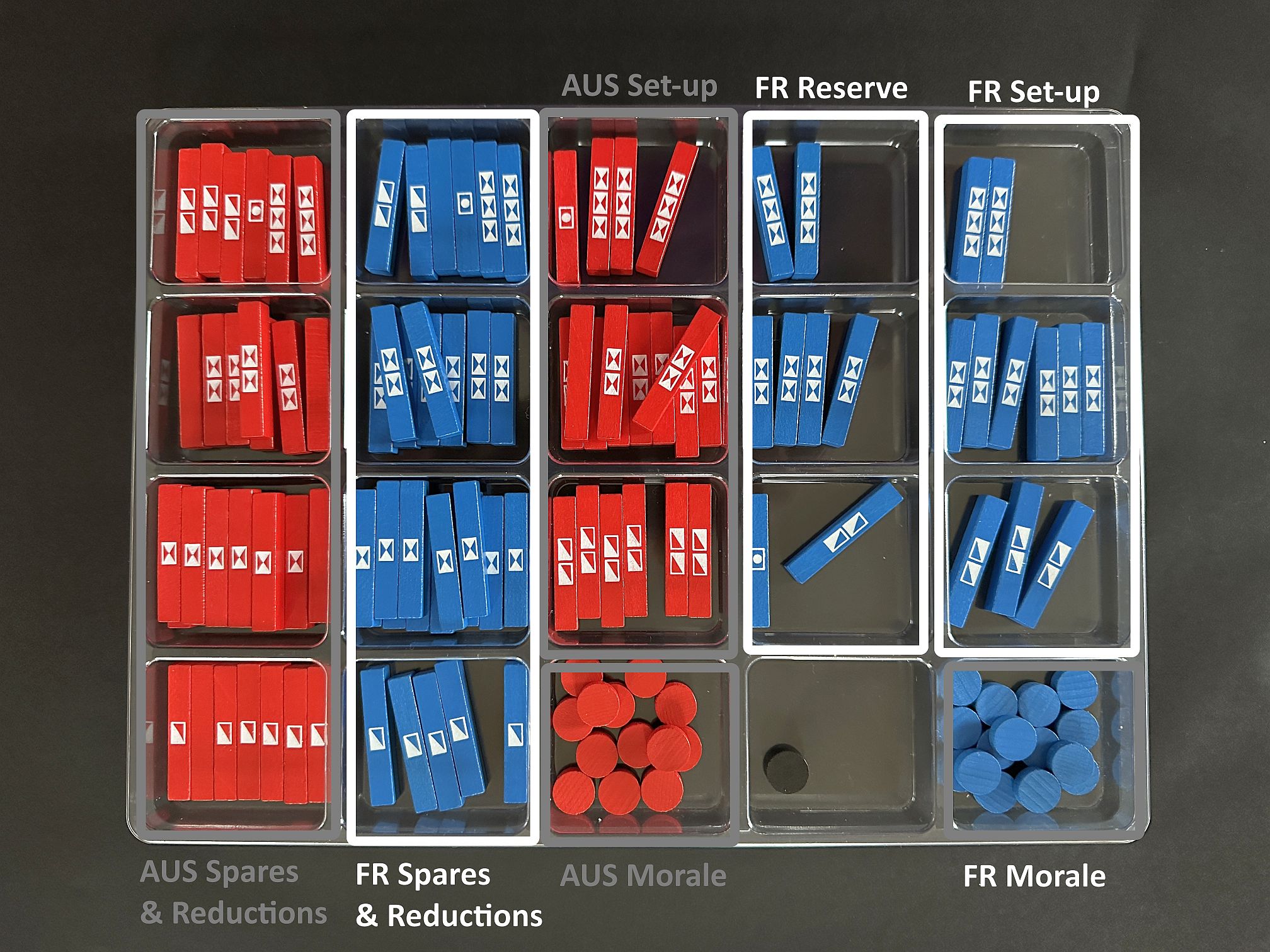
And now let us have a look at the materials created by me:
VERDICT:

Familiarizing with and playing Triomphe à Marengo was a really refreshing endeavor. That beautiful game uses some very clever, new and non-standard mechanics which makes each session a fun. It has surprisingly high replayability for a one scenario title, with nicely included morale mechanics as well as hidden information. Lack of luck ( 🙂 ) adds to the the feeling and great experience. Highly recommended!
 The Boardgames Chronicle
