
During one of our local boardgames conventions I had a pleasure to play with Maciej and Michel one of the titles from GMT’s Irregular Conflicts Series (IRC), namely Vijayanagara: The Deccan Empires of Medieval India, 1290-1398. I admit that the game made a very positive impression on me, thus I would like to present it to Dear Readers in below material. We should talk about the game itself, our session as well as what I think about this title. Enjoy!
About the Game

Vijayanagara is a 1-3 player board game depicting the dynamics of the Indian subcontinent during the years 1290-1398. The game spans the Khalji & Tughlaq dynasties of the Delhi Sultanate, while showing the birth of two upstart powers in the Deccan Plateau, the Bahmani Kingdom and the Vijayanagara Empire. The game closes with the historical invasion of Delhi by Timur in 1398, though a careful Delhi Sultanate player might be able to avoid this fate
The Delhi Sultanate is trying to maintain its grip on the south of India. Its victory points are equal to the total Prosperity of Tributary Provinces, adjusted up or down according to how well Delhi fares against Timur’s final Mongol invasion at the end of the game.
The Bahmani Kingdom and Vijayanagara Empire are both seeking to establish their own independent Control over Provinces dividing the Indian subcontinent, solidify their positions with the construction of Forts (Bahmanis) and Temples (Vijayanagara), and to ensure the propagation of their Influence throughout the Deccan region.
Regular play is also periodically interrupted by the actions of the non-player Mongol Invaders, who threaten Delhi from the northwest, and the game ends with the climactic arrival of the great Mongol warlord Timur.
All of those dynamics make for a great experience, with every faction sometimes on rise and sometimes – in decline. The system of interdependencies helps both to hurt your opponents as well as to come back in case of disasters.
Our Session
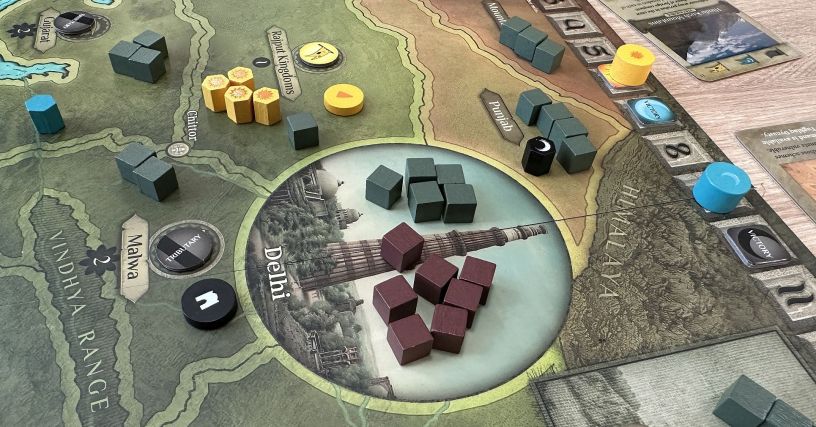
Time to jump to so far our only but full session of Vijayanagara. As this article is mainly focused on impression and evaluation of the game, I will not spend much time here. Still, this would be unforgivable not to show the beautiful components and mention a bit what story developed in our game!


First Impressions
To say that I like this game from the onset would be an understatement. I simply love it and would like to stipulate couple of points which I learned and observed during our session:
- This is truly a very fresh design among all COIN or COIN-related titles; while Volko Ruhnke moved to his new Levy & Campaign series, a lot of new authors continue the COIN genre. But rarely every those deviated from the well established, know and pretty procedural solutions we have seen in Cuba Libre, Fire in the Lake or Falling Sky. Not in Vijayanagara.
- How is that so? First of all, thanks to the dynamics of the four eras divided by Successions; each is different, each has small tweaks, like when rebellion can occur; each of them requires from players different approach.
- This is very strongly reinforced by the Mongols, especially with their final, climatic Timur assault on Delhi Sultanate! They are unpredictable, you know they will attack during each of four game phases but the exact time is unknown. And instead of creating complex decision mechanism what exactly they should do, they are operated by one of the rebellious factions (which depends on Mongol card)
- I truly appreciate also how the battles resolution procedure is constructed. Both sides roll dices – depending on whether they are attacker or defender a different number – and then score hits. But the final outcome might be influenced by cavalry (which you need to hire in advance!). What adds another taste, is that in the battles between insurgent factions (Bahmani Kingdom and the Vijayanagara Empire) there is also important influence shift. In the end, there can be only one rebel leader!
- Based on what I saw, this is a very balanced 3-player design. This is not easy feat to achieve as usually in such games two players gang-up against third, only to settle victory score between them later on. Not here – there are interactions between all sides, they can really hurt each other and they have mechanisms to keep others in check.
- Another factor which might attract new players to this title is very reasonable time to play. I believe that with the explanation, it took us no more than 2.5 hours to play the game end to end. Definitely, with experience, can be reduced to under 2 hours.
- You probably seen above box cover as well as pictures from the session. So this is not a surprise that I appreciate very much the astonishingly beautiful components and graphics. GMT did a fantastic job in that aspect!
Well, I will definitely be getting this game as it is perfect both for introducing new players to medium-complex wargames as well as having fun with seasoned players. Highly Recommended!
 The Boardgames Chronicle
Intriguing! I enjoyed Salman Rushdie’s latest novel Victory City, which is set in the (somewhat fictionalized) Vijayanagara Empire, so I’m very curious about a game approach to the subject!
LikeLiked by 1 person
For me it was a great lesson in history as well as a fresh approach to COIN-inspired game!
LikeLiked by 1 person
This sounds extremely cool! I’d like to try it one day
LikeLiked by 1 person
Indeed it is; let us gope a decent implementation of this game lands on RTT or BGA!
LikeLiked by 1 person