

For all those willing to jump to the game page immediately, follow below links:
App Store: https://apps.apple.com/us/app/arete-battles-of-alexander/id6503917149
Google Play: https://play.google.com/store/apps/details?id=com.molotovcockatiel.arete&pcampaignid=web_share
Michal: Nice to meet you Bill! Please tell us a little about yourself. What do you do for a living, what games do you play? Also, what is your role in the design and development of Arete?
Bill: Hi Michal, nice to meet you as well! I live with my wife just south of my hometown of Boston, Massachusetts and I work as a User Experience Designer. I also do a little freelance web design and development work here and there, but I’ve been focusing on game design lately.
I’ve been playing board games since the early 80s, but as much as I tried, I couldn’t get into wargames back then and only got into them about 8 or 9 years ago. Back then, I was mostly into the mainstream stuff by Parker Brothers and Milton Bradley, and I had a friend that got me into Dungeons & Dragons. Like most kids back then, I was also into video games. Atari, Nintendo, and later Genesis were all favorites, but it was the Commodore 64 that really captured my imagination, because it showed me I could code my own games. I never got much past doing tutorials and creating some really simple stuff, but it laid the groundwork for web design and more later on. I went to school for illustration and graphic design and for a while all games took a back seat as I focused on starting a career. Then the internet boom reawakened my love of coding and I realized I could now get my design work online, so I set about learning how to make websites and ended up staying in that industry.
I started playing hobby board games in 2012 and eventually discovered games like Twilight Struggle and Memoir 44, and those made me want to delve deeper into wargames and maybe learn a little history along the way. Some of my favorite board games and wargames are: Tzol’kin, Wingspan, Mage Knight, Netrunner, Arkham Horror (2e), SpaceCorp, Thunder Alley, Village, Commands & Colors, Pericles, Men of Iron, Flying Colors, Battles of the American Revolution, Combat Commander, Andean Abyss, Fields of Fire, Field Commander: Napoleon, and I’m just getting into GBoH now with Cataphract.
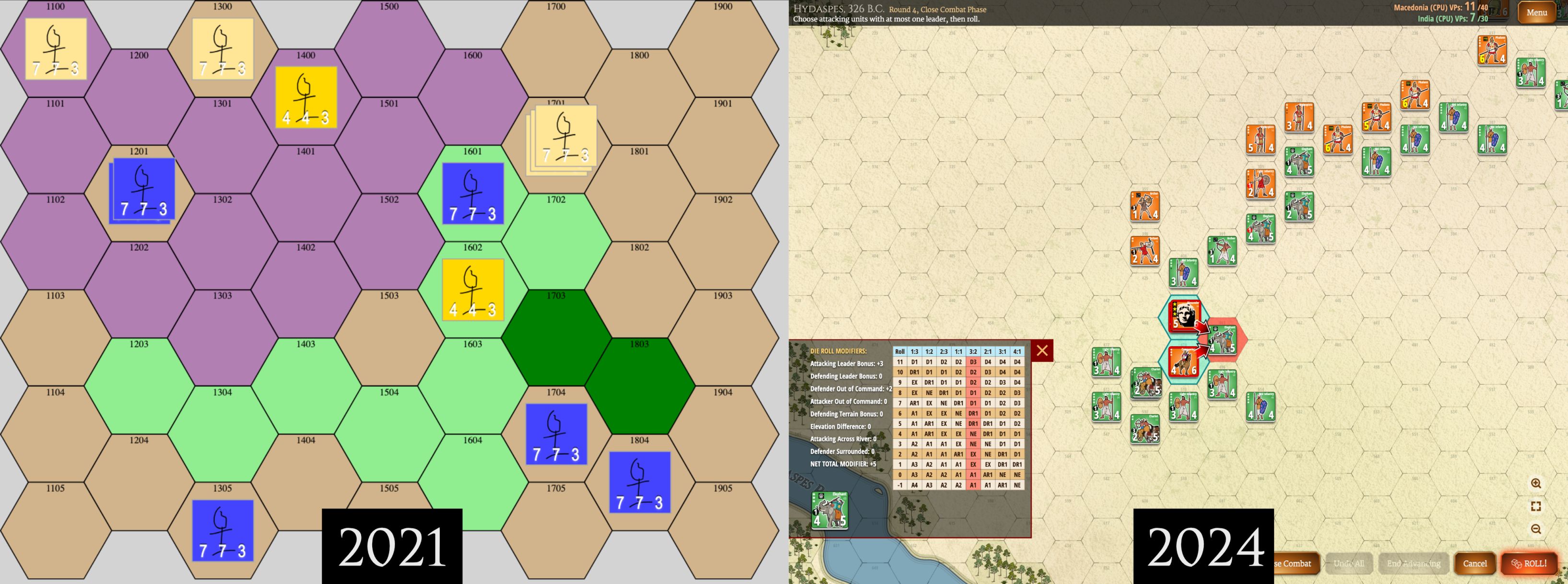
In 2021 during COVID, my wife and I were really playing a lot of wargames and I decided to take a stab at creating a digital hex-and-counter game. It would let me use my art and design skills while sharpening my coding skills and I’d learn about history. Because I’m a one-man studio my role on Arete is doing everything: game designer, illustrator, UI designer, developer, as well as historian, writer, marketer, whatever else. My wife was good enough to proofread everything and playtest the game every step of the way.
Michal: Can you tell us what Arete means and how did you come up with the idea for that great game title?
Bill: Glad you like the title! “Arete” is a Greek word that I don’t believe has a corresponding English word with the exact same translation. It’s a concept discussed by Plato in speaking of people seeking excellence, and there’s a great article on Philosophy Now’s website that gives a good description, quoting Henry Marrou: “the ideal value to which even life itself must be sacrificed.” It’s a concept that says living your life with the aim of being epic and honorable at the same time is the ultimate mortal goal. When you read about Alexander, you often hear that he carried a copy of Homer’s Iliad with him. Alexander believed he was descended from Achilles, but Homer’s work was probably also a reminder to him to live a heroic life of excellence and that his deeds should be done for good and to the fullest.
In building an empire, and despite all the bloodshed, Alexander believed he was fulfilling his divine destiny. He believed he was doing something good and honorable. Of course, today if a nation’s leader started invading neighboring countries and slaughtering people, we’d find it abhorrent, and they’d meet with worldwide resistance. As I was researching Alexander, I came across the word “arete” (or some other alternative phrasing of it) and the word stuck with me. It’s impossible to say how much power and wealth factored into Alexander’s drive to conquer, but arete seemed to be a major driving motivation. It also served as an important reminder to me, as I looked back through my modern lens, to suspend my contemporary judgments and envision his world as it was, far removed from ours.
Michal: Now, as for the game, what inspired Arete?
Bill: I chose the topic because my family is from northern Greece, and Alexander the Great is obviously a big part of the local history and yet I felt I barely knew much about him. Only the little bit I learned in school and that was many years ago. This was a perfect opportunity to learn more while designing a game at the same time.
As far as the game itself, the inspiration comes from hex-and-counter wargames in general, but especially the lighter “beer and pretzels” variety. Specifically, games like Commands & Colors: Ancients and GMT’s Battles of the American Revolution series. I enjoy wargames of all complexity, but those that have intuitive rules with the fewest exceptions are the easiest to remember and jump back into, and consequently for me those tend to hit the table more often. For an Ancients game like this, I wanted a streamlined experience that lends itself to the fast, chaotic clash that reflected what these battles were. I also think Arete is a great introductory wargame, and my hope is that it can bring some new folks into the hobby. But just because the rules are easy to learn doesn’t mean that the game is easy. There’s depth and nuance to it and you’ll need to play smart to beat the AI or another person.
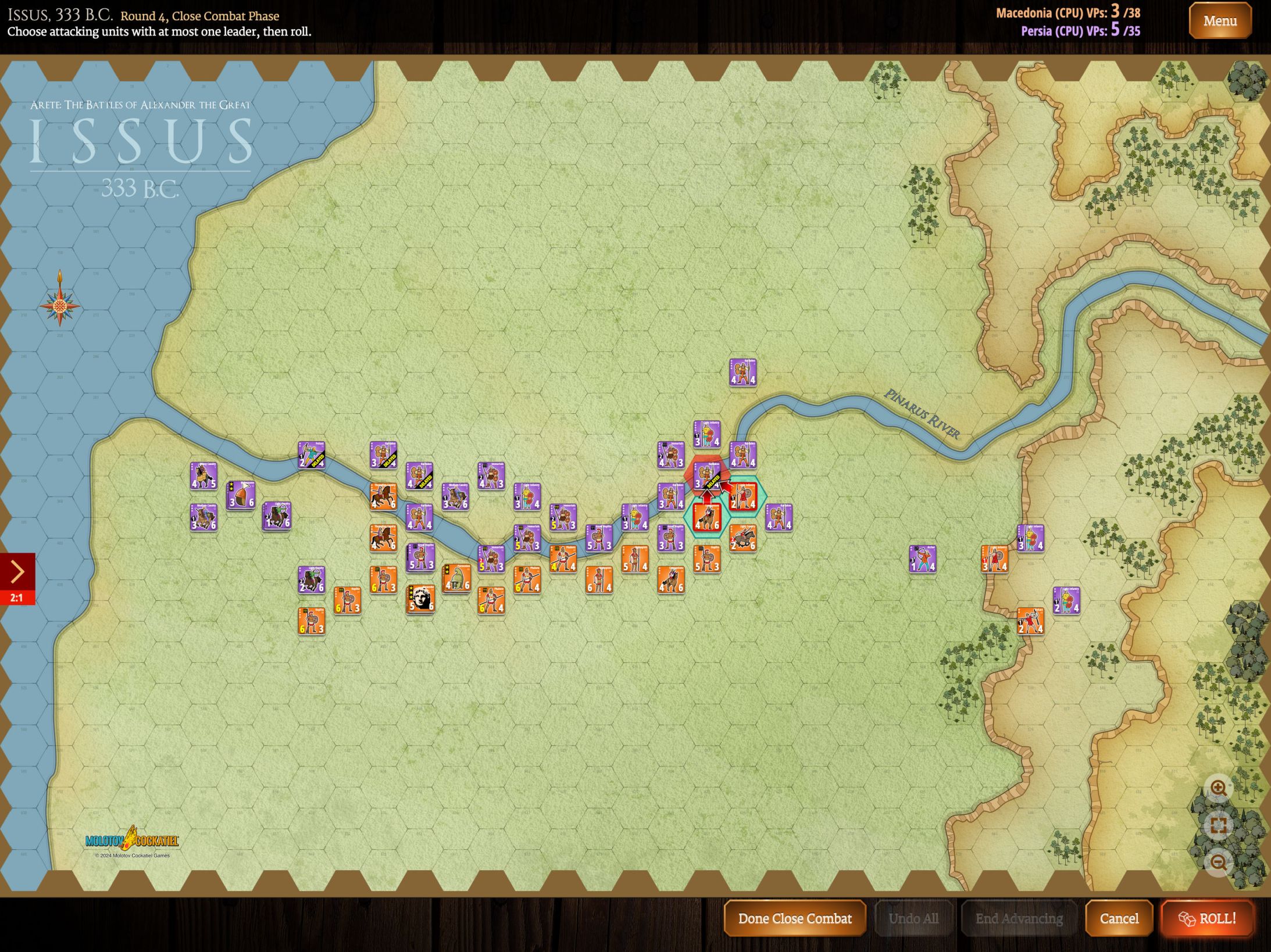
I’m not sure it’s an inspiration, but another factor that was always in the back of my mind as I designed was that this was first and foremost going to be for touch devices. When I looked for games to play on my tablet, I often found ones that were desktop games ported over to touch devices with varying degree of care. Oftentimes you can feel when a UI was made for a desktop and doesn’t work so well translated to touch screens. It feels clunky. So, I wanted touch screen wargamers (like me) to have something that was designed specifically for them.
People are also in a different frame of mind when they sit down to play a game on their computer versus when they’re playing one on their phone or tablet, and that’s another reason keeping the rules streamlined was a top priority. If a player doesn’t play for a few weeks and comes back to the game, it’s important to me that they can start playing again like they never left. If someone is commuting or waiting for their specialty coffee drink in the morning and wants to play a couple of quick turns, it’s easy to jump in and do that.
Michal: Can you elaborate a little about the game mechanics?
Bill: Sure, the game uses conventions that experienced wargamers will immediately recognize. Both players rally injured units then roll for initiative. Then each player moves, conducts ranged fire, and finally conducts close combat. Movement is affected by things like terrain and counter type. There’s stacking but it’s purposely restricted to four steps to keep counter density low. This also creates a decision point as players will occasionally have to decide if they want to stack units or leave them alone to be able to rally. Ranged Fire has all the usual Line of Sight constraints and is a great way to pick off or delay a single unit at a time. Close Combat is where the real casualties happen as you choose an enemy hex to attack and which units, with any available leader, will participate.
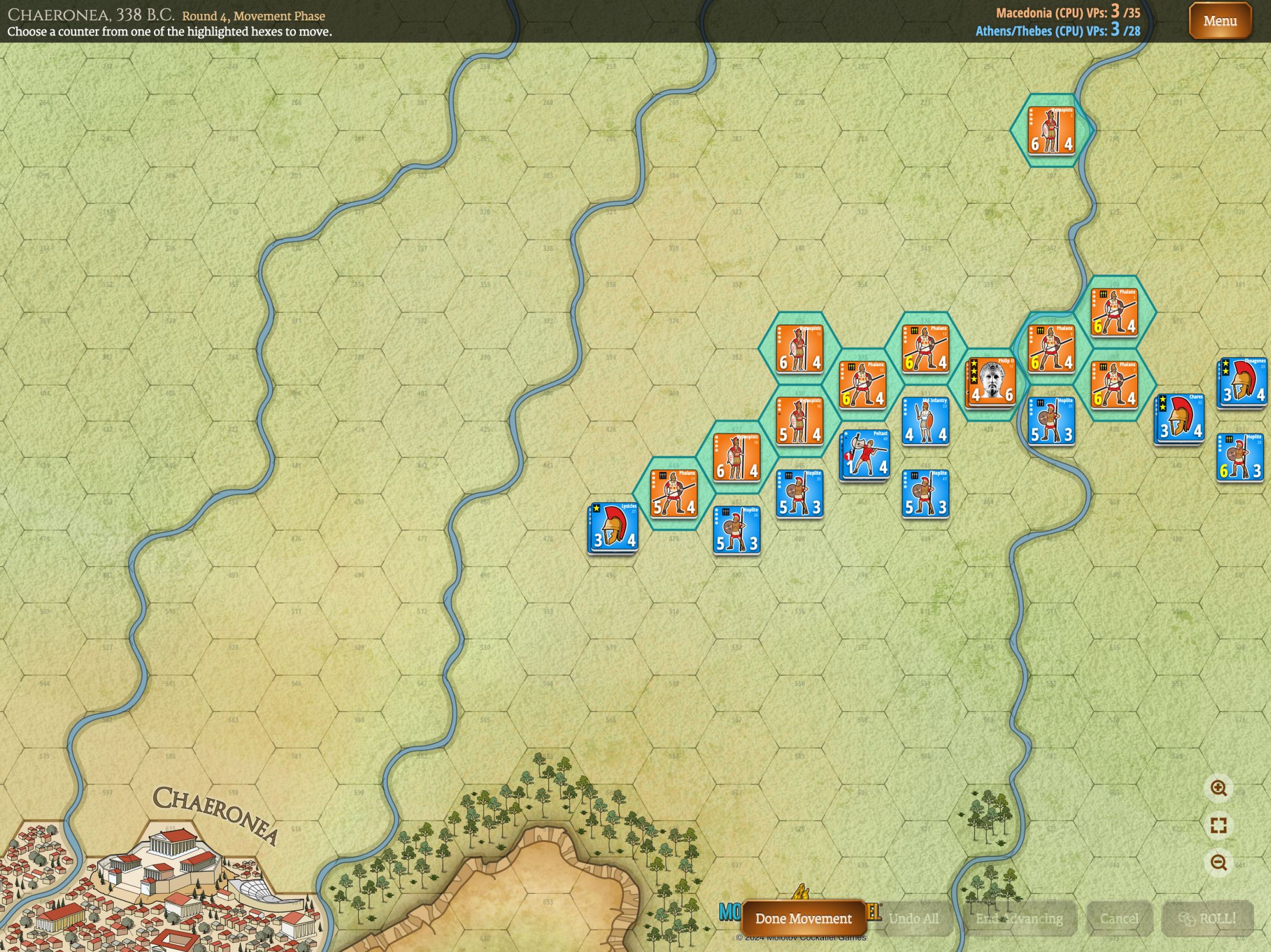
Units can have any number of steps but, as of now, the highest in the game are the 4-step units. Combat effects reduce units’ steps and their strength will be reduced proportionally to a minimum of 1. This ends up creating a some truly exciting battles as both armies might have a bunch of units hanging on for dear life, but still fighting on and providing some heroic moments. “Against all odds” last stands happen, and they’re a blast.
Along the way, there are little rules wrinkles such as Archers being able to fire back, phalangites and hoplites getting bonuses for being adjacent to other like units, and elephants trampling surrounding units. During Ranged Fire and Close Combat, in-game, collapsible panels appear that will display your combat tables and highlight the relevant column and/or result.
I already said the game is a great way to introduce someone to wargaming, but grognards will find a lot of replayability in the tactical decision-making they’ll be doing. I believe the game achieves a depth of gameplay without the rules getting in the way if that makes sense.
You can play against the computer, a local friend with pass-and-play, or against someone online. When playing against the computer, the AI is challenging and behaves with some historical accuracy. For example, at Granicus the Persians will wait for the Macedonians to come to them. Side note here, the AI for game behavior has nothing to do with “generative AI” that’s a hot-button topic right now; all art in Arete was hand-drawn by a human (me).
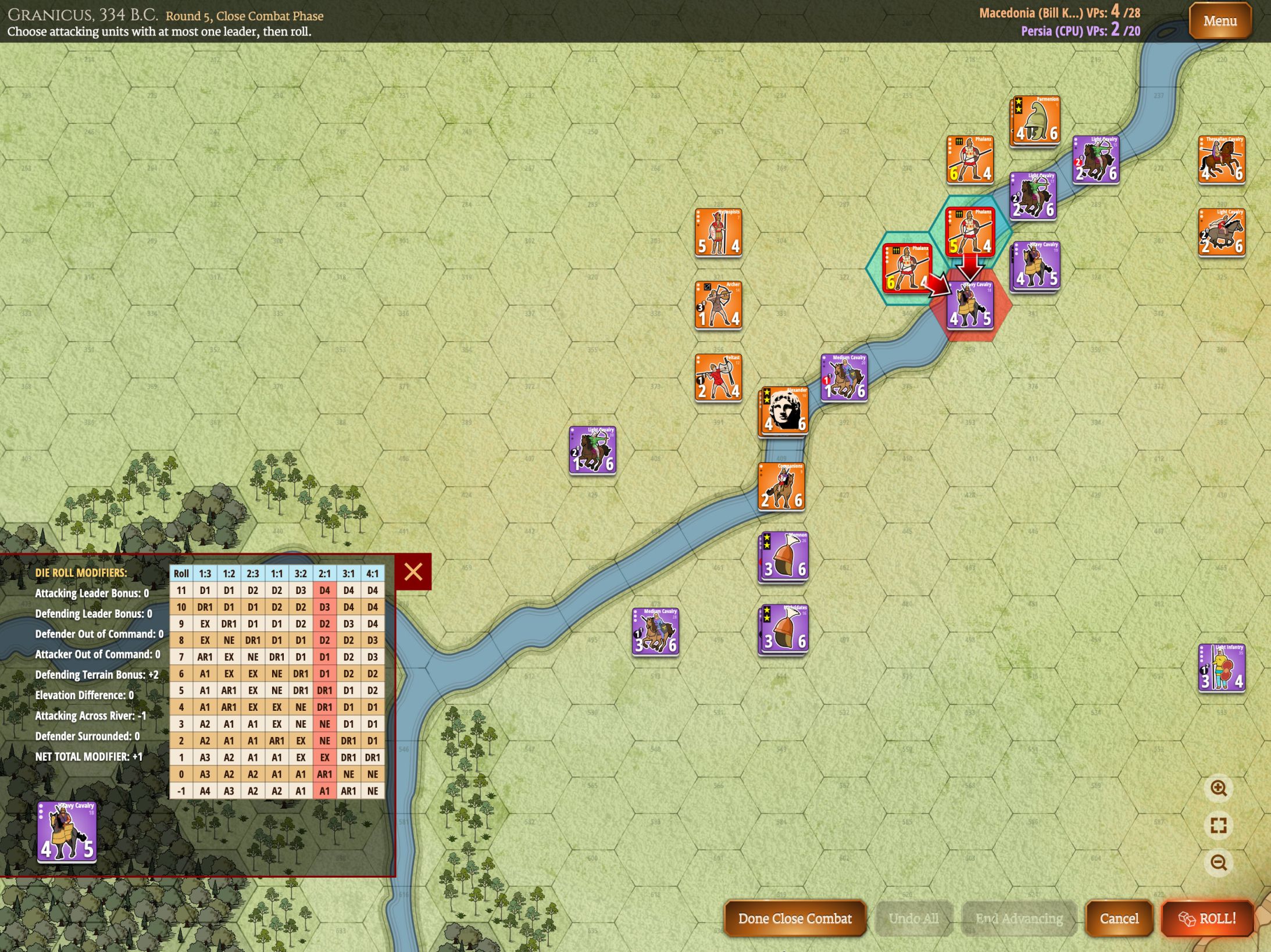
Michal: How do players determine victory? And is it only by scenario or also with the campaign mode?
Bill: Each player has a Victory Point Threshold they’re trying to achieve that varies for each scenario. They gain VP by eliminating enemy counters. If both players meet their VP requirement on the same turn, the game will be a draw. Each battle has a round limit, and if that round finishes without either side meeting their VP goal, the non-Macedonian side is the victor. In all of these battles Macedonia was the aggressor so while the round limit is fairly generous, it does force the Macedonian player to attack.
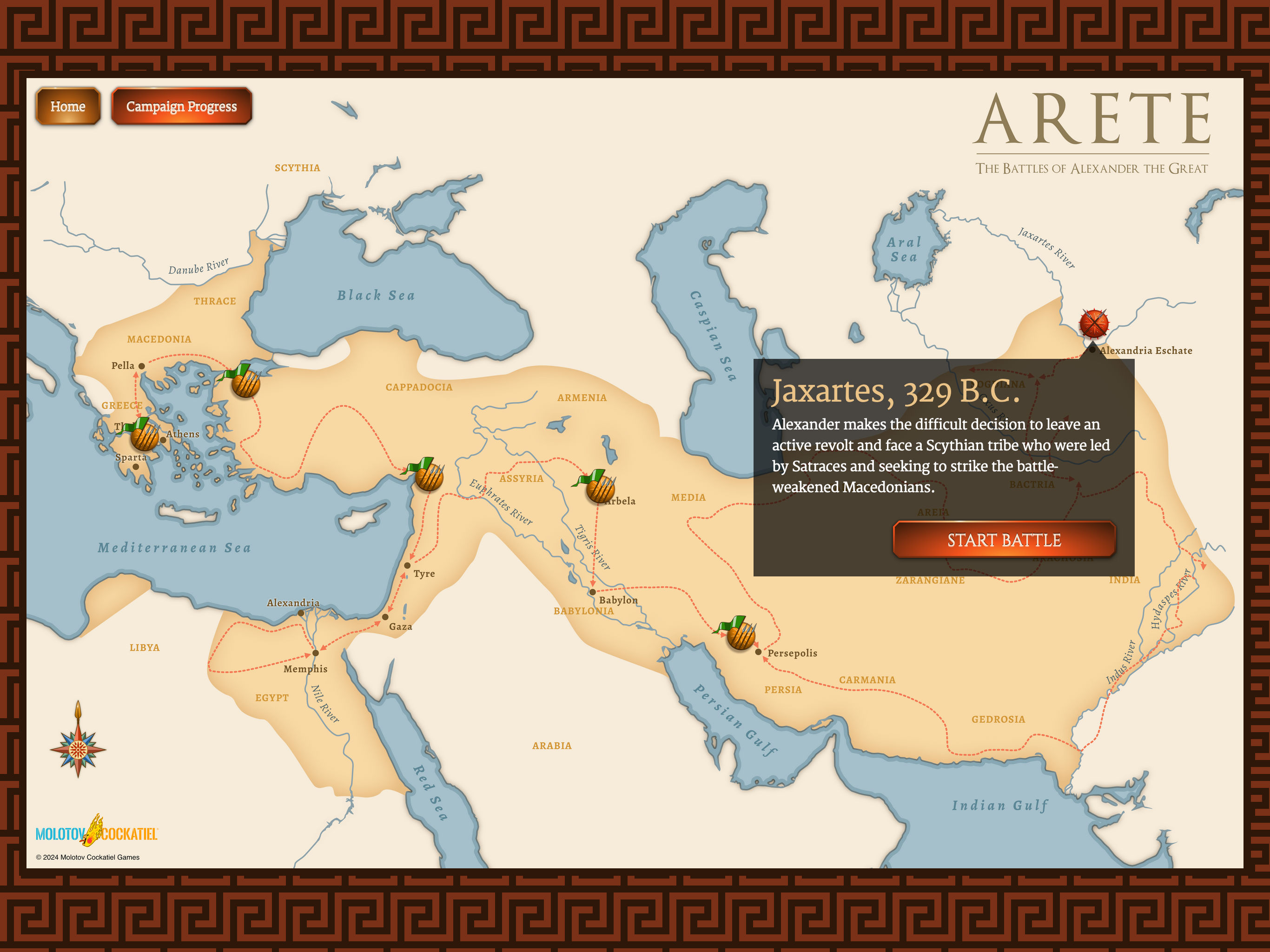
Historically, Alexander won handily at many of these battles, but that wouldn’t make for a very fun game so using the metric of VP, I can challenge the player to win by a certain amount. Show me some arete!
Other than Campaign Mode, which is always set to “unbalanced,” the other modes allow you to choose between a balanced and unbalanced game. If you’re playing fellow gamer of comparable skill, the balanced option will give you both roughly an equal chance of winning. The way I did this is to run thousands of computer-versus-computer battles until I found something close to a 50-50 split. The unbalanced option usually favors the non-Macedonians to varying degrees.
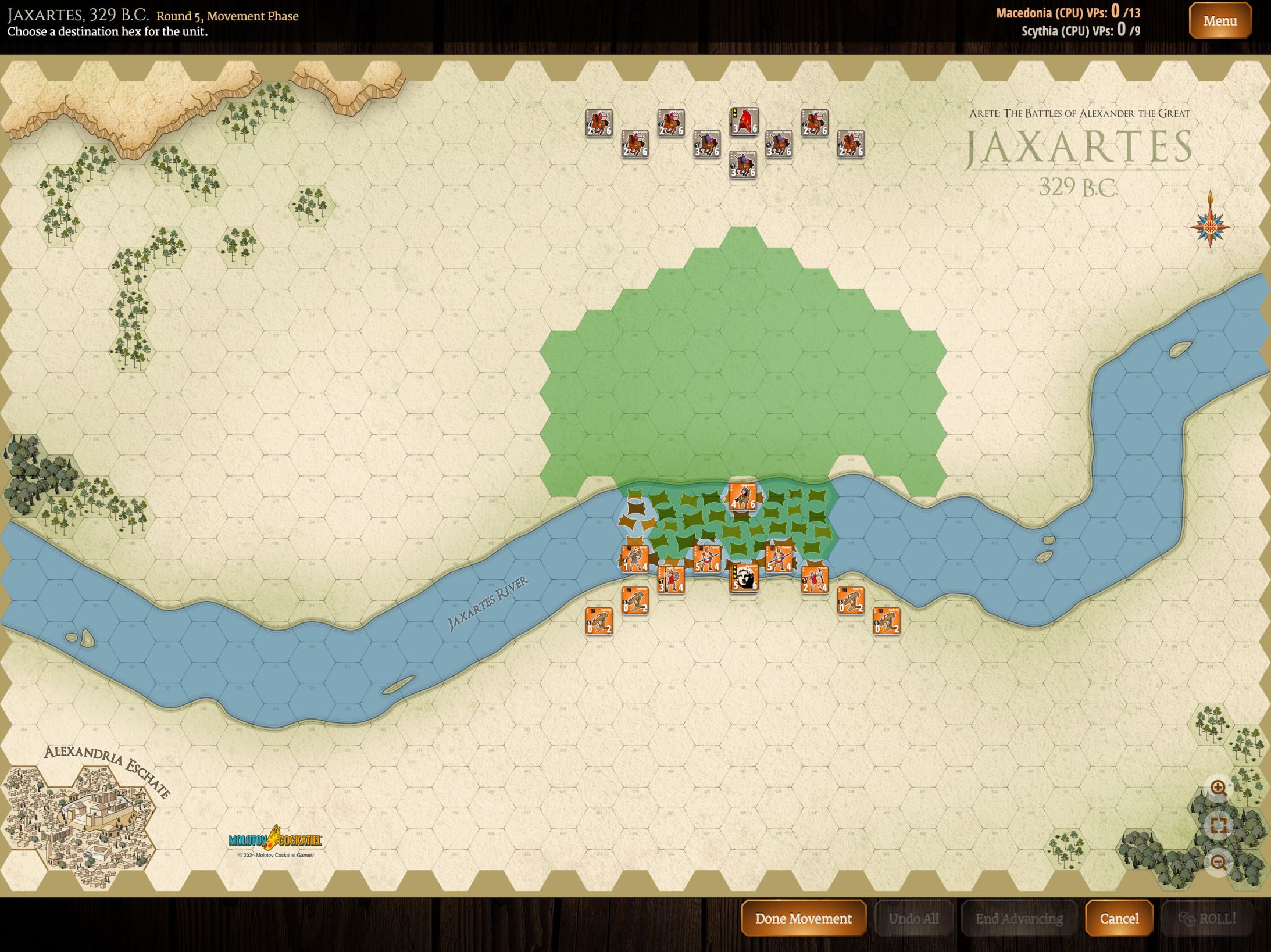
Quick Game mode lets you try any of the battles out of order and as mentioned lets you play it with both sides having similar odds of winning. The battles are Chaeronea, Granicus, Issus, Gaugamela, Persian Gate, Jaxartes, and finally Hydaspes. Campaign mode links all of the battles together chronologically and gives you a grade on each as you progress. When you’re finished you’ll get a final grade for your overall campaign. Getting an “A” in one battle is tough. If someone gets an “A” for an entire campaign, please send me a screenshot; you have truly reached Alexander status.
Michal: Now, as for Arete itself, what makes this game unique?
Bill: There are several things unique about Arete: the intuitive rules, the multiple game modes, the historical accuracy of the setup positions and AI behavior, the fact that it’s designed specifically for touch devices by a UX designer, the challenging AI, and the human-drawn art to name a few. But the number one thing in my opinion is how fun it is.

This game will draw you in and just gets more addictive the more you play. Many times while I was playtesting, I just wanted to see how a feature was working and I’d end up playing through an entire battle just for fun. Each battle has its own personality and when it’s done, you’ll want to talk about it. You’ll remember the key moments that shaped and turned the battle. You’ll have a pre-battle plan that may or may not work and as the battle progresses, pivotal moments and areas will emerge, and you’ll know that your overall victory hinges on them. I remember playing sports growing up and when we were done, my friends and I would walk back home talking about the exciting plays we made. I think (I hope) Arete provides a little bit of that feeling. I hope players will want to share their battle stories with each other like ancient combatants recovering at camp (just watch out for that unfiltered wine).
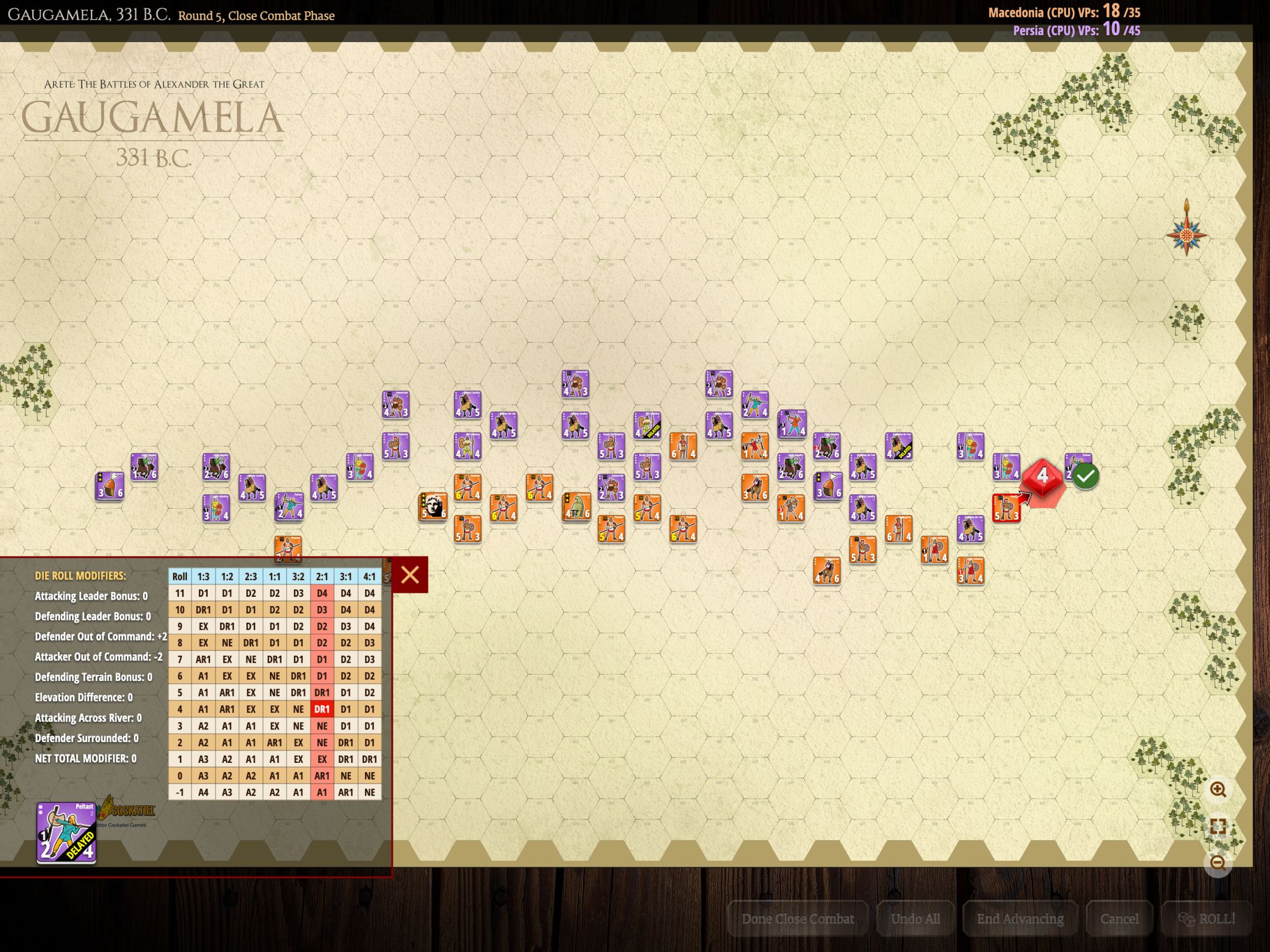
Michal: How is the game available currently? Any plans for other platforms?
Bill: As of this writing, the game is available for iOS and Android. When you buy the game for one platform, it’ll work on phones and tablets of that platform. For example, if you buy the iOS version, you’ll have the game on both, iPhone and iPad. Online mode is cross-platform, so if you have Android but your friend has iPhone, you can play each other.
I’m not sure what comes next. As I said, this was specifically designed with touch devices in mind. I’ve had people ask for desktop/Steam, Windows, and even physical versions. I’m not sure it would even work well for those, but I’m open to it. If I did end up releasing the game for any of those, I’d need to make sure it got the same care I gave for touch screens.
Search “Arete: Battles of Alexander” on Google Play or the iOS App Store or click one of the following links.
App Store: https://apps.apple.com/us/app/arete-battles-of-alexander/id6503917149
Google Play: https://play.google.com/store/apps/details?id=com.molotovcockatiel.arete&pcampaignid=web_share
Michal: What are the future plans for you? Any new designs / games in preparation?
Bill: Right now I’m just fixing little bugs that come up. I want to make sure Arete is in a good place before I move on and, once it is, I’ll explore other ways to use this same hex-and-counter system. Historically, Julius Caesar seems like the logical next step and I’m interested in continuing with Ancients for the immediate future. I’d like to also have some fun with it and release a fantasy hex-and-counter game like the old War of the Ring and I have a few other non-historical ideas. In addition to that I’d like to have some non-hex games mixed in there (that hopefully don’t take three years to make). I’ve always wanted to make a WWII submarine game and a WWI air combat game but right now those just live as ethereal ideas.
Thanks!
Michal: Bill, thank you very much for extensive and insightful interview. Good luck!
If you would like to follow further developments of Bill, I suggest following his Twitter (X) account (https://x.com/MolotovTiel) as well as his great webpage on Arete (https://molotovcockatiel.com/arete-the-battles-of-alexander-the-great/). Enjoy!
 The Boardgames Chronicle
Very interesting – a hex and counter game made specifically for mobile devices, and with a very attractive theme! I wonder how many more games I can play at the same time 🙂
LikeLiked by 1 person
I just started to play this and it is very, very addictive. So far my scores are only “D” but at least I manage to achieve victory (although with significant losses).
LikeLiked by 1 person