
To immediately jump to the Kickstarter Campaign page of the game go here:
Michal: Hi Volko! As a prolific author of such games like Labyrinth, COIN or Levy & Campaign series you are probably known by most of the wargaming enthusiast. But for those who are new to the hobby, please tell us a little about yourself. What do you do for a living, what games do you play? Also, what is your role in the design and publication of the game?
Volko: Hello Michal! And for any readers who are new to historical boardgames, welcome! I myself have been enjoying board wargames for most of my life, including designing them for about 25 years now. I am a retired US intelligence analyst and instructor. My main hobby interest is the exploration of military history through tabletop games. Board wargames have famously been called “paper time machines”, so I guess that I am a “time tourist”. I love to play the games, but making them is an added joy for me. My role is to conceive of the game, build and engineer it mechanically and to a great degree in its graphical aspects, and then to help guide a typically long test and development process to ensure that my little “machine” runs smoothly.
Michal: Now, as for the game, what inspired “Hunt for Blackbeard”?
Volko: In my day job, I got involved in a project to help teach analysts how to support law enforcement in the effort to find and capture a well-protected criminal fugitive, such as a drug lord or terrorist leader. I teamed with a technical expert in that, and we co-designed a tabletop training game based on Mexico’s successful hunt around 2014 for “El Chapo”, the then leader of the Sinaloa drug cartel. As I was retiring, I thought that I could take some of the analytic principles and game design lessons that I learned from that training game and apply them to some other historical case for a commercial game. The 1718 hunt that tracked down the famous pirate seemed to offer the perfect case for a fun 2-player game.
Michal: Most of us remember this title on GMT Games P500 couple of years ago. What happened that in the end it will be published by Fort Circle?
Volko: As GMT fans will know, GMT uses its P500 preorder system to help it determine what to print when and in how many copies. Hunt for Blackbeard struggled to get preorders, probably because the population of GMT customers who make preorders tends to expect to be able to play the games solitaire—as you can do with most wargames—but this game was for 2 players only. At the same time, I discovered a way to improve the game design that required a different set of components than that already advertised on P500.
So GMT and I decided to pull the game from P500 and rework it. I was delighted with the new 2-player mechanics in the game, but after years of trying, we did not come up with a satisfying solitaire experience—a GMT requirement. Kevin Betram of Fort Circle Games was interested in publishing the design even without a solitaire system, as it fit the company’s budding product line, so we all agreed that Fort Circle was the right home for Hunt for Blackbeard.
Michal: What are the key components of the game?
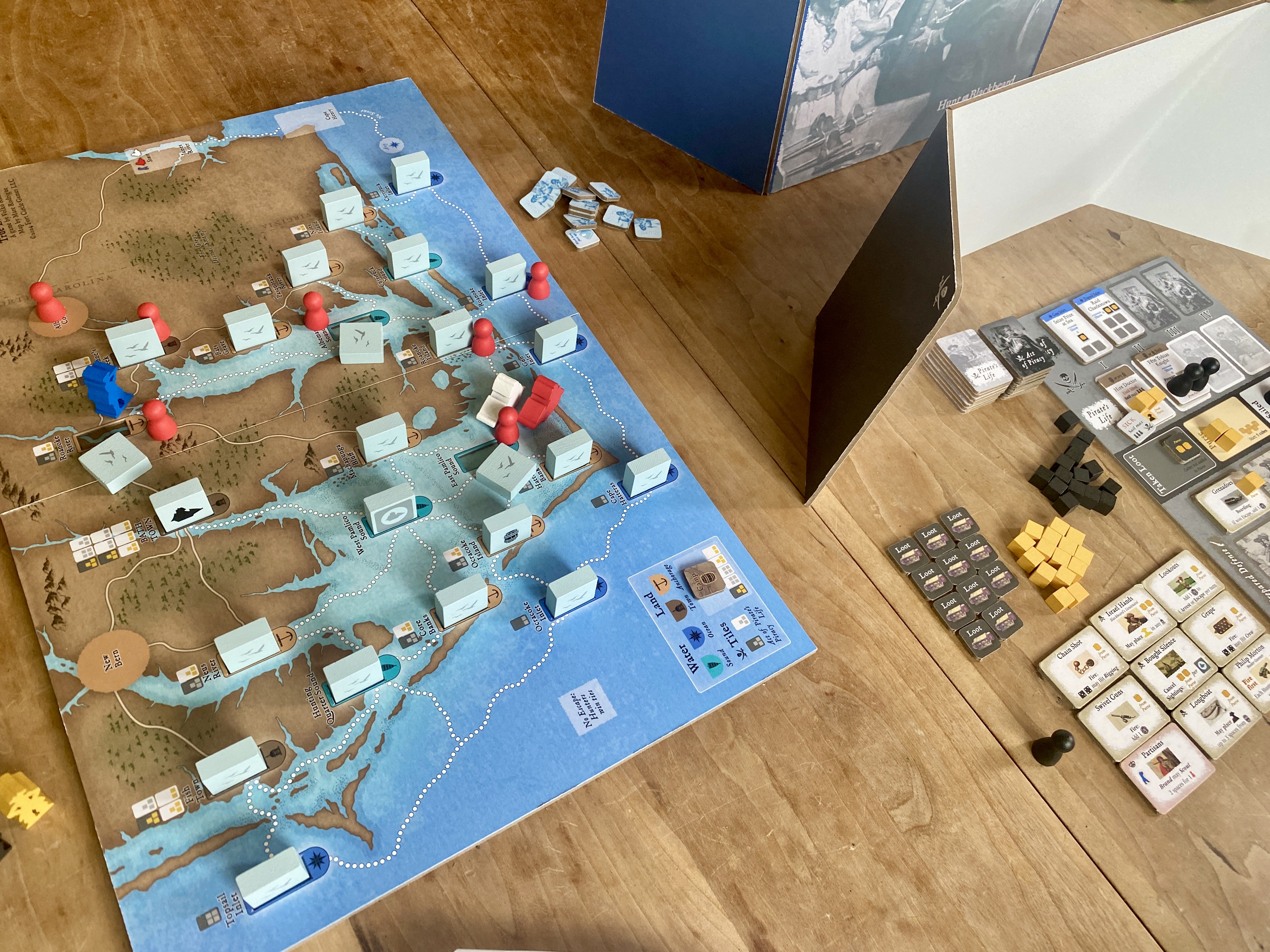
Volko: The game is built around an 11×17-inch gameboard with recessed spaces to hold standup wooden blocks that hide the pirates’ movements. The relatively small main board leaves table space for each player to have a screened game mat that holds some randomly drawn and some purchased secret tiles representing opportunities and capabilities for each side’s objectives. Custom wooden pieces, pawns, dice, markers, play aids, rules, and a volume of historical materials complete the package.
Michal: Can you elaborate a little about the game mechanics?
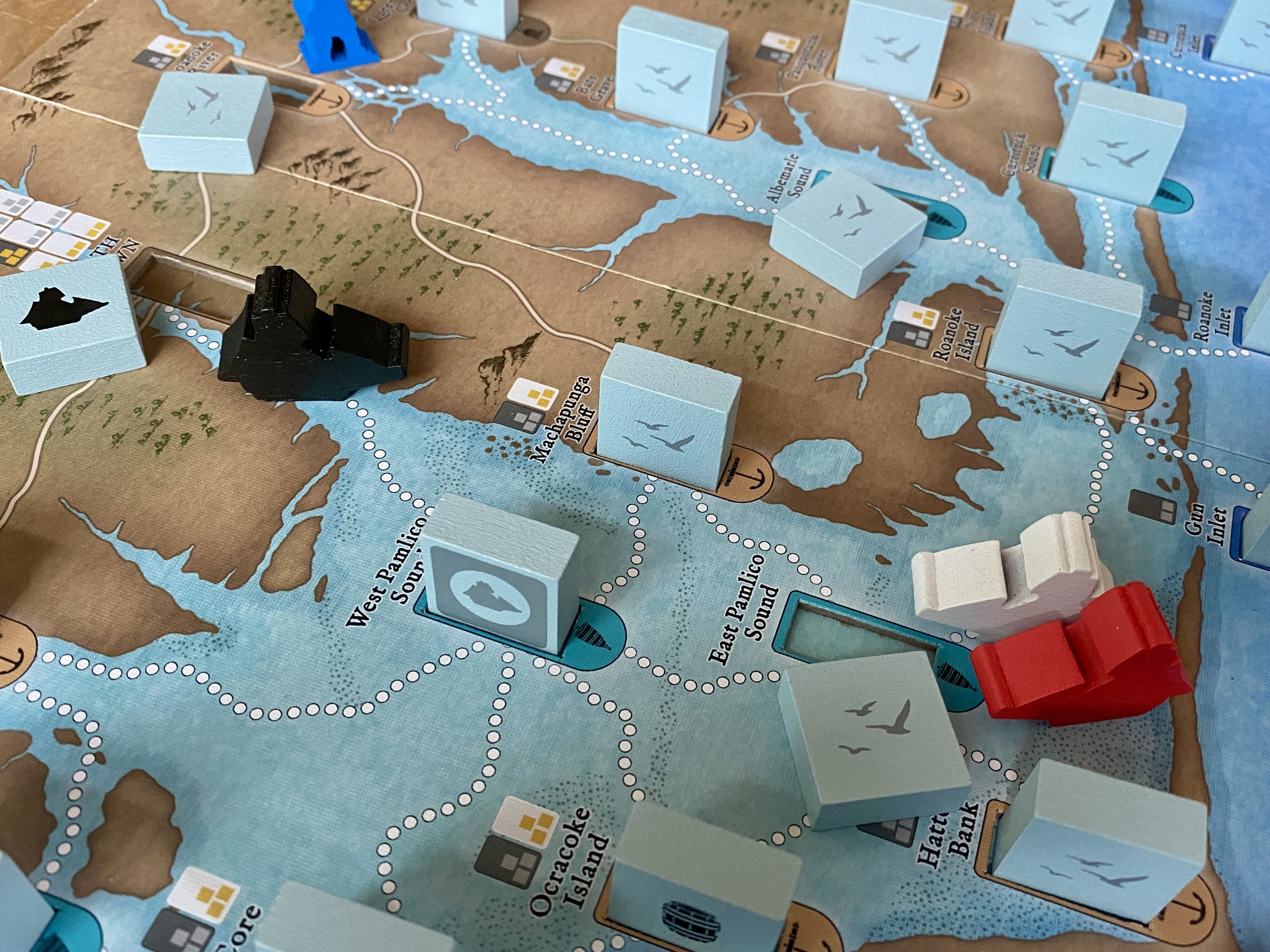
Volko: The central player interaction is via 24 standup blocks on the board. Images on the blocks face the Blackbeard player and show the location of the pirate’s sloop Adventure, the pirate camp, and perhaps individual pirate locations or signs of the ship’s passage called “Sightings”. The Hunters have two sloop pieces Jane and Ranger and a land character Captain Brand that move on the map, always visible to Blackbeard. Behind the screen, Blackbeard is pursuing “Piracy” objectives around the map of colonial North Carolina—usually by sailing his sloop. The Hunters behind their screen are interviewing Informants to secretly peek at various blocks, hoping to pick up the pirate’s trail. The Hunters also secretly equip their expedition from Virginia at the north edge of the map into North Carolina, where Blackbeard is hiding out.
Michal: How do players determine victory?
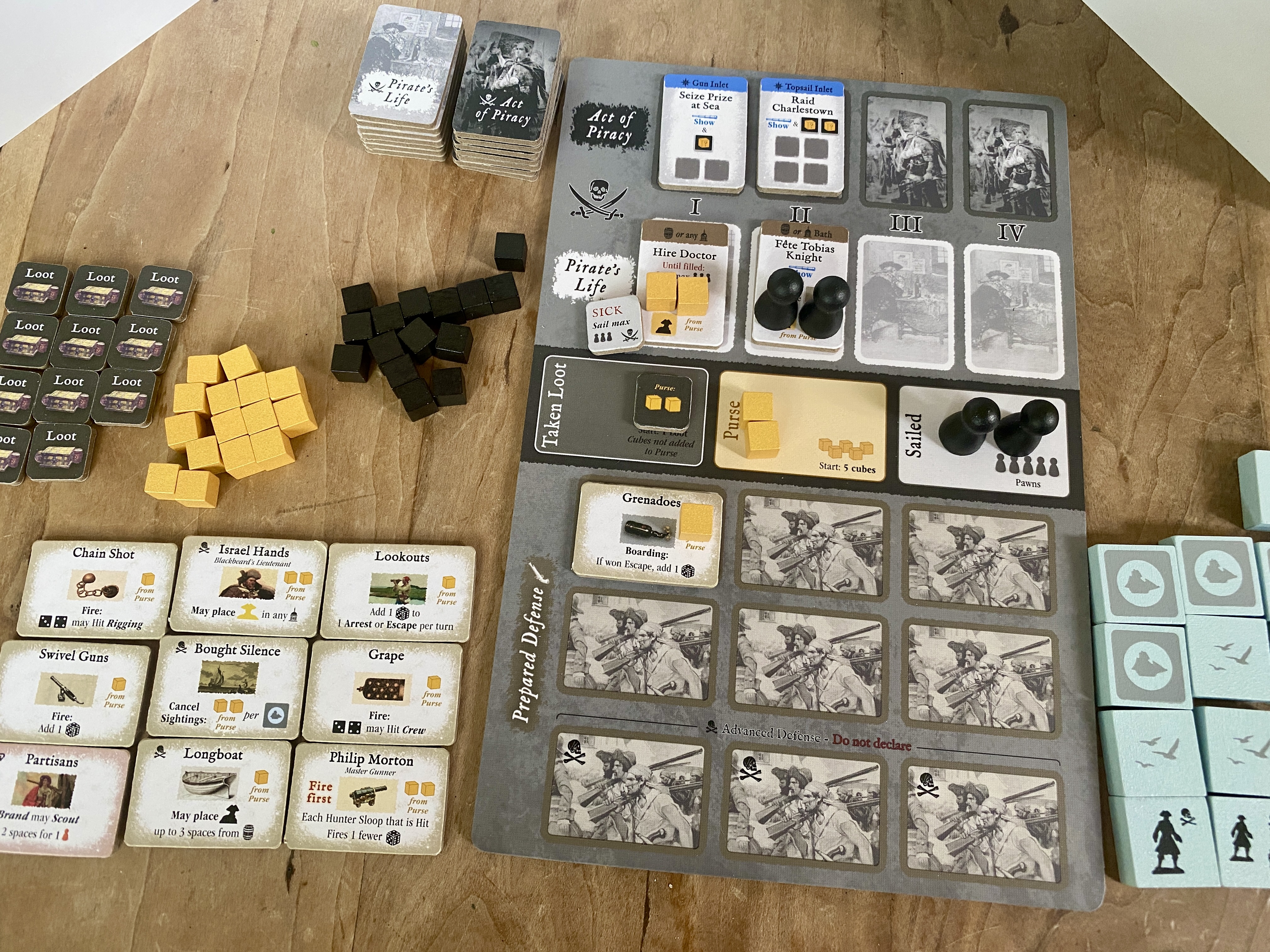
Volko: Blackbeard receives a gradually building series of missions over 4 turns, divided into “Acts of Piracy” (crimes) and “Pirate’s Life” (cashing in). To win, Blackbeard must fulfill at least half of either type of mission—while staying free. The Hunters must find and arrest or defeat Blackbeard in battle, which often involves figuring out in time which missions Blackbeard is after, since that will tend to determine where in North Carolina Blackbeard will be. The Hunters also can win by simply disrupting the pirate’s ambitions—blocking his missions. But the Hunters also can lose if they meet Blackbeard in battle and his sloop wins, so they hope to encounter Blackbeard’s Adventure with their sloops Jane and Ranger well prepared and sailing together.
Michal: Now, as for “Hunt for Blackbeard” itself, what makes this game unique?
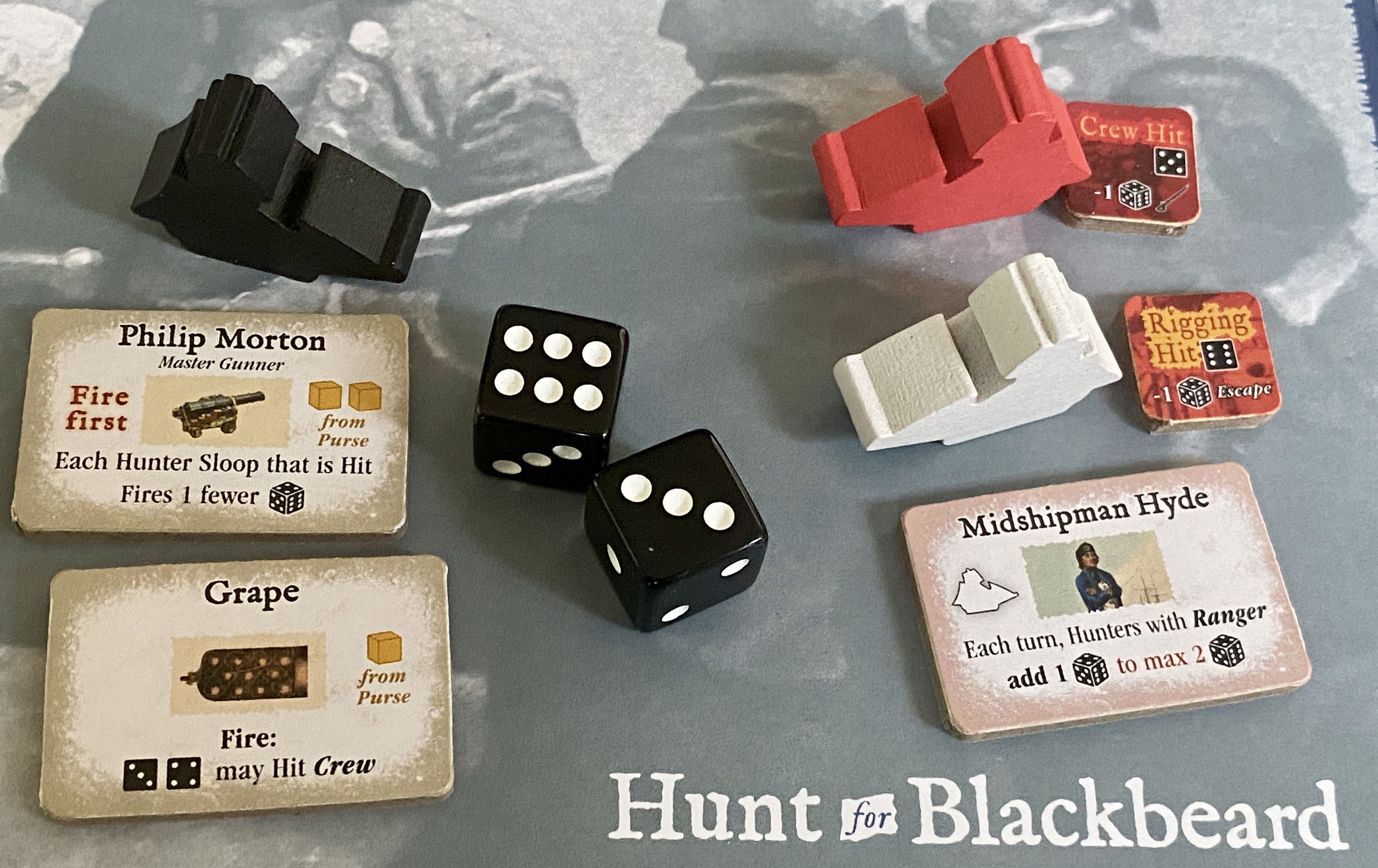
Volko: The game is at heart about intelligence and counterintelligence work. The Hunters seek to discern what Blackbeard wants and needs in order to predict where he might be and how well prepared for a fight. Blackbeard needs to balance success as a pirate against risk of discovery and capture and wants to know how much the Hunters already know—such as the location of the pirate camp. The game captures that struggle over information by enabling both sides to keep secrets, especially—in a way using the hidden location blocks that I do not believe exists in any previous historical games—to give the Hunters player secret knowledge about Blackbeard. “I know something that you don’t know that I know” is a way to describe such information advantage that the Hunters hope to gain.
Michal: Recently, solitaire games are getting a lot of traction – and your systems were usually having such mode or were pretty solo-friendly. What about “Hunt for Blackbeard”?
Volko: As mentioned above, GMT and I tried for some time to come up with a worthwhile solitaire system for Hunt for Blackbeard. The challenge was that the game’s tug of war over information—especially the opposing player’s intentions—is at the heart of game play. The Hunters are trying to discern Blackbeard’s strategy, and vice versa. A great deal of subtly of play occurs behind each player’s screen to bring that cat and mouse contest to life. It may not be impossible, but it proved beyond me, to deliver that experience effectively enough that I could be proud of the product.
Michal: How are you going to publish the game and where the players interested in the project can get more information?

Volko: Fort Circle is launching a Hunt for Blackbeard Kickstarter to fund production of the game—including a short video by the talented content creator Zilla Blitz. Earlier, when Fort Circle picked up the project but before we had any professional art done, I made my own teaser video as well, briefly introducing the history and play in the game. Hunt for Blackbeard also has a BGG page with more description, images of older versions of the game, plus recent news.
Michal: The inevitable question who all fans of your designs – including me – would like to ask: will “Hunt for Blackbeard” be part of a longer series or a stand-alone project?
Volko: As you could guess from the origin of the design in another historical situation—the modern manhunt for “El Chapo”—I know that the design innovations in Hunt for Blackbeard could well apply to other such situations of hunters and prey. Whether I will design any such second volume in a “Hunt series” will largely hang on the success of this first game. I do have an idea for such a Volume II, also set in the 18th-Century Carolinas, that I would call Swamp Fox.
Michal: What are the future plans for you? Any new designs / games in preparation?
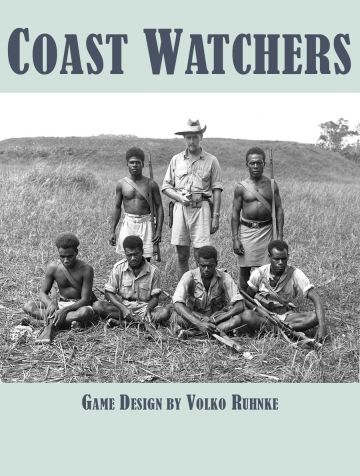
Volko: Thank you for asking! With Hunt for Blackbeard design set and my Levy & Campaign Series in the capable hands of other designers and developers, over the last year I have turned to experimenting with how the location blocks used in Hunt for Blackbeard might further explore matters of intelligence and reconnaissance in military settings. That design exploration produced the game Coast Watchers—Allied Field Intelligence in the South Pacific, 1942-1943, on GMT P500 now. If Coast Watchers succeeds on the market, I have a related volume in work that concerns reconnaissance in the World War I trench battle of Verdun in 1916.
Michal: Thank you so much for the interview Volko!
Volko: Always a pleasure working with you, Michal, thank you for having me here.
 The Boardgames Chronicle