
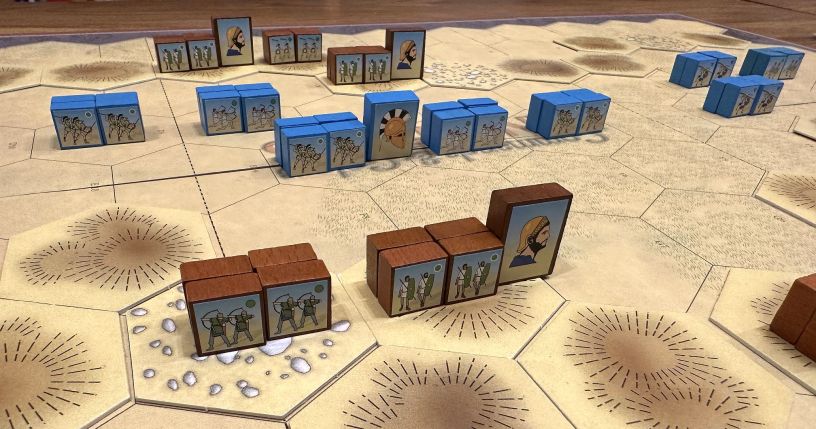
While Commands & Colors Ancients is not hitting our baordgames table so often as in the past years, I still find it very refreshing to play it from time to time. Especially when one can go through a series of scenarios, grouped in small mini-campaign, telling some interesting story.
I admit that after playing pretty intensively the Judean Hammer, my interest for Maccabean revolt (i.e. Jewish uprising against Seleucids in 160s BC) grew significantly. The idea of checking how that conflict was depicted by C&C Ancient appeared almost instantaneously. And you know, I can always count on Marcin when that game is concerned. So without much delay we agree to play that episode of history using our favorite system.
Historical Background

As a history buff, I care about story the game tells as much as for its mechanics. So let me write couple of sentences about period and events. The Maccabean Revolt was a pivotal event in Jewish history and unfolded in the 2nd century BCE under the reign of the Seleucid Empire. Antiochus IV Epiphanes, the Seleucid king, aimed to Hellenize his empire, imposing Greek customs and prohibiting Jewish religious practices. This led to widespread discontent among the Jewish population.
Mattathias, a Jewish priest, sparked the revolt in 167 BCE in Modin, refusing to offer a sacrifice to Greek gods. His son Judah Maccabee became the rebellion’s charismatic leader after Mattathias death. The Maccabees, a group of Jewish fighters, employed guerilla tactics, engaging in a series of battles against the Seleucid forces.
Despite being vastly outnumbered, the Maccabees secured significant victories, including the recapture and purification of the desecrated Jewish temple in Jerusalem. This event gave rise to the annual celebration of Hanukkah, commemorating the rededication of the Temple and the miracle of the oil lamp burning for eight days. The revolt’s success established an independent Jewish state, the Hasmonean dynasty, which endured for around a century.
The Campaign
We decided to play the set of seven battles created by irreplaceable and prolific C&C Ancients fan-made scenarios designer Jim Duncan. The Maccabean Revolt (167-160 BC) mini campaign can be found of course on https://www.commandsandcolors.net/ webpage, where fans community for that title meets and cooperates.
There are two important rules which will pertain to most of the scenarios:
- When Judas is attached to a unit, the unit will battle with 1 additional dice in close combat. Either mark Judas with a special banner or use an eastern leader for him.
- Due to the excellent ability of the Maccabeans to operate in loose order, any order requiring linked hexes, such as a Line command or Leadership card, may have one vacant hex as part of the chain.
Ok, let us see how it went. I was playing as Seleucids while Marcin was leading Jews (Hasmonaean). I strongly recommend reading Battle Context sections, as they will create incredible narrative of the struggle. I will also add the set-up of each battle and final forces disposition / results with couple of words of comment.
PS. Please remember you can click on each picture to enlarge it in new window.
Scenario 1 – The revolt begins (166 BC)
Battle Context: The Jewish revolt against the Seleucids began as a result of the Seleucid King, Antiochus IV Epiphanes, attempting to force Hellenism on the Jews. In the village of Modein, the leader of the Hasmonaean family, Mattathias, encouraged the villagers to kill the Greek enforcers when they arrived, and he then fled east into the Gophna hills with his 5 sons and a small band of followers. The revolt was on, but Mattathias died soon after and his eldest son, Judas Maccabaeus, took up the reigns of leadership.
The first Seleucid to react to the situation was Apollonius, the governor of Samaria. Judas, with only a few hundred men, set an ambush for Apollonius somewhere favorable on the road between Samaria and Jerusalem. The Seleucids were overrun with many killed, including Apollonius.


Scenario 2 – Beth Horon (166 BC)
Battle Context: Following the defeat of Apollonius, the next Seleucid attempt to suppress the Jewish revolt came from a leader called Seron who was from Thrace, and was probably in command of a force of Thracian Mercenaries. Seron and his men were ambushed by Judas Maccabaeus and a small picked force in a narrow file between the heights of Sheikh Abu-Shusha and the sheer drop to Wadi Jureidum, north of Jerusalem.
The Seleucids were once again surprised and routed, with the survivors fleeing west back to the coast after losing 800 men killed in the battle and pursuit. It was clear from these first two encounters with the Jews that the Seleucids needed to apply more force than just local garrison troops.
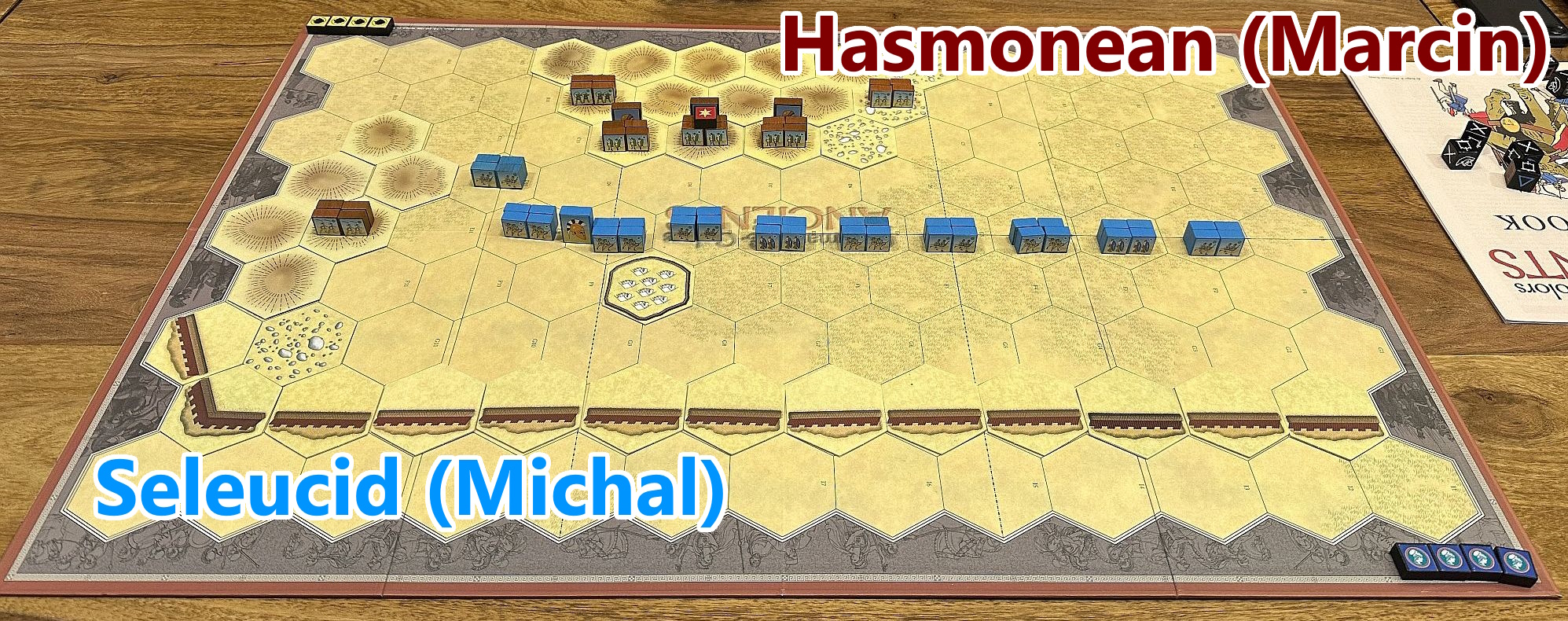

Scenario 3 – Ammaus (165 BC)
Battle Context: Despite the Seleucid defeats in Judaea, the Jewish revolt was still a low priority for Antiochus – he left his regent Lysias in charge of the western empire with instructions to sort out the Jewish problem.
The Seleucids set up camp on the plain below the hills around the town of Ammaus. Not wishing an open contest, Judas assembled his troops in the hills east of Ammaus. Seleucid general Gorgias with 6,000 of the best troops set off on a night march to surprise the Jews. Judas picked his best men and made his own night march. As dawn broke, Gorgias found a deserted camp at Mizpah, while Judas and his men fell on the unsuspecting Seleucid camp, with many men still asleep. The Jews broke into the camp and routed the Seleucids, killing 3,000, for Judas’s greatest victory.


Scenario 4 – Beth Zur (164 BC)
Battle Context: The Seleucid defeat at Ammaus, coupled with the fact that the bulk of the Royal army was on campaign with the king in the east, led Lysias to attempt to sort out the Jewish problem by himself. He assembled an army of about 20,000 men, and approached the Judaean hills from the south. This route led past the Jewish held fort of Beth Zur which Lysias stopped to capture.
The battle was a raid against Lysias camp as he prepared to head north. The Seleucids are caught by surprise, with their army in camp, and only scout patrols and observation units immediately available to oppose the Jews.
The Hasmonaean army had now reached a size of 10,000 men, although still of an irregular nature. The battle is cited in all sources as a Hasmonaean victory. What is more, with this victory and the retreat of Lysias, Judas deemed the time ripe for the re-purification of the Temple in Jerusalem.


Scenario 5 – Beth Zacharia (162 BC)
Battle Context: Following the purification of the Temple, Judas started to help the Jews in settlements outside Judaea. With his power base and manpower resources growing, and with no response from Antioch, in early 162 BC, Judas decided to capture the Acra fortification in Jerusalem, and placed it under siege.
This elicited an immediate reaction from Lysias. With the return of the Royal army from the east, following the death of Antiochus IV, Lysias, who was accompanied by Antiochus V, was able to take a much stronger army to Judaea, including the Royal Guard, cataphract cavalry and eight elephants.
Despite brave resistance, during which Judas’s brother Eleazer died killing one of the elephants, the Hasmonaean army was overwhelmed by the heavy Seleucid assault, and forced to withdraw. Lysias placed the Temple under siege, but before it fell, a man called Phillipus arrived from the east with an army and a claim to the throne. Lysias rescinded all the edicts of Antiochus IV to placate the Jews so that he could once again withdraw to Antioch where he defeated Phillipus.


Scenario 6 – Adasa (161 BC)
Battle Context: When Lysias withdrew to Syria after the battle of Beth Zacharia, he left Nicanor in charge of Judaea and the Akra garrison. As Lysias and his contender for the Seleucid throne, Phillipus, had most of the Royal army, Nicanor had to make do with local troops at his disposal.
The Seleucids were now probably outnumbered by the Jewish troops. Nicanor realized that in order to defeat the Jews he needed more men and so he requested and was granted reinforcements. Nicanor now had 9,000 men and he encountered Judas and a Hasmonaean force just north of the Jewish camp at Adasa on their way back to Jerusalem. The Seleucids were defeated, with Nicanor and 500 of his men killed. Hasmonaeans had numerical superiority in this battle as otherwise Judas would not have accepted battle in relatively open terrain and would have tried to ambush the Seleucids.
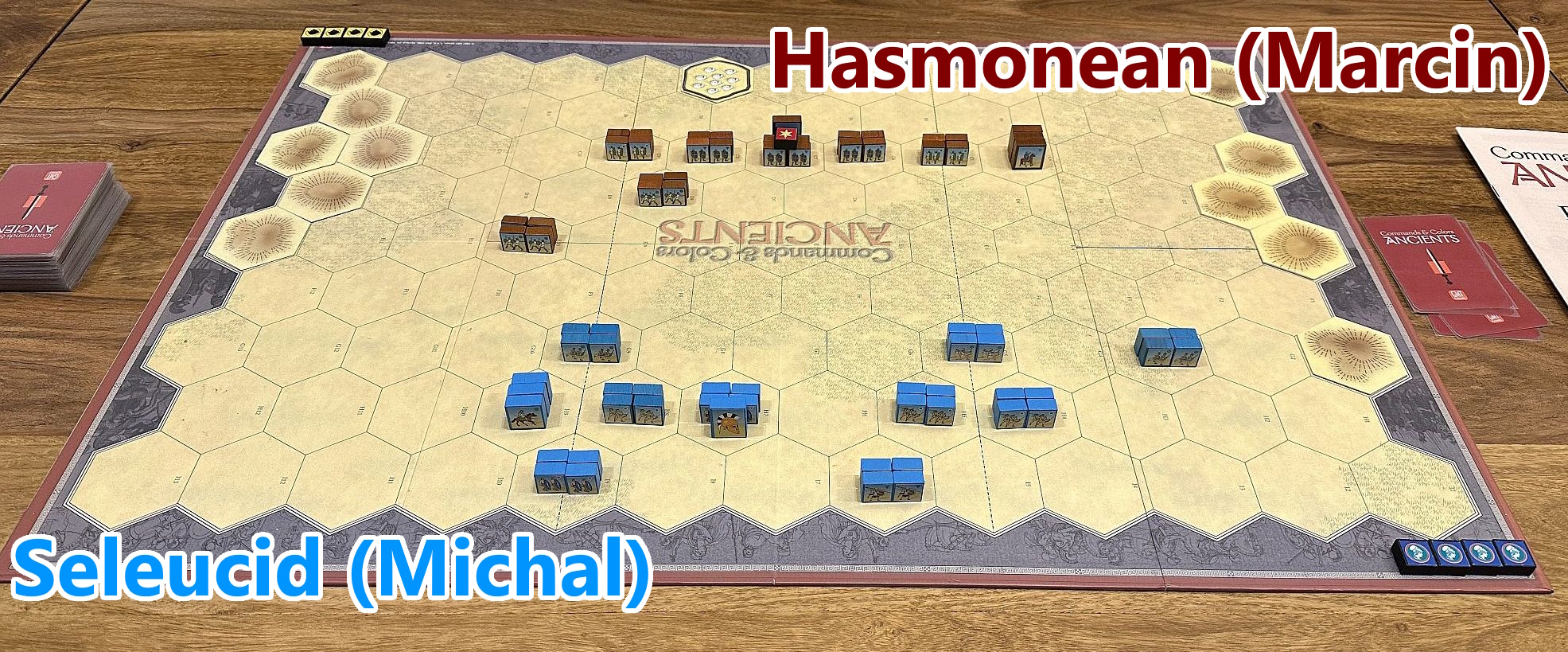

Scenario 7 – Elasa (160 BC)
Battle Context: With his victory at Edasa, Judas Maccabaeus consolidated his control over Judae even secured a pact with Rome! Meanwhile in Antioch the former heir to the throne, Demetrius I, had escaped his captivity in Rome and seized the kingship by killing Lysias and Antiochus V. The eastern satraps rose in revolt against Demetrius. Demetrius headed east and crushed the rebellion, and assigned Bacchides and Alcimus to deal with the Jewish problem.
Jews had rough parity with the Seleucids and therefore felt confident to meet them in open terrain north of Jerusalem. In the account of the battle the Jewish left-wing attacked and broke the Seleucid right with Bacchides, and pursued them for a long distance, until the Seleucid left wing cavalry came to the rescue and killed the now surrounded Judas. Command of the revolt passed to his brother Jonathan and the rebellion continued.


Campaign Summary
First and foremost, it was such a fun to play this mini-campaign and discover the story of this revolt; Jim Duncan did a tremendous job of using well-established C&C Ancients mechanics, tweaking the special rules a bit and achieving the real feel of this uprising. From ambushes to night raids of the camps, from suicidal battles with heavy Royal Bodyguards to quick hit and run tactics. We experienced all of this!
And for the results? Here they are – congrats for Marcin for successfully lead rebellion!

We will definitely play more C&C Ancients in campaign way, discovering some interesting, sometimes obscure historical events. That is what our hobby is for – to have fun on table and to get insight in past events. More to come!
 The Boardgames Chronicle
Amazing post! Not one C&C Ancients battle report, but seven of them 🙂
I do enjoy the thematically connected campaigns very much. And that it was from the Maccabee Uprising was also a plus for me after our Judean Hammer games last year 🙂
LikeLike
Played out the campaign of 7 games in one Friday evening. 28-10 to the Hasmoneans with the Seleucids having disastrous malfunctions at both Beth Zacharia and Elasa.
LikeLiked by 2 people
Wow, what a campaign!
LikeLike
We are planning another C&C campaign with Caesar in Gaul and Britain. C&C lends itself very well to gaming through such a format.
LikeLiked by 1 person
That would be great!
LikeLike