

So far I played Judean Hammer five times with various opponents – each time learning something new about that small, neat wargame. While not taking too much time to play it end-to-end, there is something which drags you to this position to try one more time – maybe with different approach, strategy or concept. Whatever it is, I am always gladly coming back to this title. Today we shall look in more details at its rules, components and my impressions based on various sessions / plays. Enjoy!
The game

First, a few words of introduction. Judean Hammer is a fast-playing wargame which depicts tense struggle between the rebel player (The Maccabeans) and the empire player (The Seleucid Greeks) trying to re-assert their control. This two-player wargame plays in about an hour or two, with a lightning-fast set-up time. The Greeks start in their unassailable supply centers, controlling Jerusalem, but the Maccabeans can use ambushes to whittle their foe while cutting off the Greek supply.

At the heart of the game, you strive for control of critical cities in the region, especially Jerusalem, playing cards to move or recruit units or to use a special ability that benefits only your faction. However, there is only one deck, and the more special ability cards you play, the weaker your side becomes in combat — which leaves you to make tough decisions at almost every play: Do you push for an early advantage, capturing critical regions and amassing a victory point advantage? Or do you bide your time, watching your opponent weaken themselves, then strike hard at the end to steal the win?
As for the victory, after each turn you give 1 Victory Point to the side which controls one of six regions. To gain control you need to have more cities occupied by your units than opponent. Whoever first reach 12 VPs wins. game can be finished also if only twelve or less cards are left in draw deck.
Historical Background

As a history buff, I care about story the game tells as much as for its mechanics. So let me write couple of sentences about period and events. The Maccabean Revolt was a pivotal event in Jewish history and unfolded in the 2nd century BCE under the reign of the Seleucid Empire. Antiochus IV Epiphanes, the Seleucid king, aimed to Hellenize his empire, imposing Greek customs and prohibiting Jewish religious practices. This led to widespread discontent among the Jewish population.
Mattathias, a Jewish priest, sparked the revolt in 167 BCE in Modin, refusing to offer a sacrifice to Greek gods. His son Judah Maccabee became the rebellion’s charismatic leader after Mattathias death. The Maccabees, a group of Jewish fighters, employed guerilla tactics, engaging in a series of battles against the Seleucid forces.
Despite being vastly outnumbered, the Maccabees secured significant victories, including the recapture and purification of the desecrated Jewish temple in Jerusalem. This event gave rise to the annual celebration of Hanukkah, commemorating the rededication of the Temple and the miracle of the oil lamp burning for eight days. The revolt’s success established an independent Jewish state, the Hasmonean dynasty, which endured for around a century.
Session Reports
Now, in a lightning report I will share the game set-up as well as quickly report on games I played, underlying especially what I learned during each of them.
PS. Feel free to click any of below images to expand them in new window for more details.
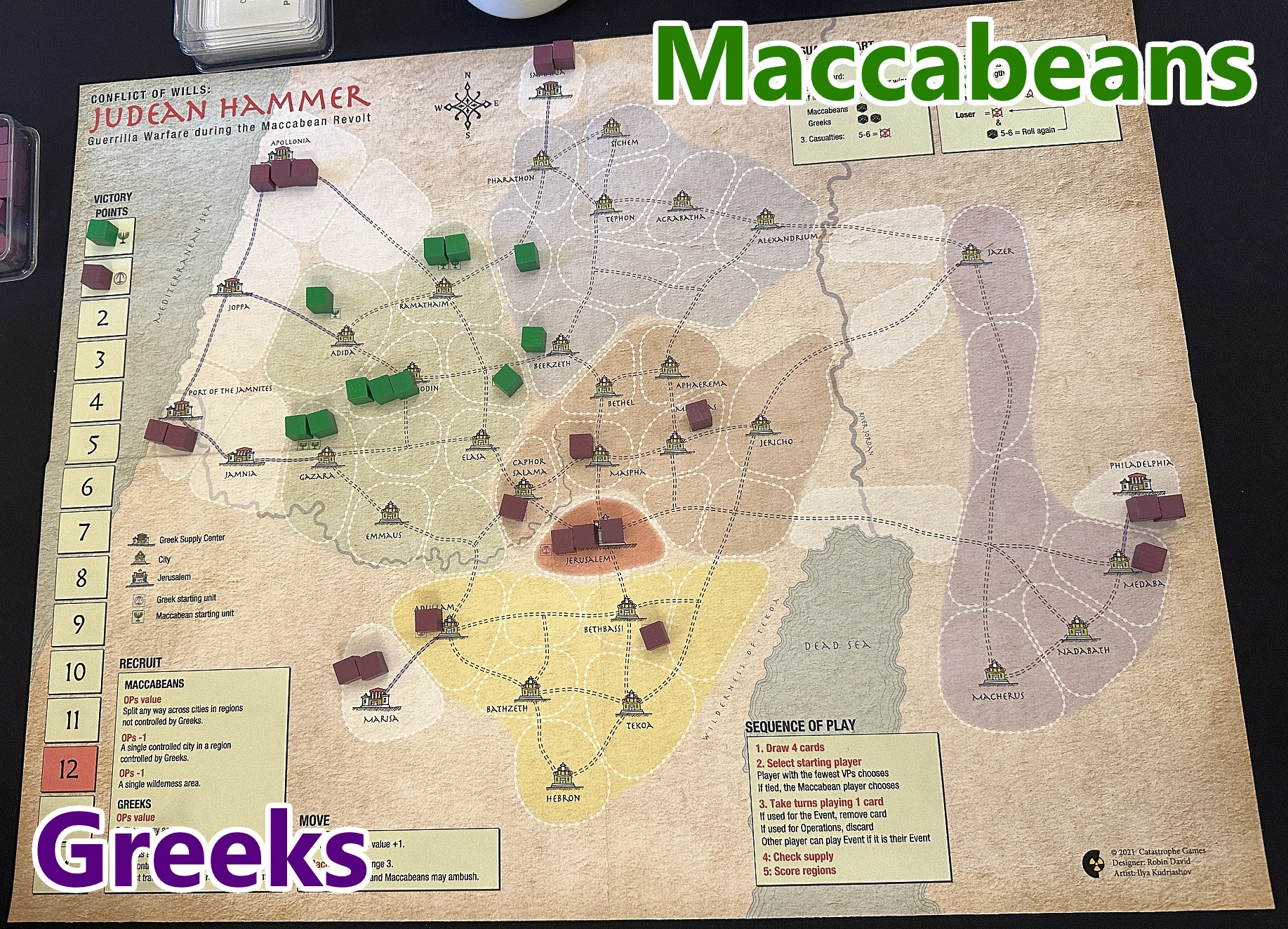
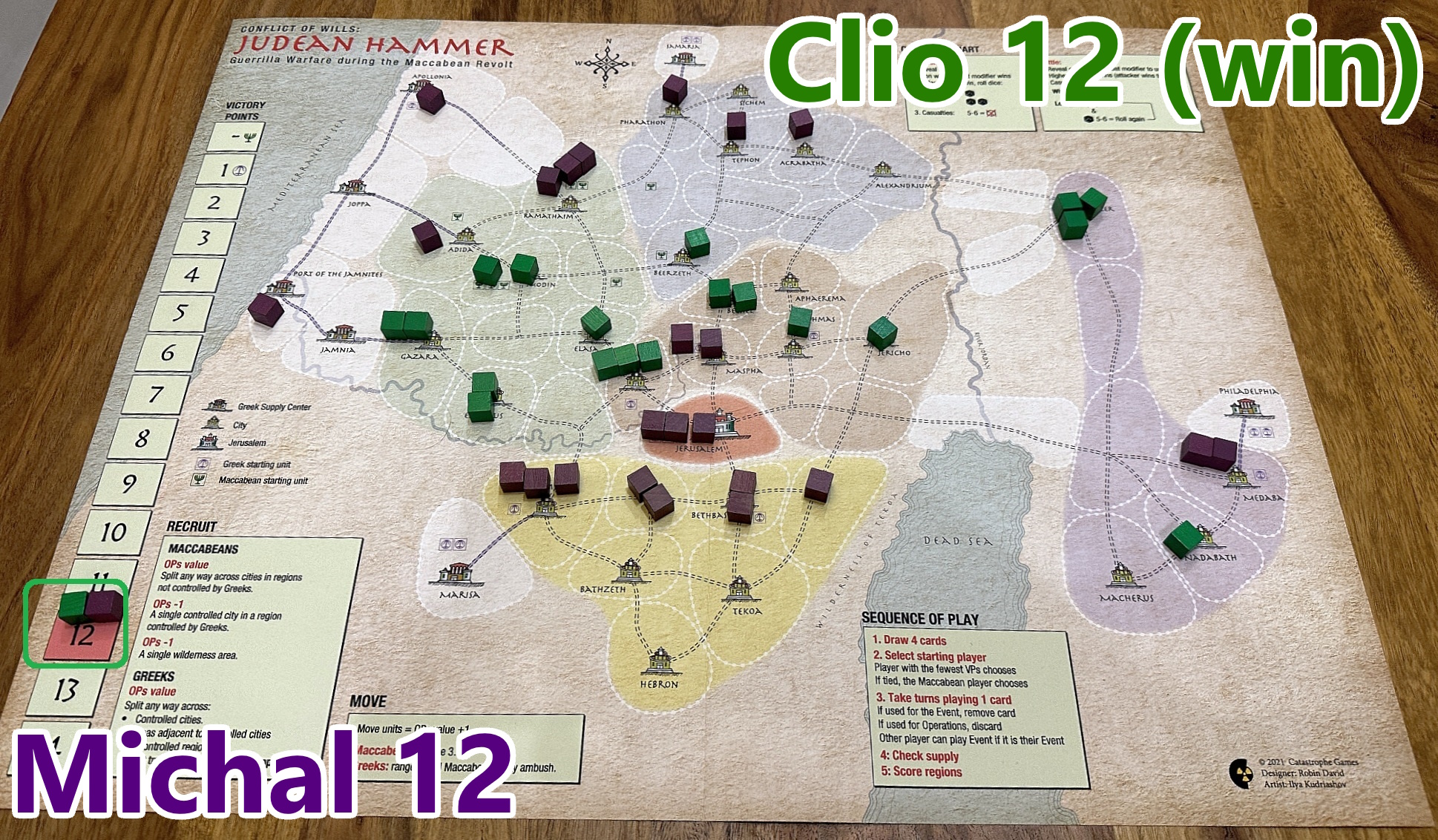


If you look above, insurgents won four out of five games; each time that was victory hard fought, oftentimes by minimal value. What I learned, is that it is better to start with Greeks, as at least initially, they have more forces and better position on map. Will definitely suggest it in future plays.
First Impressions
Let me share now my impressions, observations, things I liked after that couple of plays and elements which I found less impressive. Let us see:
- Definitely, big plus to the game for the asymmetrical concept of Greek and Jewish forces. This is visible in events, combat modifiers, move and recruit actions as well as special ambush mechanic.
- What is another positive is relatively short time to play – not too short, just enough to taste the game and immediately change sides to play rematch.
- The connection of deck shaping with the impact on combat and events is something unique. You have one, common deck. Each time you play event – you remove it form game but also lose your positive combat modifier.
- As far as components are concerned, I am divided. On one had you are getting all you need – nice map, decent cubes, proper cards. On the other, Ione would love to see a bit higher quality of box, rulebook, maybe even map. That does not hurt, but also does not impress.
- It feels sometimes a bit random – while I appreciate deck shaping, for game which lasts three, sometimes four rounds you simply do not have enough time to feel that deck shaping. More plays will be needed here to formulate final opinion.
Now, the final and most important question: do I like this game? Definitely yes. A short, asymmetric design which you can play changing sides in under two hours. For sure it will hit the table in the future.
 The Boardgames Chronicle
Oh wow, this is a conflict you don’t see come up every day! Sounds like a game I’d enjoy, so I’ll be keeping a lookout for this one!
LikeLiked by 1 person
Indeed, very few games about Maccabean revolt. I like how our hobby gives us possibility to learn new things from history.
LikeLike
Interesting subject matter and quick to start, both huge plusses for me.
What keeps me away from wargames is the learning/playing ratio. An RPG, once you understand the rules, you could be playing that game continually for a year. I’m a busy guy. I struggle with the paradigm of learning a game to play it one time.
However, I reckon that once you get as experienced as you are with wargames, that the learning goes quickly?
LikeLiked by 1 person
Very good point about learning games. I like to discover new patterns and solutions, see how they will play out in the game. Recently I appreciate more and more shorter forms – like the one above where rules explanation takes 5-7 minutes. But sometimes I also like to dig into something more complex – that is of course bigger time investment so I rather try to choose titles which have positive opinions.
LikeLiked by 1 person
A fun little game! I like how the result often depends on one daring move for supply lines or control of Jerusalem.
LikeLiked by 1 person
Yes, a lot of small design decisions which have actually big impact on gameplay.
LikeLike